The Nuance of Language in DEBI Initiatives
For decades, professionals and activists have championed the principles of diversity, equity, and inclusion, often articulating their meaning in abstract terms. While well-intentioned, this approach frequently overlooks the profound psychological impact of specific words. When terms like "diversity," "equity," and "inclusion" are introduced, individuals’ reactions can range from immediate understanding and acceptance to skepticism, confusion, or even outright resistance. These reactions are not arbitrary; they are deeply rooted in personal experiences, societal narratives, and subconscious associations.
Imagine the myriad thoughts and feelings that might be activated. For some, "diversity" might conjure images of quotas or tokenism; for others, "equity" could imply a zero-sum game where one group’s gain necessitates another’s loss. These varied interpretations are a direct consequence of inconsistent or poorly articulated definitions, leading to a fragmented understanding across an organization or community. The result is often a disconnect between the stated goals of DEBI initiatives and the actual behaviors and mindsets they aim to influence.
Common Misconceptions and Unintended Barriers
Observations from numerous organizations reveal recurring patterns of misunderstanding that impede DEBI progress. These "hidden trip wires," as some experts describe them, manifest in various ways:
- Exclusionary Perceptions of Diversity: A common misconception is that diversity solely pertains to minority groups, absolving majority group members from responsibility or engagement. Statements like, "Diversity isn’t my issue; it only applies to people from minority groups, not me," reflect this narrow view. This perception alienates a significant portion of the workforce, positioning DEBI as a niche concern rather than a collective imperative.
- Blame and Entitlement: Conversely, individuals from minority groups may feel burdened by the expectation to "fix" diversity issues, perceiving it as "your problem" (directed at the majority) or "your problem" (directed at other diverse individuals). This can lead to resentment and disengagement, as it places the onus of systemic change on those who are often its primary beneficiaries, rather than on the systems themselves.
- Peripheral Status: Many employees view DEBI as an add-on, separate from their core responsibilities. "Diversity and inclusion are not my day job, so I don’t really have time for that. Someone else has got to fix it," is a sentiment that highlights the failure to integrate DEBI into the fundamental fabric of work and organizational culture.
- Tokenism and Misguided Talent Acquisition: Phrases such as "Let’s make sure we attract some diversity talent" often inadvertently reduce complex individuals to their demographic characteristics, implying that "diversity" is a singular trait rather than a multifaceted reality encompassing all individuals. This approach risks tokenism and fails to appreciate the full spectrum of human difference.
- Fear of Exclusion (Zero-Sum Game): A significant barrier arises from the perception that promoting women and minorities necessitates the exclusion or demotion of others, particularly white men. This "zero-sum game" mentality fuels resistance, triggering anxieties about personal loss of power, privilege, or opportunity.
These reactions are not arbitrary but are a direct outcome of how DEBI efforts have historically been structured. Many organizations have focused on setting targets for specific demographic groups or creating programs designed to "help the minority" or "fix the women." Such approaches often neglect the critical task of engaging all people and redesigning implicit norms and systems that perpetuate discriminatory practices. The outcome is frequently an emphasis on assimilation rather than genuine inclusion, reinforcing an "us and them" dynamic that undermines the very benefits diversity aims to achieve.
The Psychological Underpinnings of Word Choice
The power of language to shape perceptions and behaviors is well-documented in cognitive science and psychology. Words are not merely labels; they are potent triggers that can unconsciously influence thoughts, emotions, and subsequent actions.
- Priming Effect: Research on the priming effect demonstrates how exposure to certain words or images can subtly alter behavior. For instance, studies have shown that individuals exposed to words associated with the elderly (e.g., "wrinkle," "forgetful") subsequently walk slower than those exposed to neutral words. In a DEBI context, words that evoke stereotypes or negative associations can unconsciously reinforce biases, even when the explicit intention is to challenge them. For example, telling girls they are "as good as boys at math" can inadvertently strengthen the underlying stereotype that boys are inherently better at math.
- Loss Aversion: This cognitive bias highlights that the pain of losing something is psychologically more powerful than the pleasure of gaining an equivalent item. When DEBI initiatives are framed in a way that suggests a "zero-sum game"—where one group’s advancement means another’s loss of power or privilege—it triggers loss aversion. This powerful emotional response can lead individuals to resist change, fight to maintain the status quo, and view equity efforts as a personal threat.
- Tribalism and In-Group/Out-Group Dynamics: Humans possess an innate tendency towards tribalism, an instinctive fear of the "unknown" and a preference for those within their "in-group." When DEBI language inadvertently emphasizes differences in a divisive manner, it can activate this tribal mentality, leading to unconscious exclusion of "out-group" members. This manifests as a diminished trust in information from perceived outsiders and a greater openness to ideas from those within one’s familiar circle, creating invisible barriers to collaboration and genuine inclusion.
- Shame and Guilt: A less acknowledged but significant emotional barrier in DEBI work is shame. Individuals may feel shame when confronted with language that implies their complicity in discrimination (even if unintentional) or when faced with their own unearned privilege in the context of systemic inequality. This discomfort can trigger defensive behaviors, including micro-aggressions or disengagement, as a subconscious coping mechanism to alleviate the painful emotion.
These psychological responses demonstrate that the words used in DEBI discourse are not neutral. They carry significant emotional and cognitive weight, profoundly impacting engagement, resistance, and the ultimate success of change initiatives.
The Imperative for Clear and Inclusive Definitions
Despite the profound impact of language, formal articulation of DEBI definitions remains surprisingly rare within organizations. This vacuum forces individuals to construct their own interpretations based on personal experiences, media narratives, and social constructs, leading to a fragmented understanding. For some, "diversity" might equate solely to gender representation; for others, "inclusion" might mean superficial social events. Without a common framework, expecting aligned actions and behaviors becomes an "absurd reality," often resulting in stalled progress and frustration.
A study by McKinsey & Company, "Diversity Wins: How Inclusion Matters," found that companies in the top quartile for racial and ethnic diversity are 35% more likely to have financial returns above their respective national industry medians. However, realizing these benefits requires more than just targets; it demands a culture where diversity is genuinely understood, valued, and leveraged. Gartner research indicates that only 33% of DEBI initiatives are considered successful by employees, with a lack of clear definitions and perceived relevance often cited as key stumbling blocks.
Redefining DEBI for Action and Engagement
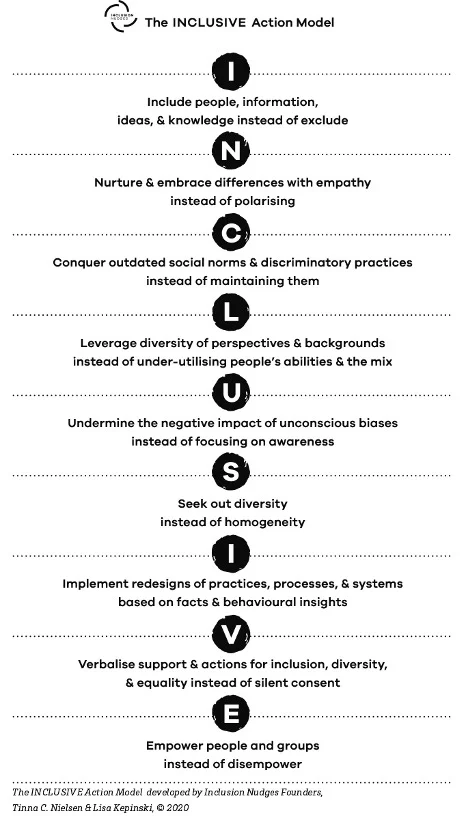
To overcome these challenges, a deliberate shift towards universally understood, action-oriented definitions is essential. The Inclusion Nudges global initiative, for example, advocates for a framework that recontextualizes DEBI:
- Diversity: The Mix of All of Us. This definition broadens diversity beyond specific minority characteristics to encompass all people, recognizing the vast spectrum of demographic differences, backgrounds, multiple identities, unique experiences, perspectives, knowledge, and abilities that exist within any group or society. It reframes diversity as a collective reality, not an "other" category.
- Equity: The Fairness Frame for the Mix. Equity is defined as ensuring equal access to opportunities and fair treatment for all, actively working to eliminate discriminatory practices, systems, laws, policies, social norms, and cultural traditions. It emphasizes balancing power, correcting historical inequalities, and addressing patterns of behavior that perpetuate unfairness. The core intent is fairness for everyone, recognizing that equal opportunity may require different support for different individuals.
- Belonging: I Feel Valued as a Part of the Mix. This concept focuses on the individual’s lived experience within a setting. Belonging is achieved when people feel welcomed, safe, seen, heard, and genuinely valued for their authentic selves. It implies the presence of equitable and inclusive practices, norms, and systems that allow individuals to contribute fully without having to "cover" or downplay their personal traits. When diversity, equity, and inclusion are effectively implemented, belonging is the natural outcome.
- Inclusion: Welcoming and Applying the Mix. Inclusion is about actively fostering the structures, systems, processes, culture, behaviors, and mindsets that embrace and respect all people and their diverse attributes. It involves seeking out diverse perspectives, challenging exclusionary norms and stereotypes, being open to others, and speaking up against injustice. Inclusion ensures that the richness of diverse knowledge, information, and ideas is not only welcomed but actively utilized, enabling all individuals to participate and contribute to their fullest potential.
These definitions serve as "guiding stars," providing a clear vision for the desired workplace cultures, communities, and societies. They shift the focus from abstract ideals to tangible outcomes, enabling the design of interventions that foster genuine change.
Beyond Definitions: Action-Oriented Engagement
While clear definitions are foundational, merely articulating them is insufficient. Rational understanding, residing in the conscious mind (System 2 thinking), often fails to translate directly into unconscious behaviors (System 1 thinking). True progress requires engaging individuals at a deeper level, moving beyond intellectual assent to emotional buy-in and behavioral change.
A more effective approach involves involving all people in co-creating the definitions and, more importantly, identifying the actions that embody these principles. This means shifting the conversation from abstract terms to concrete, observable behaviors. Instead of asking, "What is inclusion?" ask, "What specific actions make you feel included, valued, respected, and empowered?"
This inclusive, co-creation process offers multiple benefits:
- Contextual Relevance: Definitions and actions emerge that are highly relevant and meaningful to the specific organizational or community context.
- Ownership and Engagement: By actively participating in the definition process, individuals develop a sense of ownership, transforming them from passive recipients of change into active co-creators. This significantly boosts engagement and reduces resistance.
- Leveraging Internal Diversity: The process itself becomes an exercise in inclusion, leveraging the diverse perspectives and experiences within the group to build a shared understanding.
Once these inclusive behaviors are identified, the next critical step is to make them visible and celebrated. Rather than burying them in spreadsheets or policy documents, these real-life examples and personal stories should be widely shared through communication materials, displayed on walls in workplaces, and integrated into daily conversations. Highlighting that "peers and similar others" are enacting these behaviors can leverage social proof, a powerful psychological nudge, to encourage broader adoption. For example, communicating that "8 out of 10 of your colleagues actively seek diverse perspectives in meetings" can be far more impactful than a generic statement about the importance of inclusion.
Strategic Communication and Long-term Impact
Ultimately, the goal is to achieve inclusion without necessarily having to constantly talk about inclusion as a standalone buzzword. This involves strategically reframing the conversation:
- Focus on Outcomes: Instead of saying, "We need more inclusion," articulate the desired outcome: "We need the thinking from everyone for new solutions," or "We need our systems designed to enable our most objective decision-making." This connects DEBI directly to business value, innovation, and organizational effectiveness.
- Integrate into Daily Operations: Frame inclusion as "how work gets done here" or "how people experience being in the group." This positions DEBI not as an initiative, but as an intrinsic part of organizational culture and operational excellence.
- Avoid Overuse of Jargon: While definitions are necessary for strategic documents and KPIs, their constant, abstract repetition can lead to "DEI fatigue." The emphasis should be on demonstrating DEBI through actions and their positive impact.
This approach creates perceptions of diversity and inclusion that are resource-oriented, fostering positive associations in the human mind. It shifts DEBI from a potentially divisive or peripheral concept to a core driver of organizational success and a fundamental aspect of a healthy, productive environment.
The challenge of translating abstract definitions into widespread, consistent actions across thousands of individuals is formidable. This is precisely the dilemma that methodologies like the Inclusion Nudges change approach seek to address, providing practical tools and strategies for designing environments that inherently foster inclusive behaviors.
By intentionally shaping how DEBI is defined and communicated, organizations can dismantle psychological barriers, foster genuine engagement, and create environments where every individual feels valued, respected, and empowered to contribute their fullest. This commitment to intentional language and action is not just a matter of corporate responsibility; it is a strategic imperative for building resilient, innovative, and thriving organizations in the 21st century. The call to action is clear: join forces to make inclusion the norm—everywhere, for everyone.