A significant shift in Republican attitudes towards the North Atlantic Treaty Organization (NATO) is evident in a recent Pew Research Center survey, which indicates a considerable decrease in the proportion of Republicans who believe the United States benefits from its membership in the military alliance. The findings suggest a growing skepticism within the Republican party regarding the value and strategic importance of NATO, a cornerstone of Western defense for over seven decades.
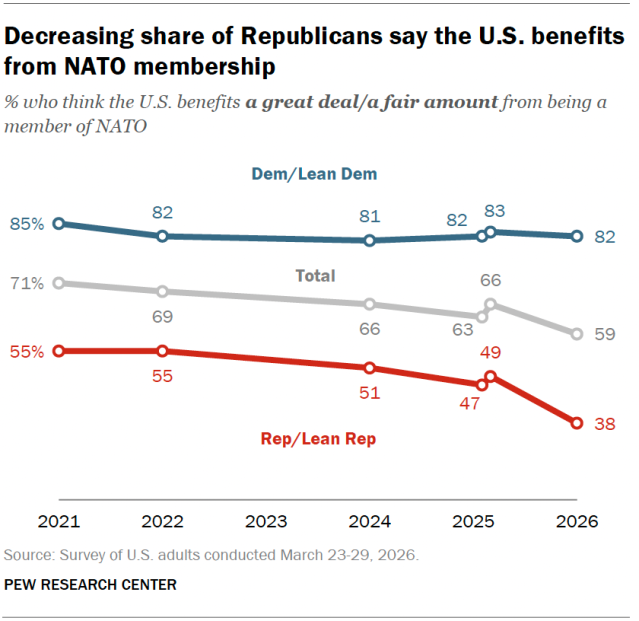
The survey, conducted in late March 2026, revealed that only 38% of Republicans and Republican-leaning independents now state that the U.S. benefits "a great deal" or "a fair amount" from its NATO membership. This figure represents a substantial drop from 49% in the previous year, marking a notable erosion of support for the alliance within the GOP. Correspondingly, a majority of Republicans, 60%, now contend that the U.S. benefits "not too much or not at all" from its NATO involvement, a stark contrast to the 50% who held this view in 2025. This marks the first instance in Pew Research Center’s surveys where a majority of Republicans have expressed a negative or indifferent stance on the benefits of NATO membership.

This decline in Republican support for NATO comes at a critical juncture, shortly before President Donald Trump indicated in an interview published on April 1, 2026, that he was "strongly considering" withdrawing the U.S. from the military alliance. This statement, if translated into policy, would represent a seismic shift in American foreign policy and could profoundly alter the geopolitical landscape of Europe and beyond.
Broad American Support for NATO Remains
Despite the waning enthusiasm among Republicans, a majority of Americans overall continue to view NATO membership favorably. The survey found that 59% of all U.S. adults believe the United States benefits from its participation in the alliance. This broad support is particularly strong among Democrats and Democratic-leaning independents, with 82% expressing the view that NATO serves U.S. interests. This consistent support from the Democratic party has remained relatively stable over the past five years, highlighting a growing partisan divide on the issue of NATO.
Generational and Ideological Divides Within the GOP
Further analysis of the survey data reveals nuances within the Republican party’s views on NATO. Younger Republicans, aged 18 to 49, demonstrate a somewhat more favorable outlook towards NATO membership compared to their older counterparts. Forty-two percent of younger Republicans believe the U.S. benefits from the alliance, while only 33% of Republicans aged 50 and older share this sentiment. This suggests that as younger generations come of age, their perspectives on international alliances may differ, potentially influenced by contemporary geopolitical discussions and the evolving role of the U.S. on the global stage.
Ideological differences also play a role within the Republican party. While the survey does not provide specific percentages for these divisions within the Republican cohort on the benefit question, previous Pew Research Center analyses have consistently shown that more conservative Republicans tend to be more skeptical of international alliances and commitments compared to moderate Republicans. This trend likely contributes to the overall decline in support for NATO among the party.
Confidence in Trump’s NATO Decision-Making
The survey also delved into Americans’ confidence in President Trump’s ability to effectively manage U.S. relations with NATO. A significant majority of Americans, 63%, expressed a lack of confidence that Trump can make sound decisions concerning effective collaboration with the alliance.
This lack of confidence is starkly divided along partisan lines. A substantial 62% of Republicans stated they are "very" or "somewhat" confident in Trump’s decision-making regarding NATO. In contrast, a mere 11% of Democrats shared this confidence. Conversely, approximately two-thirds of Democrats reported being "not at all confident" in Trump’s ability to work effectively with NATO, underscoring a deep partisan chasm in perceptions of the President’s foreign policy acumen concerning this critical alliance.
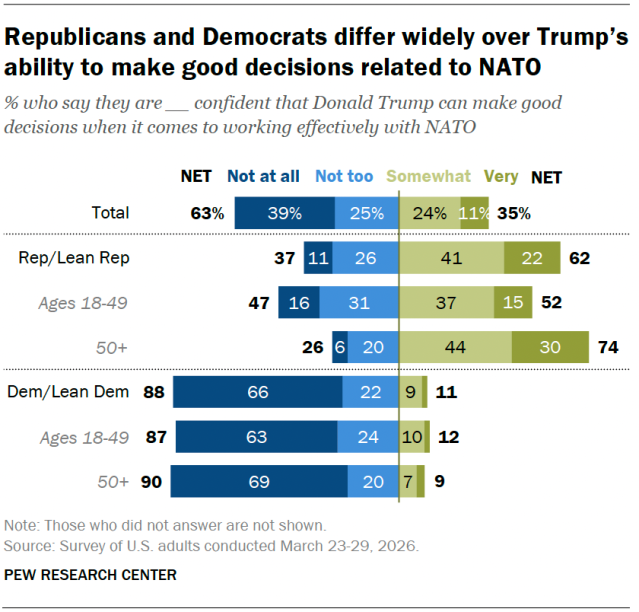
Within the Republican party, similar to the views on NATO benefits, younger Republicans (18-49) expressed higher confidence in Trump’s decision-making on NATO compared to older Republicans (50+). This suggests that while there is overall Republican support for Trump’s stance, generational differences might also exist within this segment regarding the nuances of international alliances.
Favorable Views of NATO Amidst Shifting Perceptions
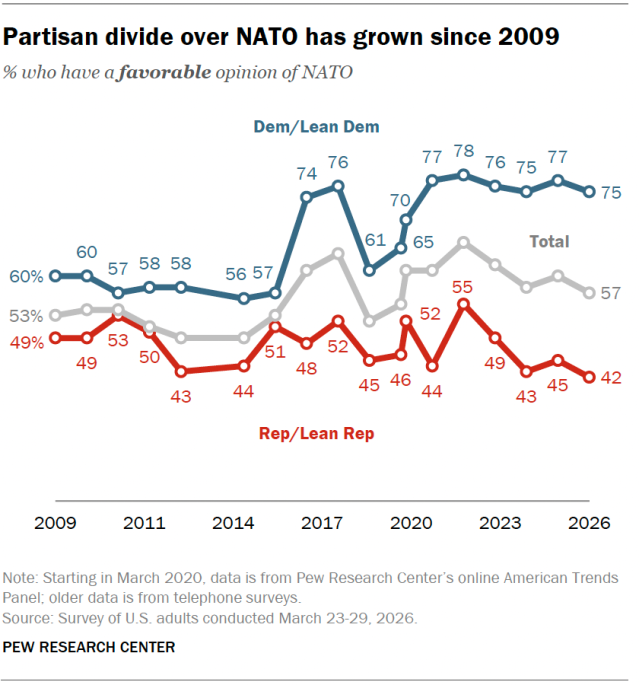
Despite the growing skepticism about the benefits of membership among Republicans, a majority of Americans (57%) still hold a favorable view of NATO itself. This sentiment has remained relatively stable over the past year. However, a significant partisan disparity persists, with 75% of Democrats expressing a favorable view of the alliance compared to only 42% of Republicans. This consistent pattern has been observed in previous Pew Research Center surveys, indicating a long-standing divergence in how the two major parties perceive NATO.
Over the longer term, favorable views of NATO in the U.S. have seen some fluctuation. Notably, Americans were more likely to view the alliance favorably in April 2022, a period shortly after Russia’s full-scale invasion of Ukraine. This suggests that heightened geopolitical tensions and perceived threats can temporarily bolster support for collective security arrangements like NATO, but these shifts may not always translate into sustained, long-term consensus, especially when other political factors come into play.
Background and Context of NATO
The North Atlantic Treaty Organization was established on April 4, 1949, as a collective defense alliance between North American and European countries. Its primary objective was to counter the perceived threat from the Soviet Union during the Cold War. Article 5 of the North Atlantic Treaty, often referred to as the cornerstone of the alliance, states that an attack against one member shall be considered an attack against all. This principle of collective defense has been invoked only once in the alliance’s history, following the September 11, 2001, terrorist attacks on the United States.
NATO has evolved significantly since its inception, adapting to new security challenges. In recent years, particularly following Russia’s annexation of Crimea in 2014 and its full-scale invasion of Ukraine in 2022, NATO has refocused on collective defense and deterrence, especially along its eastern flank. This renewed emphasis has led to increased defense spending commitments from member states and a strengthened military posture.
Implications of Declining Republican Support
The decline in Republican support for NATO and the President’s expressed willingness to reconsider U.S. participation carry significant implications. A potential U.S. withdrawal from NATO would fundamentally weaken the alliance, potentially undermining its credibility and effectiveness as a deterrent against aggression. This could embolden adversaries and create instability in Europe, forcing European nations to reassess their own security arrangements and potentially leading to a more fragmented and less secure international environment.

Furthermore, a U.S. departure could strain transatlantic relations, impacting economic ties, diplomatic cooperation, and shared democratic values. The alliance has played a crucial role in promoting stability, democracy, and economic prosperity in Europe for decades. Its erosion could have far-reaching consequences for global security and international order.
The survey data underscores a widening partisan gap in U.S. foreign policy perspectives, particularly concerning long-standing alliances. As the political landscape continues to evolve, understanding these shifts in public opinion will be crucial for policymakers navigating the complexities of international relations and ensuring the continued relevance and strength of U.S. global leadership.
About the Research
This analysis is based on a Pew Research Center survey conducted from March 23 to March 29, 2026, among 3,507 U.S. adults. Participants were drawn from the Center’s American Trends Panel, a nationally representative online survey panel. The survey methodology is designed to provide reliable insights into the views of the broader U.S. adult population. The specific questions, detailed responses, and methodology documents are publicly available through the Pew Research Center website, offering transparency and allowing for further academic and public scrutiny. The research was conducted by Moira Fagan, a research associate focusing on global attitudes, and Sneha Gubbala, a research analyst specializing in global attitudes at Pew Research Center.