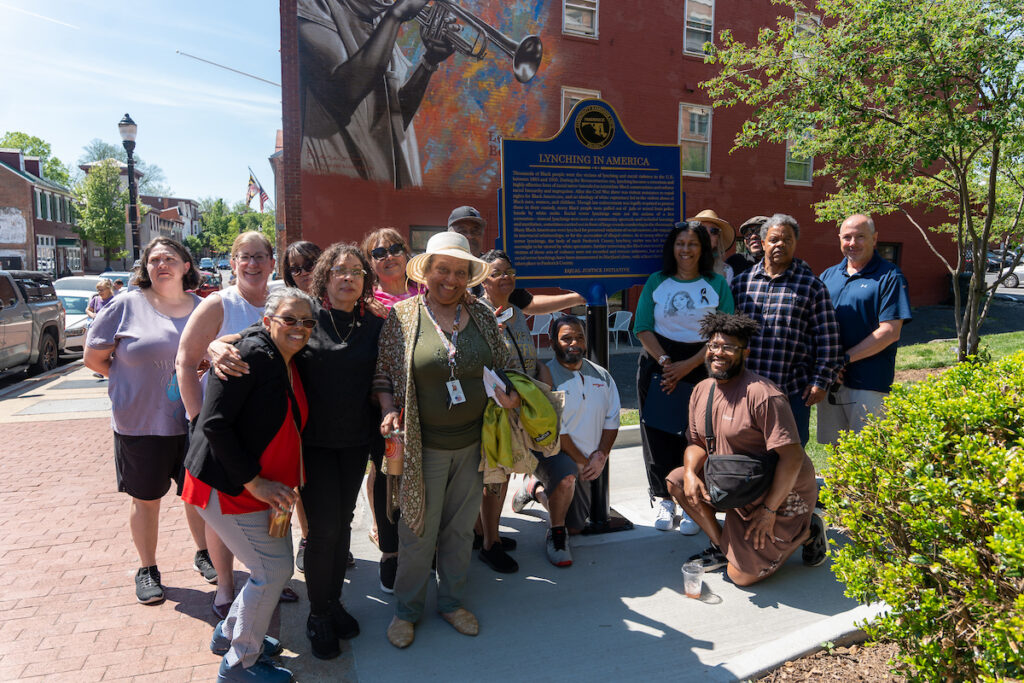
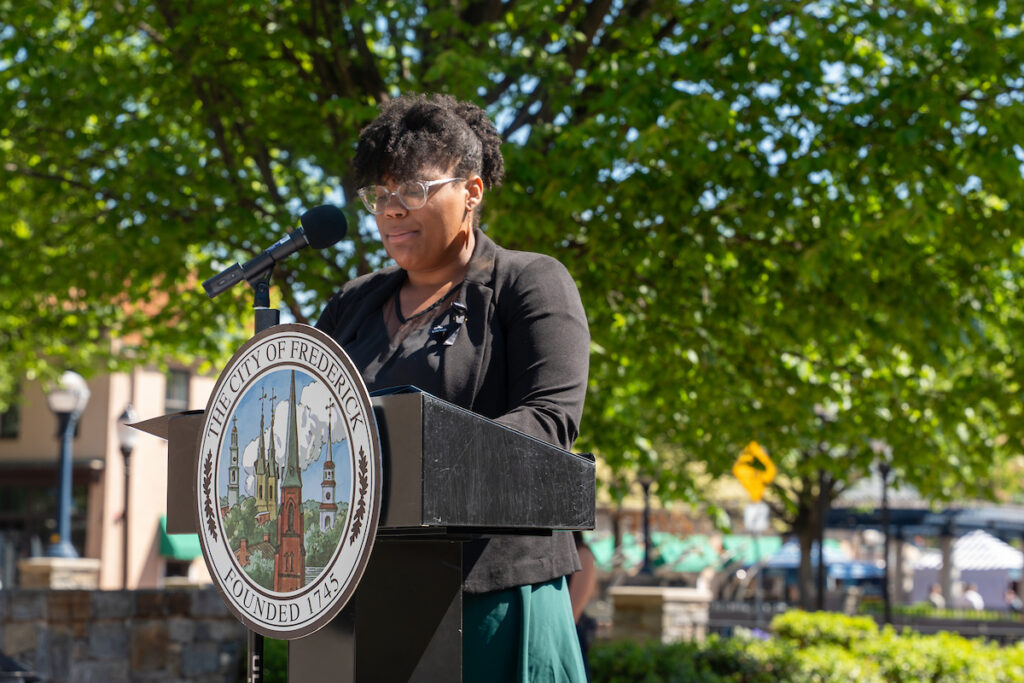
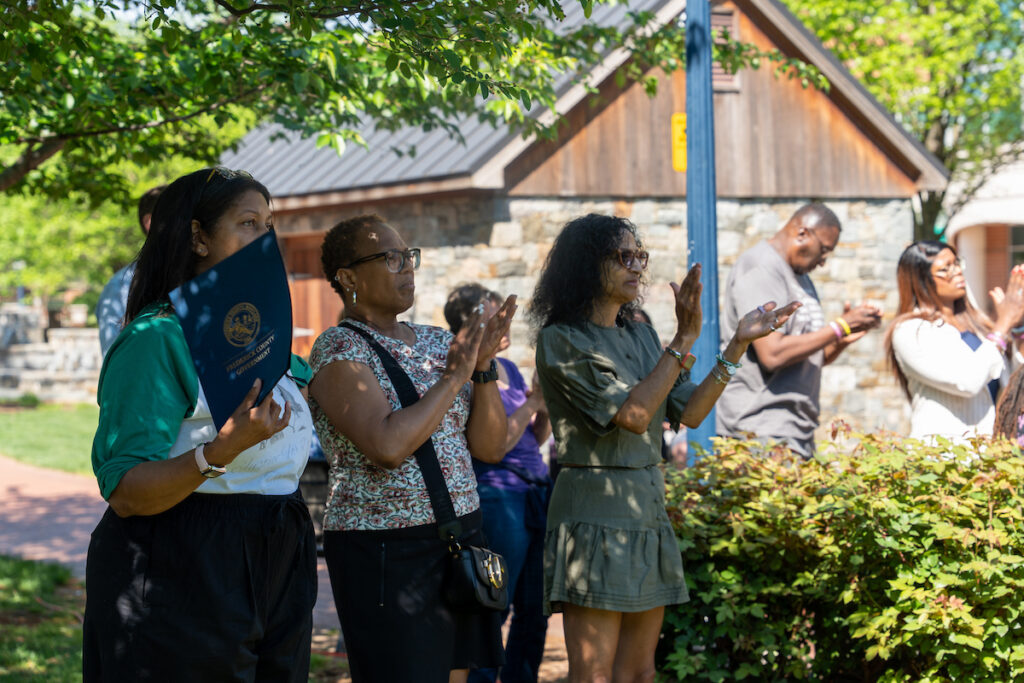
The poignant dedication ceremony, orchestrated by the dedicated Frederick Remembrance Memorial Coalition, unfolded on April 18 on historic South Market Street, adjacent to Carroll Creek in downtown Frederick. This pivotal event brought together a diverse assembly of community members, local officials, and the direct descendants of John Biggus and James Bowens, all united in the shared purpose of truth-telling and remembrance. Among the notable figures who addressed the gathering were Frederick County Executive Jessica Fitzwater and Mayor Michael O’Connor, alongside other community advocates.
A Community Confronts Its Past
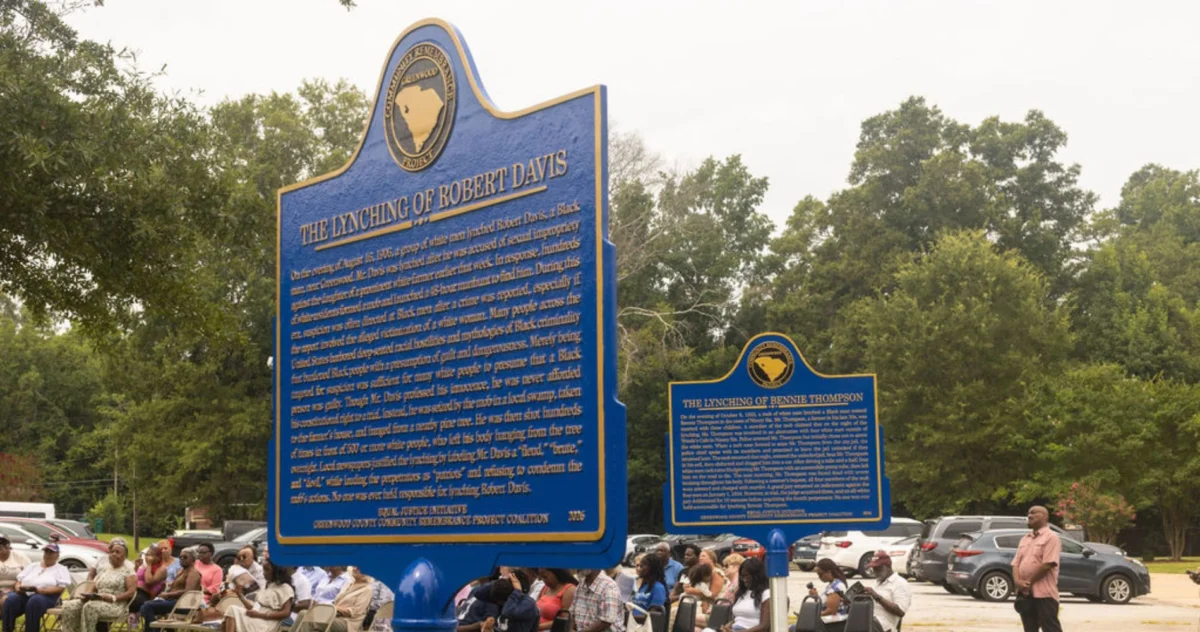
The ceremony commenced with a powerful opening statement from organizer Tina Allen, who underscored the profound importance of memorializing the victims of racial terror lynchings and directly confronting the enduring legacy of such violence. “Today, we are here to honor the lynching victims James Carroll, John Biggus, and James Bowens,” Allen declared, setting a tone of solemn reflection and resolute commitment to historical accuracy. This dedication is a tangible outcome of EJI’s broader Community Remembrance Project, a national initiative that sees counties across Maryland and the United States partner with the organization to install historical narrative markers, acknowledging and commemorating the victims of racial terror lynchings. These markers serve as permanent educational tools, ensuring that these atrocities are neither forgotten nor relegated to the margins of history.
The spiritual foundation of the event was laid by the Rev. Ernest Thomas, who led an opening prayer. His invocation resonated with a plea for collective strength, asking for the county to possess “the strength to confront the legacy of this violence, to speak truth, and to walk humbly towards true racial reconciliation and justice.” Rev. Thomas articulated the ceremony’s core purpose: to “honor the lives of all the victims by ensuring this history is not forgotten, and by building a community where all are safe, protected, and treated with dignity.” His words highlighted the dual objective of remembrance and aspirational community building, aiming to transform historical pain into a catalyst for positive change.
In a significant gesture of official recognition and solidarity, County Executive Jessica Fitzwater presented the Frederick Remembrance Memorial Coalition with a certificate of recognition. Further cementing the day’s importance, she shared a proclamation formally declaring April 18th as Frederick Remembrance Memorial Day in Frederick County. This official designation underscores the county’s commitment to ongoing remembrance and education. Ms. Fitzwater emphasized the unique character of Frederick County, particularly its contemporary diversity. “It is moments like this that remind us what a special place Frederick County is,” she remarked, noting its vibrant multi-ethnic communities. She articulated the essential need for all residents to acknowledge “the painful legacy of racism and discrimination faced by African Americans through openly commemorating, reflecting on, and grieving past injustices.” The county, she affirmed, is actively striving “to promote healing and advanced reconciliation for all.”
Unveiling the Truth: The Stories of the Victims
The heart of the ceremony involved the retelling of the victims’ stories, meticulously researched and presented by Jane Weir, a local family history researcher. Weir’s narrative brought to light the harrowing details of the three lynchings commemorated by the marker, expressing a fervent hope that these stories would finally be remembered and taught. “It’s important for the truth to come out and to be taught,” she asserted, “not silenced.” Her emphasis on the importance of truth-telling served as a powerful reminder of the long-standing efforts to suppress these historical facts.
Robin Dorsey-Cosley, the grand-niece of victim John Biggus, offered a deeply personal perspective. She described her family’s recent discovery of this painful history, a truth that had been buried for generations. Her family’s journey to uncover and share the truth about their loved one’s fate resonated deeply with the audience. “We should be able to talk about it,” she shared, expressing profound gratitude for the community support that enabled “this commemorative moment in honor of the ones whose lives were taken without true justice being served.” Her words underscored the enduring intergenerational trauma of racial violence and the profound relief that comes with public acknowledgment.
Mia Taylor, a Project Manager at EJI, provided a broader context for the community’s efforts. She spoke eloquently about the immense significance of the community uniting to address and confront the profound damage inflicted by this history. “You are embracing the process of truth, justice, and reconciliation with difficult histories that is essential for us to recover from a history of racial injustice,” Taylor stated, validating the courageous steps taken by Frederick’s residents. Her insights framed the local dedication within a larger national movement towards historical reckoning and systemic healing.
The ceremony also featured a moving rendition of “Total Praise” by Terrence Boyd, a moment of profound reflection that preceded Mayor Michael O’Connor’s address. Mayor O’Connor delivered a significant apology on behalf of the city, acknowledging the “acts and omissions of government officials that contributed to the three racial terror lynchings.” This official apology was a crucial moment, recognizing institutional complicity in these historical injustices. “I ask each of us to let this moment guide us, let it deepen our commitment to being a community where truth is not feared, where justice is not delayed, and where every person’s story is honored,” the mayor implored. He concluded with a hopeful vision: “May this place serve as a place of reflection, a place where we remember James Carroll, John Biggus, and James Bowens.”
Before the marker was officially unveiled, organizer Tina Allen announced its formal transfer to the city, signifying a communal acceptance of responsibility and stewardship of this history. Her final words before the unveiling were a powerful declaration: “The Frederick Remembrance Memorial Coalition will continue its work. This is just the beginning.” This statement serves as a promise that the dedication is not an end point but a significant milestone in an ongoing journey towards justice and reconciliation.
Lynching in Frederick County: A Dark History Unearthed
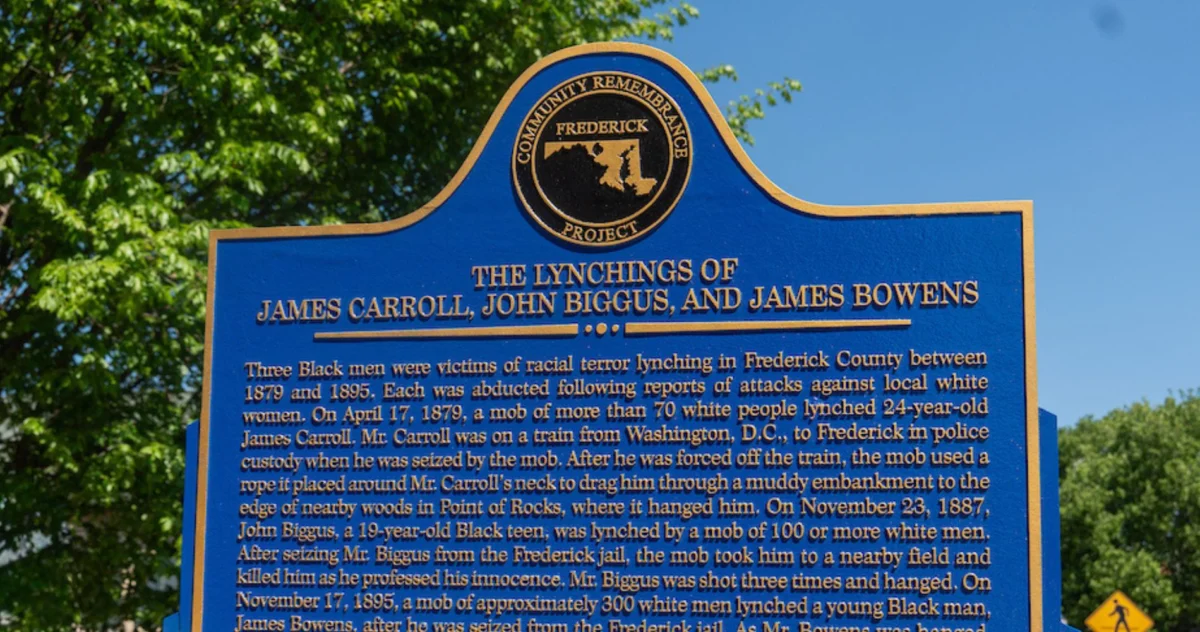
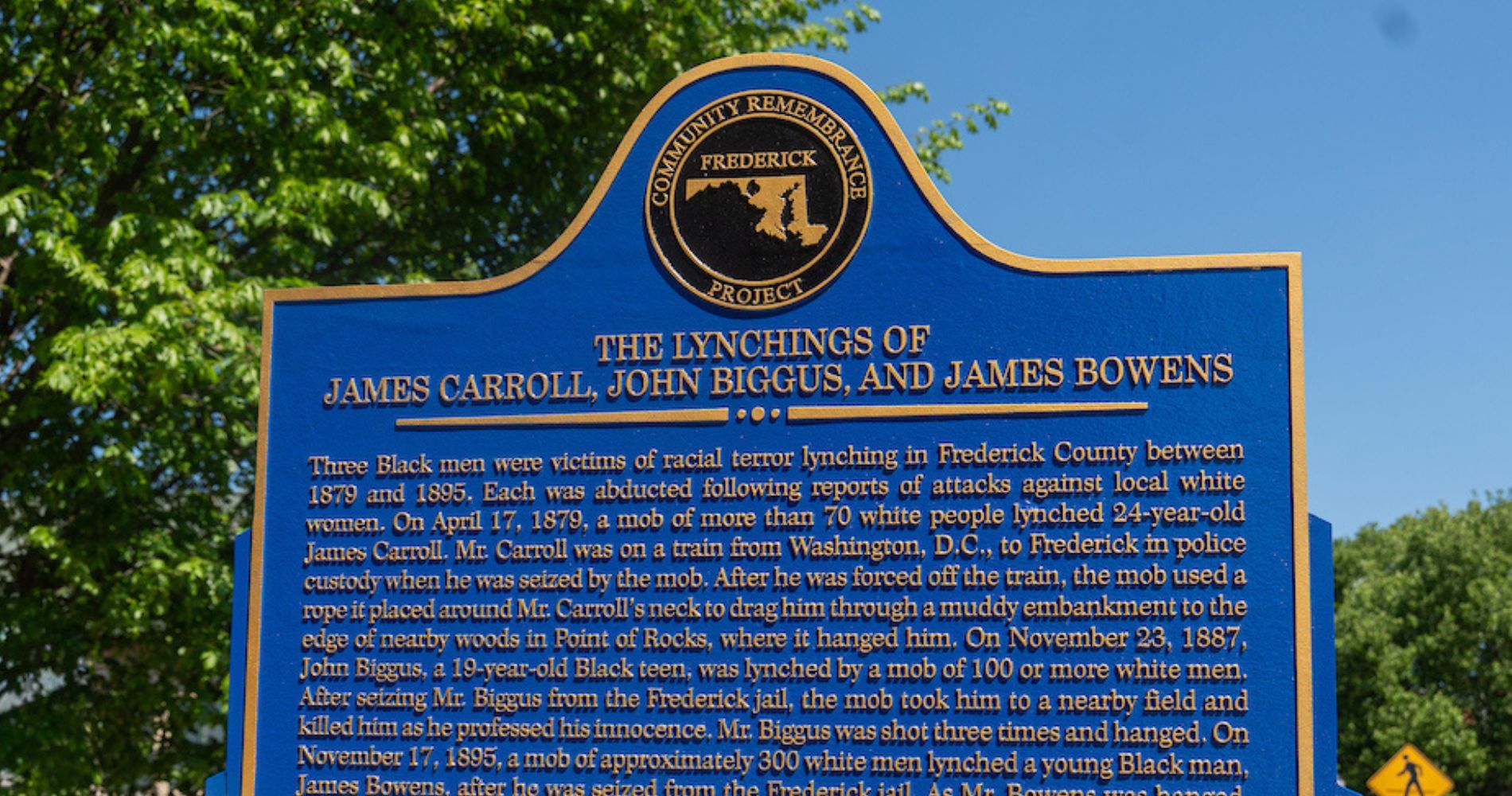
The historical marker stands as a stark reminder of the racial terror that gripped Frederick County between 1879 and 1895, claiming the lives of three Black men. Each victim, James Carroll, John Biggus, and James Bowens, was subjected to racial terror lynching, abducted from police custody following accusations—often unsubstantiated—of attacks against local white women. As Jane Weir highlighted during the dedication, prominent citizens of Frederick were implicated in these killings, yet no individual was ever held accountable for these brutal murders. This pervasive lack of justice was a hallmark of racial terror lynchings across the South and border states, where the legal system often conspired with or capitulated to mob violence.
James Carroll: A Life Cut Short in Point of Rocks
On April 17, 1879, a mob exceeding 70 white individuals orchestrated the lynching of 24-year-old James Carroll. Carroll was forcibly removed from police custody while traveling by train from Washington, D.C., to Frederick. The mob seized him, tied a rope around his neck, and brutally dragged him through a muddy embankment to the edge of a wooded area in Point of Rocks, where he was hanged. In a horrifying display of dehumanization, members of the mob took macabre "souvenirs" from the lynching site, including pieces of the tree and even a tip of Mr. Carroll’s finger. His lifeless body was left on public display until the Frederick County coroner and a constable arrived the following afternoon to cut him down. Despite numerous witnesses to the crime, a coroner’s jury was convened but failed to identify or prosecute anyone for Mr. Carroll’s murder, illustrating the systemic impunity afforded to white perpetrators of racial violence.
John Biggus: Murdered in the Heart of Frederick
Eight years later, on November 23, 1887, 19-year-old John Biggus became the victim of another brutal lynching. A mob of 100 or more white people, equipped with axes and a rope pilfered from a nearby fire station, violently broke into the Frederick jail. Ms. Weir recounted how the perpetrators dragged Mr. Biggus from his cell by a rope tied around his neck, taking him down South Street to a nearby field. Throughout this ordeal, Biggus steadfastly professed his innocence. The mob hoisted him by the rope from a tree limb, and as he slowly suffocated, he was shot three times, a gruesome testament to the mob’s intent to inflict maximum terror and suffering.
James Bowens: A Repeated Atrocity
The terror continued on November 17, 1895, when a mob of approximately 300 white individuals seized a young Black man, James Bowens, from the Frederick jail. Ms. Weir noted the chilling detail that the mob dragged Mr. Bowens to the very same field where John Biggus had been murdered eight years prior, underscoring the ritualistic nature of these acts and their symbolic power to instill fear. As Bowens was hanged, one of the perpetrators fired a gunshot into his head. After the killing, a member of the mob chillingly announced that they had murdered Mr. Bowens "to teach men of his class that they must let the white women of Frederick county alone or suffer the consequences." This statement explicitly revealed the underlying racist ideology of controlling Black men and enforcing racial hierarchies. Like Carroll, photographs of Mr. Bowens’s corpse were taken as mementos, and after the coroner cut him down, the rope used to hang him was divided and distributed as souvenirs, further highlighting the public, celebratory, and terrorizing aspects of these lynchings.
Lynching in America: A National Campaign of Terror
The stories of Carroll, Biggus, and Bowens are not isolated incidents but part of a widespread campaign of racial terror that permeated the United States. Between 1865 and 1950, over 6,500 Black men, women, and children were victims of racial terror lynchings across the nation. This period, following the Civil War and the nominal end of slavery, saw many white people, particularly in the South and border states like Maryland, vehemently oppose equal rights and Black advancement. Lynching emerged as the most public, notorious, and brutal form of racial terrorism employed to re-establish and enforce a rigid racial hierarchy. It was a tool of social control, economic subjugation, and political disenfranchisement, designed to intimidate the entire Black community.
The motivations for these lynchings were varied but consistently rooted in white supremacy. Approximately 25% of documented lynchings were sparked by charges of "inappropriate behavior" or "assault" between a Black man and a white woman. These accusations, often baseless and fueled by racist tropes of Black male hypersexuality and white female vulnerability, served as potent triggers for fatal mob violence, circumventing any semblance of due process. The very accusation, regardless of evidence, was often sufficient to seal a Black man’s fate.
A chilling and consistent feature of this era was the common practice of lynch mobs seizing their victims directly from jails, prisons, courtrooms, or out of police hands. Despite being armed and officially charged with protecting those in custody, law enforcement almost universally failed to use force to resist white lynch mobs intent on killing Black people. In many documented cases, police officials were found to be complicit, actively participating in lynchings, or at the very least, passively allowing them to occur. This systemic failure of justice underscores the deep-seated racial bias within the legal and governmental structures of the time.
The lynching of African Americans was, fundamentally, terrorism—a widely supported campaign aimed at enforcing racial subordination and segregation. Lynch mobs frequently enacted extreme violence, mutilating victims’ bodies, and then leaving them to hang for hours, deliberately preventing families from claiming their loved ones. This public display of brutality was a calculated attempt to maintain the racial order through the omnipresent threat of violence to the entire Black community, ensuring compliance and suppressing aspirations for equality.
James Carroll, John Biggus, and James Bowens are three of at least 34 Black victims of racial terror lynching killed in Maryland between 1865 and 1950. Their stories, now etched in stone, highlight that Maryland, despite its status as a border state, was not immune to the pervasive racial violence that defined this dark chapter of American history.
The Community Remembrance Project: A Path to Healing and Reconciliation
The dedication in Frederick County is an integral component of the Equal Justice Initiative’s broader Community Remembrance Project. This ambitious campaign seeks to acknowledge and honor the victims of lynching through several key initiatives: collecting soil from lynching sites, erecting historical markers like the one unveiled in Frederick, and developing the Legacy Sites in Montgomery, Alabama, including the National Memorial for Peace and Justice and the Legacy Museum.
EJI’s foundational belief is that true societal healing and reconciliation can only begin by confronting the truth of racial violence and its enduring impact. By openly acknowledging these painful histories, communities can initiate necessary conversations that pave the way for understanding, justice, and ultimately, genuine reconciliation. The historical markers serve as enduring educational tools, ensuring that future generations understand the gravity of past injustices and are equipped to advocate for a more equitable future.
The Frederick Remembrance Memorial Coalition’s work, in partnership with EJI, represents a vital step in this national effort. It transforms a suppressed history into a public lesson, fostering an environment where difficult truths can be spoken, acknowledged, and used as a foundation for building a more just and compassionate society. The unveiling of this marker is not merely an act of remembrance; it is an act of defiance against historical silence and a declaration of commitment to a future where such atrocities are never repeated.