The Equality Trust has released a comprehensive analysis revealing that as of May 2026, the 157 billionaires residing in the United Kingdom now command a collective wealth equivalent to 22% of the nation’s Gross Domestic Product (GDP). This figure represents a profound structural shift in the British economy over the last three and a half decades; in 1990, billionaire wealth accounted for only 4% of GDP. This surge in concentrated capital comes at a time when economic analysts and international bodies are warning of "Ghost GDP"—a phenomenon where headline economic growth remains robust on paper while the actual living standards and infrastructure of the nation undergo a period of hollowing out.
The report, timed to coincide with the annual publication of the Sunday Times Rich List, argues that the celebratory nature of wealth rankings obscures a systemic crisis. While politicians frequently cite GDP growth as a primary indicator of national success, the Equality Trust suggests that the metric has become decoupled from the lived experience of the majority. The data indicates that the richest 50 families in the UK now hold more wealth than the bottom 34 million citizens combined, illustrating a wealth gap that has reached historic proportions.
The Evolution of the Hollow Economy: A 36-Year Chronology
The trajectory of British wealth concentration can be traced back to the late 1970s and 1980s. Following the economic reforms of the Thatcher administration, which prioritized deregulation and the dismantling of postwar social protections, the UK began to move away from its most egalitarian period. By 1989, when the first Rich List was published, the infrastructure for extreme wealth accumulation was firmly in place.
In 1990, the UK recorded 15 billionaires with a combined wealth of £27 billion. At that time, this represented approximately 4 pence of every pound of the nation’s total economic output. By 2026, that number has escalated to 157 individuals holding nearly £670 billion, or more than 22 pence of every pound of GDP. This transition has occurred alongside the longest sustained squeeze on worker wages in modern history, with many local authorities reporting that real pay packets remain lower than 2008 levels.
The nature of wealth creation has also shifted significantly. In 1990, only three billionaires derived their primary wealth from the "rentier" sectors of property, inheritance, and finance. By 2025, that number had risen to 42. Currently, the financial sector alone accounts for 30% of all billionaire wealth in the UK—a fourfold increase in its share. Analysts describe this as "rentier capitalism," a system where wealth is extracted through the ownership of existing assets and the movement of money rather than through the production of goods or the provision of innovative services.
The Rise of Ghost GDP and Artificial Intelligence
In early 2026, Citrini Research introduced the term "Ghost GDP" to describe an economy increasingly distorted by artificial intelligence and automated systems. This model predicts a future where productivity and corporate profits soar due to AI integration, but the benefits fail to circulate through the labor market. The Equality Trust posits that Britain has already entered this "hollow economy" phase.
The report highlights Ireland as a cautionary precursor. In 2025, Ireland reported a 12% increase in GDP, yet much of this growth was attributed to multinational corporations routing intellectual property and profits through Dublin for tax optimization. The distortion became so extreme that the Irish government was forced to adopt "Modified Domestic Demand" as a more accurate measure of the actual domestic economy. The UK appears to be following a similar path, where high-level growth figures mask a generation priced out of housing and a crumbling public sector.
Structural Corruption and Elite Capture
The maintenance of the hollow economy is supported by what the Equality Trust terms "structural corruption"—a legal and normalized framework that protects concentrated wealth. This capture of democratic institutions is evidenced by several key metrics:
- Political Influence: Large-scale political donations increased sixfold between 2002 and 2019. Wealthy donors now exercise unprecedented access to policy-making circles, often shaping legislation that favors asset protection and deregulation.
- Media Concentration: Currently, three media conglomerates own 90% of the UK’s national newspaper circulation. This concentration of media power is seen as a primary driver in normalizing extreme wealth and limiting the public discourse on alternative economic models.
- Legislative Inflation: The House of Lords has grown to over 750 members, making it the second-largest legislative body in the world after China’s National People’s Congress. Research published in British Politics has documented a persistent correlation between significant financial donations to political parties and the attainment of peerages.
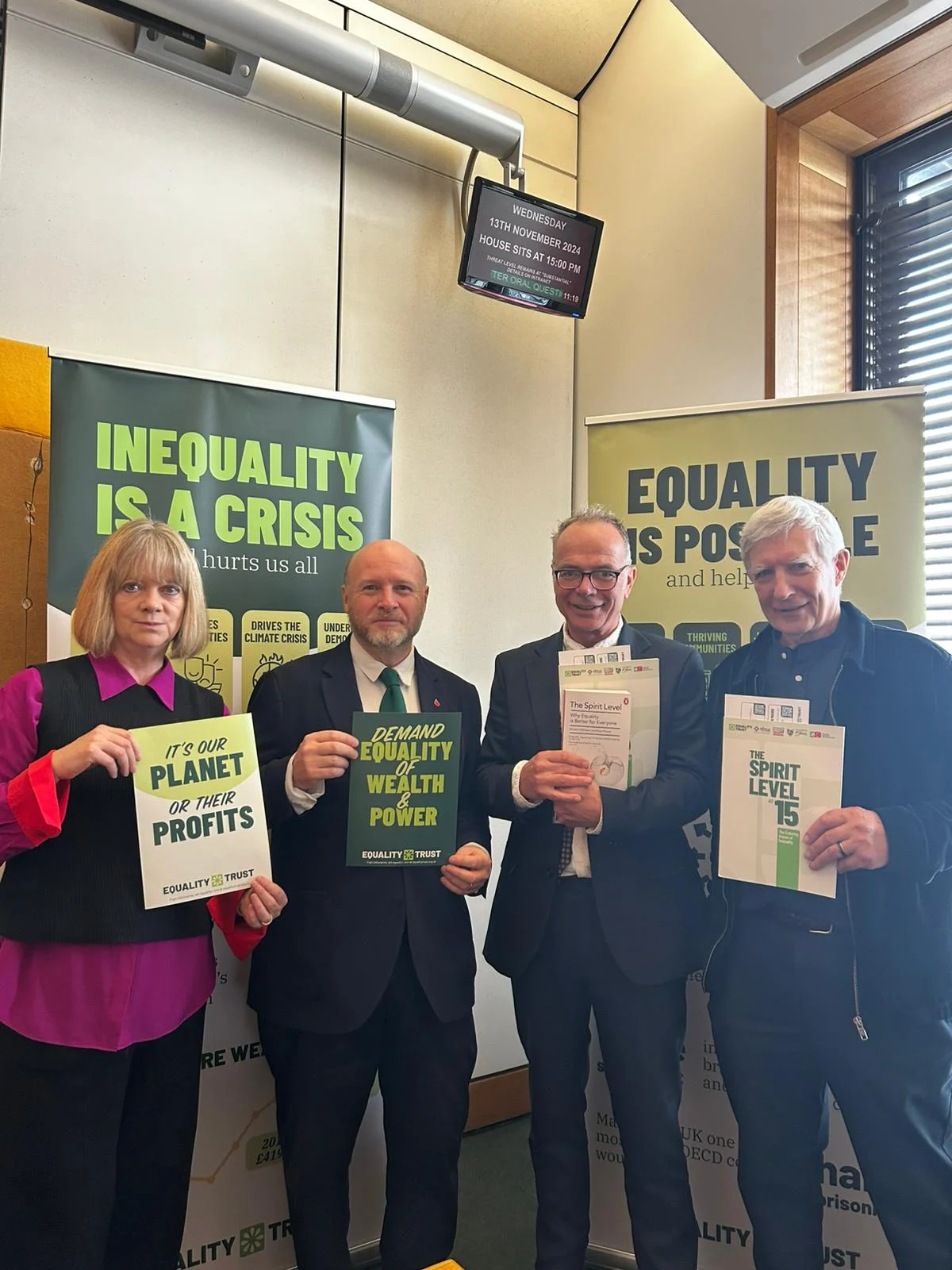
Professor Kate Pickett, a patron of the Equality Trust and member of the consultative council to the International Panel on Inequality, argues that these inequalities create a "dual-track" society where different legal and social rules apply to the elite. Even figures within the highest echelons of global finance have expressed concern; Larry Fink, CEO of BlackRock, warned in his 2026 Chairman’s Letter that AI-driven inequality could lead to a total social breakdown if not addressed through broader investment participation.
The Human Cost: Health and Wellbeing
The hollowing out of the UK economy has tangible consequences for public health. The Health Foundation recently reported that healthy life expectancy in Britain has declined by two years over the last decade, falling to below 61 years of age. Despite being the world’s sixth-largest economy, the UK ranks second to last among comparable wealthy nations for the duration of time citizens can expect to live in good health. Only the United States, which maintains higher levels of income inequality, performs worse.
This health crisis is sharply divided by class. Individuals in the most affluent areas of the UK can expect up to 20 more years of healthy life than those in the most deprived regions. Furthermore, the UNICEF Report Card 20, published this year, ranks the UK 24th for child wellbeing and 35th for income inequality among the world’s richest nations. These statistics suggest that the current economic structure is failing to provide the foundational requirements for the next generation.
Environmental Impact of the Wealth Gap
The Equality Trust report also links the hollow economy to the accelerating climate crisis. Data from Oxfam’s Climate Plunder report indicates that the carbon emissions of the richest 0.1% of Britons are 56 times higher than those in the lowest income brackets. Since 1990, while the bottom 90% of the population reduced their carbon footprint by 26%, the emissions of the billionaire class rose by 53%.
This disparity is driven largely by investment choices. Approximately 40% of billionaire investments are currently tied to high-polluting industries such as oil, gas, shipping, and cement. The report argues that the climate emergency is not a separate issue but is an "irreversible output" of an economic system designed to prioritize capital accumulation over planetary limits.
International Responses and the "Beyond GDP" Movement
The growing dissatisfaction with traditional economic metrics has reached the highest levels of international governance. On May 7, 2026, the United Nations High-Level Expert Group on Beyond GDP launched its final report at the UN Headquarters. The proposal advocates for replacing GDP with 31 distinct indicators that track wellbeing, equity, and environmental sustainability.
Simultaneously, Olivier De Schutter, the outgoing UN Special Rapporteur on Extreme Poverty, published a "Roadmap for Eradicating Poverty Beyond Growth." De Schutter’s findings suggest that the pursuit of GDP growth has become a barrier to poverty eradication rather than a solution. He argues that the focus must shift toward the redistribution of existing wealth and the strengthening of public services.
Analysis of Potential Solutions
The Equality Trust concludes that "sticking plaster" reforms, such as minor adjustments to the welfare state, are no longer sufficient to address the scale of the crisis. Instead, they advocate for a fundamental restructuring of the British economy, including:
- A Progressive Wealth Tax: Implementing a structural limit on the concentration of power by taxing assets above a certain threshold.
- Democratic Reform: Capping political donations and breaking up media monopolies to reduce elite capture of the state.
- Alternative Success Metrics: Adopting the UN’s "Beyond GDP" framework to ensure government policy is measured by its impact on citizen wellbeing rather than asset inflation.
- Limitarianism: Adopting the principles proposed by scholars like Ingrid Robeyns, which suggest that there should be an upper limit to the amount of wealth any one individual can accumulate in the interest of social stability.
The 2026 local elections reflected a growing public anger toward the "hollowed-out" state of the economy. As billionaire wealth continues its trajectory from 4% of GDP in 1990 to 22% today, the risk of systemic collapse—as warned by researchers like Professor Luke Kemp—becomes an increasingly urgent concern for policymakers. The Equality Trust’s analysis serves as a final warning that without an irrevocable shift toward an equitable society, the "Ghost GDP" will continue to haunt a nation that is, in reality, becoming poorer.