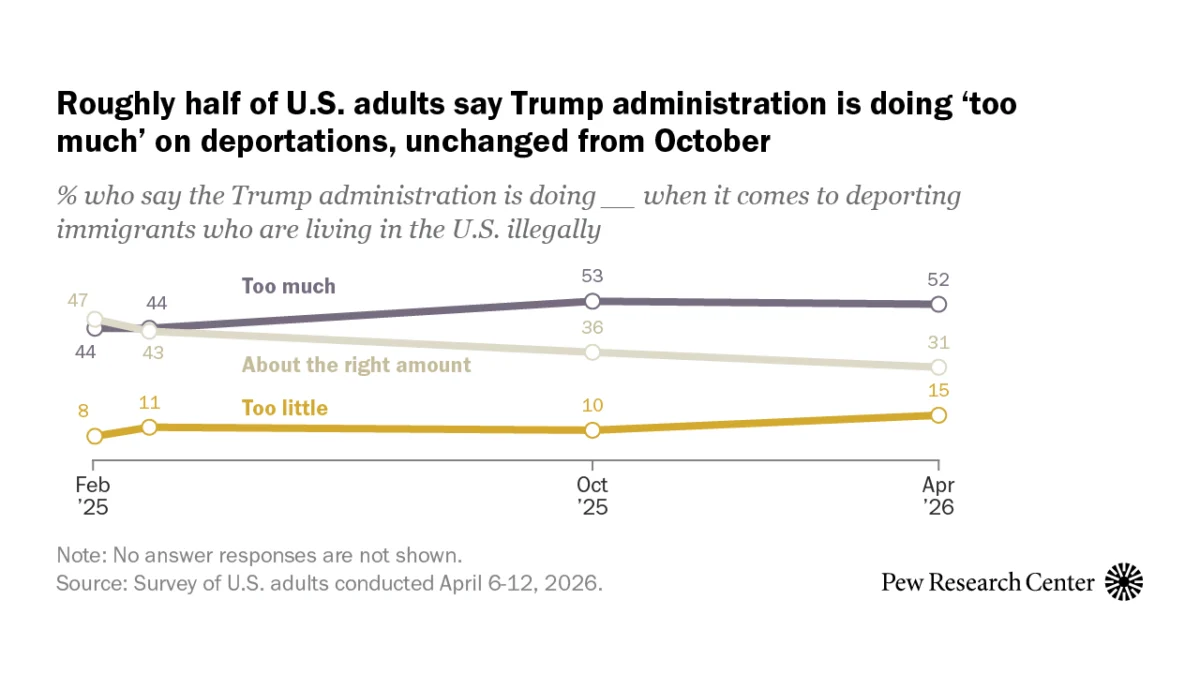
The Trump administration’s approach to deporting immigrants living in the U.S. illegally continues to divide American public opinion, with roughly half of U.S. adults, 52%, expressing the view that the administration is undertaking too many deportations. This sentiment has remained remarkably stable, showing little change since October 2025, according to a comprehensive survey conducted by the Pew Research Center. The survey, which polled 3,592 U.S. adults between April 6 and April 12, 2026, indicates a persistent divide in how the public perceives the effectiveness and fairness of the administration’s immigration enforcement policies.
This ongoing public sentiment highlights the enduring complexity of immigration policy debates in the United States, particularly concerning the balance between border security and humanitarian concerns. The administration’s stance on deportations, a cornerstone of its immigration agenda, has consistently been a focal point of national discourse, reflecting deeply held beliefs across various demographic and political spectrums.
Shifting Perceptions on Deportation Volume
While the overall percentage of Americans believing the Trump administration is doing "too much" on deportations has held steady at 52%, other metrics within the Pew Research Center’s findings reveal subtle yet significant shifts in public perception. Notably, the proportion of Americans who believe the administration is doing "too little" to deport immigrants living in the country illegally has seen an increase. This figure stands at 15% in the latest survey, up from 10% in October 2025. This rise is largely attributed to a surge in opinion among Republicans and Republican-leaning independents, with 28% now expressing this view. This represents the highest percentage since early 2025, specifically February, when such sentiments were first measured early in Donald Trump’s second term.
Conversely, the segment of the U.S. adult population that believes the administration is striking "about the right amount" with its deportation policies has experienced a steady decline. This group constituted 47% in February 2025, but has since fallen to 31% in the April 2026 survey. This downward trend suggests a growing dissatisfaction with the current balance, with fewer Americans finding the administration’s efforts to be adequate or appropriate.
Demographic Divides in Deportation Opinions
The Pew Research Center’s data further illuminates the partisan and demographic fault lines that characterize the immigration debate. Democrats and those leaning Democratic overwhelmingly continue to believe the administration is doing "too much" on deportations, with 84% holding this view in the April 2026 survey. This figure has remained consistently high, hovering around the mid-80s since October 2025.
In stark contrast, Republicans and those leaning Republican are far more likely to believe the administration is doing "too little" or "about the right amount." Only 19% of Republicans and Republican-leaning individuals believe the administration is doing "too much" regarding deportations. A significant majority, 53%, feel the administration is doing "about the right amount," while 28% believe it is doing "too little." This latter group, as previously noted, has grown since previous survey periods.
Beyond party affiliation, views on deportation volume also vary by race and ethnicity, as well as by immigrant generation. Hispanic adults, while still more likely than the general population to believe the administration is doing "too much" (65%), have shown a slight decrease in this sentiment compared to October 2025, when it stood at 71%. Black adults (69%) and Asian adults (58%, representative of English speakers only) also express a higher likelihood of believing the administration is doing "too much" compared to White adults (45%).
The data also reveals differences based on immigration status and generational background. Immigrants themselves are most likely to express the view that the administration is doing "too much" (65%). Second-generation adults, defined as U.S.-born individuals with at least one immigrant parent, also show a strong inclination towards this view, with 62% agreeing. Third- or higher-generation adults, those born in the U.S. to U.S.-born parents, are less likely to hold this opinion, with 48% believing the administration is doing "too much." This suggests that direct or familial experience with immigration may influence perspectives on enforcement policies.
Evolving Public Sentiment Over Time
The Pew Research Center’s consistent tracking of these questions provides a valuable timeline of public opinion. The period between February 2025 and April 2026 has seen a noticeable shift in the perception of deportation volume. In February 2025, a substantial 47% of U.S. adults believed the administration was doing "about the right amount," indicating a more balanced view at that time. By April 2026, this figure has dropped by 16 percentage points, indicating a growing segment of the population is no longer satisfied with the current level of enforcement, leaning either towards more or less aggressive action.

The uptick in Republicans expressing concern about "too little" action on deportations is particularly noteworthy. This could be interpreted as a response to ongoing debates about border security and the perceived effectiveness of current enforcement strategies, or perhaps a reflection of shifting priorities within the Republican party itself. Conversely, the stable, high percentage of Democrats who believe "too much" is being done underscores a consistent opposition to the administration’s immigration enforcement tactics.
Where Immigration Arrests Should Occur: A Matter of Location
Beyond the volume of deportations, the Pew Research Center’s survey also delved into public attitudes regarding the locations where immigration arrests should be permissible. The findings reveal a strong consensus against enforcement actions in sensitive areas, while opinions are more divided regarding other settings.
A significant majority of Americans believe that law enforcement officers should not be allowed to arrest immigrants living in the U.S. illegally in places of worship (71%), hospitals (67%), and schools (67%). These figures suggest a widespread belief that such locations should be considered protected zones, free from immigration enforcement activities, likely due to their roles in community well-being and public health.
In contrast, opinions are more divided when it comes to other locations. At workplaces, 51% of Americans believe arrests should be allowed, while 47% disagree. Similarly, for homes, 56% believe arrests should be allowed, with 43% opposing. These results indicate a greater acceptance of enforcement in private and employment settings, though still not a unanimous view.
The least restrictive environment, according to public opinion, is at protests or rallies, where a substantial 62% of Americans believe arrests should be allowed, compared to 36% who believe they should not. This finding may reflect a perception that such gatherings are public forums where law enforcement has a broader remit.
These views on arrest locations have remained relatively consistent, mirroring findings from a similar survey conducted in early March 2025. This stability suggests that public attitudes on where immigration enforcement should or should not take place are deeply ingrained and have not been significantly swayed by recent events or policy shifts.
Broader Implications and Context
The data from the Pew Research Center survey underscores the persistent polarization surrounding immigration policy in the United States. The administration’s focus on increased deportations, while appealing to a segment of its base, appears to be met with sustained skepticism and concern from a broad swath of the American public. The growing sentiment among some Republicans that "too little" is being done suggests internal party dynamics and potential pressure for even more stringent measures.
The consistent majority of Americans who believe that sensitive locations like places of worship, schools, and hospitals should be off-limits for immigration arrests highlights a potential area for bipartisan agreement. These findings could inform policy discussions and provide a basis for establishing clearer guidelines and protections for vulnerable populations and community institutions.
The survey, conducted by the American Trends Panel (ATP), a nationally representative online survey panel, is a critical resource for understanding public sentiment on this complex issue. With a margin of error of plus or minus 1.9 percentage points, the findings provide a reliable snapshot of American attitudes. The detailed methodology and questionnaire are publicly available, allowing for further scrutiny and analysis by researchers and policymakers.
As the political landscape continues to evolve, the persistent divisions in public opinion on immigration enforcement, particularly deportations, will likely remain a significant factor in shaping policy debates and electoral strategies. The data suggests that finding common ground on immigration will continue to be a formidable challenge, requiring careful consideration of diverse perspectives and evolving public sentiments. The administration’s future actions on deportations will undoubtedly be closely watched, both domestically and internationally, as they navigate these deeply held and often conflicting views.