Americans Are More Dissatisfied With How Their Democracy Is Working Than People in Other High-Income Countries
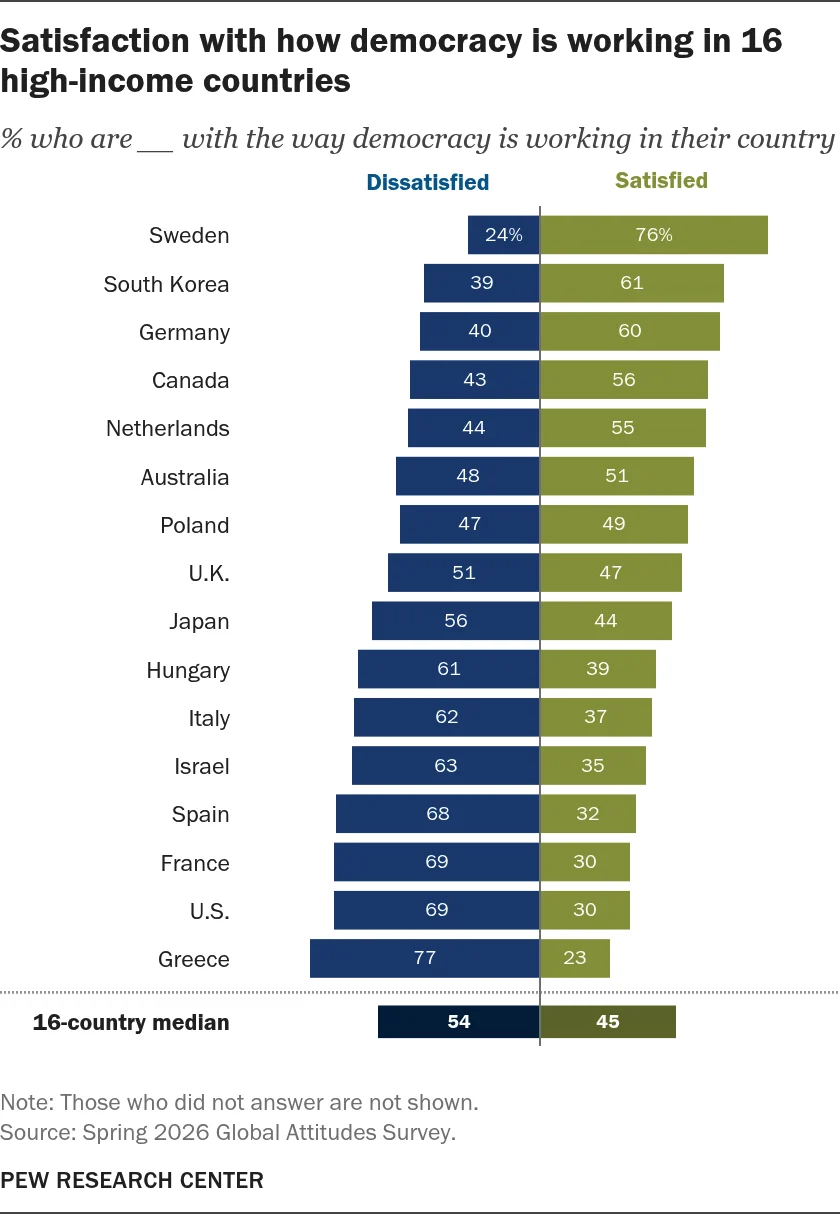
A significant majority of U.S. adults, approximately 69%, express dissatisfaction with the current state of democracy in their country, a sentiment that outpaces that of citizens in most other high-income nations surveyed by the Pew Research Center. This finding, part of a comprehensive Spring 2026 Global Attitudes Survey, paints a stark picture of public sentiment regarding democratic governance in the United States. The survey, which polled 19,715 individuals across 16 developed economies, reveals a widespread erosion of confidence in democratic institutions, with the U.S. lagging behind many of its international peers in terms of citizen satisfaction.
The data indicates a deeply divided political landscape within the United States regarding democratic satisfaction. A substantial 86% of Democrats and Democratic-leaning independents report being dissatisfied with how American democracy is functioning. On the Republican side, a significant portion, approximately 51% of Republicans and GOP leaners, share this sentiment of dissatisfaction. This partisan divide highlights the profound ideological chasm that continues to shape perceptions of governance and national well-being.
Global Perspectives on Democratic Satisfaction
The Pew Research Center’s Spring 2026 Global Attitudes Survey offers a comparative lens through which to view American sentiments on democracy. Across the 16 surveyed high-income countries, a median of 54% of adults expressed dissatisfaction with their respective democratic systems, while a median of 45% reported satisfaction. This global median underscores that while dissatisfaction is a widespread phenomenon, the United States stands out with a higher proportion of its population expressing discontent.
The survey data reveals a wide spectrum of satisfaction levels internationally. At one end of the spectrum, Greece exhibits the highest level of dissatisfaction, with a striking 77% of its adults reporting unhappiness with their democracy’s performance. Conversely, Sweden stands as a beacon of democratic contentment, with a similar proportion, approximately 76%, expressing satisfaction. Other nations like South Korea (61% satisfied), Germany (60% satisfied), and Canada (56% satisfied) demonstrate higher levels of public endorsement for their democratic frameworks compared to the United States. In contrast, countries such as Japan (56% dissatisfied), Hungary (61% dissatisfied), and Italy (62% dissatisfied) show levels of discontent that, while significant, are still generally lower than that observed in the U.S.

The survey, conducted between February 9 and May 6, 2026, involved rigorous methodology to ensure representativeness. Interviews were conducted across Australia, Canada, France, Germany, Greece, Hungary, Israel, Italy, Japan, the Netherlands, Poland, South Korea, Spain, Sweden, the United Kingdom, and the United States. The timing of interviews in Hungary, specifically before the April 2026 parliamentary elections, aimed to capture pre-election sentiment. The survey questions and methodology documents are publicly available, offering transparency into the research process.
Shifting Tides: Year-Over-Year Changes in Democratic Satisfaction
An analysis of year-over-year trends reveals dynamic shifts in public perception regarding democratic governance. While satisfaction levels remained largely stable in most surveyed nations from 2025 to 2026, notable exceptions highlight significant political or societal transformations.
South Korea’s Democratic Resurgence
South Korea experienced a dramatic surge in democratic satisfaction, a phenomenon directly linked to significant political upheaval. Following the impeachment of President Yoon Suk Yeol, the nation held early presidential elections in mid-2025. The election of former opposition leader Lee Jae Myung as president marked a pivotal moment. Between the 2025 and 2026 surveys, the percentage of South Korean adults satisfied with their democracy more than doubled, soaring from 28% in 2025 to an impressive 61% in 2026. This substantial increase represents the most significant rise in democratic satisfaction observed across all surveyed nations, indicating a strong public endorsement of the new political direction and a renewed optimism in the country’s democratic trajectory.
Japan’s Leadership Transition and Renewed Confidence
Japan also witnessed a considerable uptick in democratic satisfaction, coinciding with a change in national leadership. Prime Minister Shigeru Ishiba’s resignation and the subsequent appointment of Sanae Takaichi preceded a snap election in February 2026, which Takaichi’s party won decisively, just days before the survey fieldwork commenced. In the wake of this electoral victory and the historic appointment of Japan’s first female prime minister, satisfaction with democracy in Japan climbed from 24% in 2025 to 44% in 2026. Interestingly, the gender gap in satisfaction observed in 2025, where men were more likely to express satisfaction than women, disappeared in 2026, suggesting a more broadly shared sense of optimism following the political developments.
Australia’s Economic Woes Impact Democratic Outlook
In contrast to the positive trends in South Korea and Japan, Australia experienced a decline in democratic satisfaction. The percentage of Australians satisfied with their democracy dropped from 61% in 2025 to 51% in 2026. This decline appears to be closely correlated with a significant downturn in public sentiment regarding the national economy. Over the same period, the proportion of Australians describing the country’s economic situation as "good" fell sharply from 37% in 2025 to just 20% in 2026. This economic pessimism likely contributed to a broader dissatisfaction with the country’s overall governance and democratic performance.

United States: A Declining Trend Driven by Republicans
The United States, while not experiencing the dramatic shifts seen elsewhere, registered a notable decline in satisfaction with democracy, falling from 37% in 2025 to 30% in 2026. This decrease was primarily fueled by a significant drop in satisfaction among Republicans. In 2025, 60% of Republicans expressed satisfaction with American democracy, a figure that has since fallen to 48%. The satisfaction levels among Democrats remained relatively stable, indicating that the erosion of confidence in the U.S. democratic system is not uniformly distributed across the political spectrum but is particularly pronounced within the Republican base.
Furthermore, a significant majority of Americans across both parties, totaling 68%, believe that while the U.S. democracy may have once served as a global example, it has failed to maintain that status in recent years. This sentiment underscores a shared perception of a diminished international standing and a potential decline in the health of American democratic institutions, a concern echoed in other Pew Research Center analyses examining the state of U.S. democracy in 2025.
Background and Methodology of the Research
This extensive research initiative by the Pew Research Center is part of its ongoing commitment to understanding global attitudes towards democracy, a topic of paramount importance in the current geopolitical climate. The study builds upon previous analyses that have consistently highlighted widespread dissatisfaction with democratic systems in numerous nations. The Center’s objective is to provide valuable insights to the public, media, and policymakers, fostering a deeper comprehension of the challenges and opportunities facing democratic governance worldwide.
The survey methodology employed by the Pew Research Center is designed to ensure robust and reliable data. The 2026 Global Attitudes Survey involved interviews with 19,715 individuals across 16 high-income countries. The selection of these countries was based on their status as developed economies, providing a relevant comparative framework for assessing democratic satisfaction. The interviews were conducted via telephone and online platforms, utilizing nationally representative samples. The survey instruments were carefully designed to elicit nuanced responses on complex issues related to democratic governance, political systems, and societal well-being.
The comprehensive survey methodology, including sampling procedures, weighting techniques, and question wording, is detailed in accompanying documentation. This transparency allows for critical evaluation of the findings and facilitates further academic and policy-oriented research. The data collected serves as a crucial benchmark for tracking trends in public opinion and understanding the evolving relationship between citizens and their democratic institutions.

Broader Implications and Future Outlook
The widespread dissatisfaction with democracy, particularly evident in countries like the United States, carries significant implications for political stability, social cohesion, and economic development. When a substantial portion of the populace feels that their democratic system is not functioning effectively, it can lead to increased political polarization, erosion of trust in institutions, and a heightened susceptibility to populist or authoritarian appeals.
The findings suggest that governments in these high-income countries face a critical challenge in rebuilding public trust and demonstrating tangible improvements in democratic governance. Addressing the root causes of dissatisfaction, whether they stem from economic inequality, perceived political corruption, or the inability of democratic institutions to deliver on promised outcomes, will be crucial. The contrasting trends observed in South Korea and Japan, where significant political changes appear to have revitalized public confidence, offer potential models for other nations grappling with similar issues. However, the decline in Australia and the U.S. highlights the fragility of democratic sentiment and the need for continuous efforts to strengthen and adapt democratic systems to contemporary challenges.
The Pew Research Center’s ongoing work in this area will be vital for monitoring these trends and providing data-driven insights into the future of democracy globally. As nations navigate complex domestic and international landscapes, understanding citizen sentiment remains a cornerstone of effective governance and a key indicator of democratic health. The data from the Spring 2026 Global Attitudes Survey serves as a stark reminder that the perceived effectiveness and responsiveness of democratic systems are not static but are subject to the evolving experiences and expectations of the people they are meant to serve.