On January 13, 2026, Priya Sahni-Nicholas, Co-Executive Director of The Equality Trust, addressed the Public Policy Exchange to provide a comprehensive evaluation of the government’s recently unveiled Child Poverty Strategy, titled Tackling Child Poverty: Improving Welfare, Security and Future Prospects. The briefing, delivered during a period of intense national debate regarding fiscal priorities, highlighted a critical tension between the government’s renewed focus on poverty reduction and its apparent reluctance to confront the underlying structures of economic inequality. While Sahni-Nicholas acknowledged a significant ideological shift in the government’s approach compared to the previous decade, her analysis underscored a fundamental omission: the role of concentrated wealth and systemic power in perpetuating hardship for millions of British families.
The release of the Child Poverty Strategy in December 2025 marked the first UK-wide initiative of its kind since the early 2000s. It arrived against a backdrop of deteriorating social indicators; by the start of 2025, an estimated 4.5 million children—approximately one in three—were living in poverty. Furthermore, nearly 20% of UK households were reported to be experiencing consistent food insecurity. The government’s strategy frames these figures not as an inevitability of global economic trends, but as a direct consequence of policy choices made since 2010. By defining child poverty as a "moral, economic, and public-services failure," the administration has signaled an intent to reverse the trends of the last fifteen years, aiming for a significant reduction in poverty within the current parliament and total eradication in the long term.
A Chronology of Policy and Poverty
The trajectory of child poverty in the United Kingdom has undergone distinct phases over the last thirty years. Between 1997 and 2010, the then-Labour government implemented a series of redistributive measures, including tax credits and increased investment in public services, which successfully lifted approximately 600,000 children out of poverty. However, this progress was largely stalled or reversed during the era of austerity following the 2008 financial crisis.
In 2017, the introduction of the two-child limit on welfare benefits became a focal point of criticism for social advocates, who argued it unfairly penalized larger families and acted as a primary driver of rising deprivation. By 2024, the UK stood as an outlier among advanced economies; while many European neighbors saw poverty rates stabilize or decline, the UK’s figures continued to climb. The December 2025 strategy was developed to address this divergence, incorporating feedback from advocacy groups and, notably, individuals with lived experience of poverty through initiatives like Changing Realities.
Immediate Policy Successes and Redistributive Gains
The Equality Trust’s analysis identifies several "wins" within the new strategy that represent a departure from previous administrative stances. Most notably, the abolition of the two-child limit is cited as the single most impactful policy change. Projections suggest that this move alone will lift roughly 450,000 children out of relative poverty. By addressing a policy that disproportionately affected marginalized communities and larger households, the government has taken a significant step toward reinstating social security as a functional safety net.

Furthermore, the strategy moves away from the "individual failure" narrative that characterized welfare discourse for much of the 2010s. Instead, it recognizes "in-work poverty" as a systemic reality. With a focus on the National Living Wage, the expansion of free school meals, and the implementation of breakfast clubs, the government is targeting the "cost of essentials" that often consumes the entirety of low-income wages. The inclusion of a "spatial lens"—acknowledging that poverty is not uniform but varies wildly by region, local authority, and neighborhood—is also praised as a genuine strength, allowing for more localized, place-based interventions.
The Wealth Gap: The Missing Dimension of Inequality
Despite these advancements, Sahni-Nicholas argues that the strategy remains incomplete because it fails to address the "missing pillar" of wealth. In the 2026 briefing, it was noted that the word "wealth" does not appear in the government’s diagnosis or its proposed metrics for success. The Equality Trust contends that treating poverty solely as an income and cost problem ignores the reality of asset distribution in the UK.
Families with identical incomes can experience vastly different standards of living based on their access to assets, such as homeownership, savings, or inherited wealth. This "wealth buffer" provides security against economic shocks—such as sudden illness or job loss—that can otherwise plunge a family into destitution. By ignoring wealth, the strategy fails to account for the structural advantages that allow some families to flourish while others remain trapped in a cycle of precariousness.
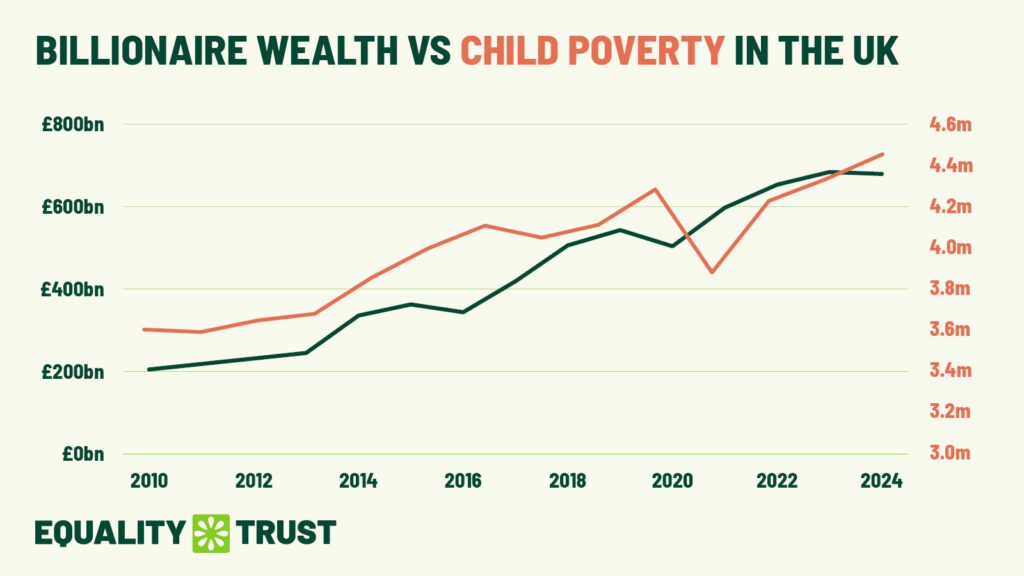
The briefing invoked the economic theories of Thomas Piketty, specifically the concept that the return on capital (r) often outpaces economic growth (g). When wealth grows faster than wages, structural inequality widens, and those without assets find it increasingly difficult to catch up, regardless of their employment status. Sahni-Nicholas likened the current strategy to "trying to empty a bath while leaving the taps running," suggesting that without addressing the concentration of wealth at the top, income-based interventions will only provide temporary relief.
Power, Corporate Influence, and Historical Context
A second major critique leveled by The Equality Trust concerns the dimension of power. The strategy frequently utilizes terms like "opportunity" and "life chances," yet it avoids discussing how corporate power, housing market volatility, and the political influence of the affluent shape the economic environment. The briefing suggests that child poverty is not an accidental byproduct of the system but a result of an economic model designed to prioritize the interests of those with capital.
Historically, the most significant reductions in UK inequality were not the result of targeted anti-poverty programs alone but of wholesale shifts in the balance of power. The post-World War II era serves as the primary example. During this period, the establishment of the National Health Service (NHS), the expansion of social security, the strengthening of trade unions, and the implementation of progressive taxation on both income and wealth led to a sustained period of "Great Compression." During this time, inequality fell, and living standards for the working class rose simultaneously. The Equality Trust argues that a similar systemic shift is required today to ensure that the current reductions in child poverty are not merely cyclical.

Implications and the Path Toward Structural Reform
The analysis concludes that while the December 2025 strategy is a necessary corrective to the policies of the last decade, it is not yet a transformative document. To move from "poverty reduction" to "inequality reduction," future iterations of the strategy must integrate fiscal reforms that address the disparity between the taxation of labor and the taxation of capital. Currently, income from work is often taxed at a higher effective rate than income from assets, a structure that further entrenches the wealth gap.
The Equality Trust has proposed a set of recommendations to strengthen the national approach:
- Binding Targets: The ten-year ambition to end child poverty must be backed by legally binding targets and transparent annual reporting to ensure political accountability.
- Wealth Integration: Future strategies should include metrics on asset ownership and household debt, recognizing that financial resilience is as important as monthly income.
- Cross-Government Mechanisms: Implementation must be synchronized across the Department for Work and Pensions (DWP), Health, Education, and Housing to address the compounding nature of disadvantage.
- Fiscal Realignment: The government must be willing to discuss how redistribution through wealth and land taxes can fund the social investment required to sustain a poverty-free society.
Conclusion
The 2026 Child Poverty Strategy represents a pivotal moment in British social policy, signaling a return to the principle that the state has a moral obligation to protect its most vulnerable citizens. The abolition of the two-child limit and the focus on the cost of living are evidence of a government responding to the immediate crisis of deprivation. However, as the Equality Trust’s analysis makes clear, these measures address the symptoms rather than the cause.

To truly "end" child poverty, the government must look beyond the poverty line and address the widening chasm of wealth and power that defines the modern British economy. Without confronting the structures that allow wealth to accumulate at the top while millions struggle at the bottom, the progress made in this parliament may remain fragile. The challenge for the coming years will be to evolve this strategy from a relief effort into a blueprint for a fundamentally more equal society.