A comprehensive new study from the Pew Research Center reveals significant disparities in how different racial and ethnic groups in the United States engage with and perceive artificial intelligence (AI). The research, conducted between February 17-23, 2026, underscores that adoption rates and outlooks on AI are not uniform across the American population, with race and ethnicity emerging as key differentiating factors. Asian adults, in particular, stand out for their higher rates of chatbot usage and a more optimistic outlook regarding AI’s future impact.
This latest research effort by the Pew Research Center is part of its ongoing commitment to understanding the evolving role of AI in society. The Center aims to provide crucial insights for the public, journalists, and policymakers by tracking the proliferation of AI technologies and gauging public sentiment. The study delves into the usage patterns of AI-powered tools like chatbots and smart home devices, alongside Americans’ personal and societal views on AI’s influence.
AI Chatbot Adoption: A Growing Trend with Racial and Ethnic Divides

The survey data indicates that approximately half of all U.S. adults report using AI chatbots such as ChatGPT, Gemini, or Copilot. However, this aggregate figure masks substantial differences across demographic groups. A striking 70% of Asian adults report ever using these AI chatbots, a considerably higher proportion compared to other racial and ethnic groups. In contrast, only about half or fewer of Hispanic, Black, and White adults indicated similar usage. This trend echoes findings from previous years, suggesting a sustained pattern of higher engagement with AI chatbots among Asian adults.
Digging deeper into usage frequency, the data reveals that Asian Americans are also more likely to use chatbots on a daily basis. Nearly half of Asian adults reported daily usage, a rate significantly higher than that of Hispanic, Black, and White adults, where roughly a quarter or less indicated daily engagement.
Awareness of AI Chatbots: A Near-Universal Phenomenon, with Nuances
The awareness surrounding AI chatbots is broadly high across the U.S. population, with the vast majority of adults reporting at least some familiarity with these tools. However, here too, Asian Americans demonstrate a heightened level of engagement, with approximately seven-in-ten Asian adults reporting they have "heard a lot" about AI chatbots. This contrasts with Black, Hispanic, and White adults, where less than half of each group expressed the same level of awareness. This pattern of greater awareness and engagement among Asian adults is consistent across various AI-related topics.

Diverse Applications of AI Chatbots: Information Seeking and Professional Tasks Lead
Americans are utilizing AI chatbots for a diverse range of purposes. The most common applications identified in the study include searching for information and, among those employed, performing tasks related to their work. The survey found that 66% of Asian adults use chatbots to search for information, a figure substantially higher than their White (39%), Hispanic (41%), and Black (42%) counterparts.
The professional sphere also shows significant engagement. Among employed adults, 60% of Asian individuals reported using chatbots for tasks at work, compared to 36% of White adults, 37% of Hispanic adults, and 36% of Black adults. This suggests that AI tools are being integrated into the professional lives of Asian Americans at a disproportionately higher rate.
Beyond these primary uses, Asian adults also show higher rates of utilizing chatbots for creative endeavors like image and video editing (38% vs. 22%-24% for other groups), seeking medical advice (39% vs. 18%-23%), and accessing news (29% vs. 10%-18%). While White adults are generally less likely to use chatbots for many of these specific applications, the overall adoption rates for basic information seeking and entertainment are comparable across most groups.

Views on AI: Optimism Among Asian Adults, Caution Elsewhere
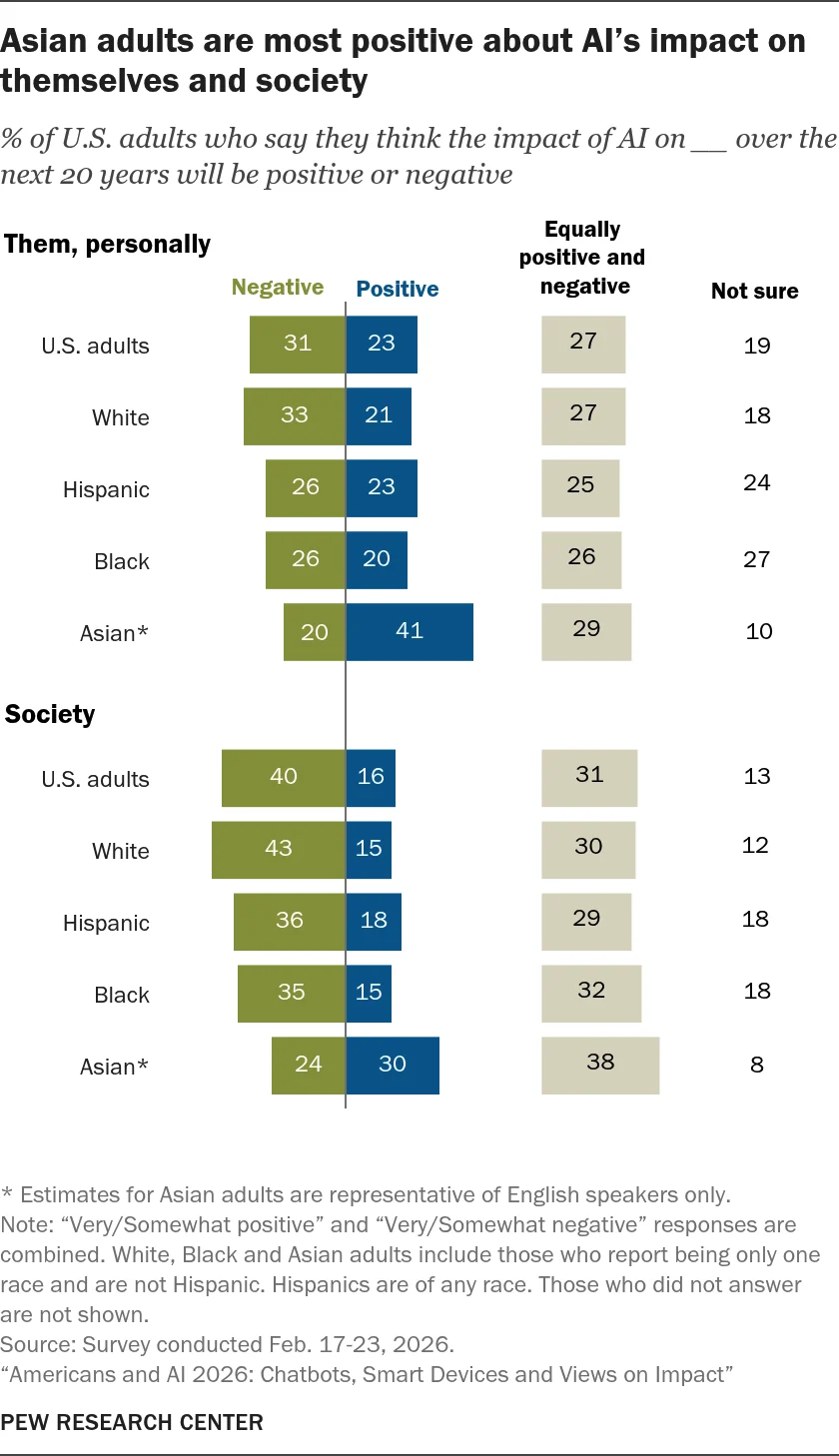
The divergence in AI adoption is paralleled by differences in perspectives on its future impact. The Pew Research Center’s findings indicate that Asian adults are the only demographic group where attitudes toward AI’s personal impact lean more positive than negative. Specifically, 41% of Asian adults believe AI will have a positive impact on them personally over the next two decades, compared to 20% who anticipate a negative impact. This contrasts with White, Hispanic, and Black adults, for whom negative perceptions of AI’s personal impact are more prevalent or equally balanced with positive views.
On a societal level, Asian adults also express more optimism about AI’s future. While views on AI’s impact on society are generally more negative across all surveyed groups, Asian adults are more likely to perceive a positive societal outcome (30%) than a negative one (24%). For White, Hispanic, and Black Americans, the outlook on AI’s societal impact is predominantly negative.
A Shared Concern: The Pace of AI Advancement

Despite these differing views on AI’s ultimate impact, a strong consensus emerges across all racial and ethnic groups regarding the speed of its development. A significant majority in every surveyed group believe that AI is advancing too quickly. This sentiment is particularly pronounced among White, Hispanic, and Asian adults, with six-in-ten or more expressing this concern. A majority of Black adults also share this view. Very few individuals across any group believe AI is advancing at the right pace, and even fewer think it is moving too slowly. This widespread apprehension suggests a shared societal anxiety about the rapid and potentially unchecked progress of artificial intelligence.
Background and Methodology
The Pew Research Center’s commitment to understanding technology’s societal impact has been a long-standing priority. This study builds upon years of research into internet adoption, digital divides, and emerging technologies. The survey was conducted via online and mail surveys among a nationally representative sample of U.S. adults. The margin of error for the total sample is plus or minus 3.2 percentage points. Specific margins of error vary for each subgroup. The research team emphasizes that estimates for Asian adults are representative of English speakers only, a crucial caveat for interpreting these specific findings.
The study’s findings are particularly relevant in the current technological climate, where AI is rapidly integrating into various aspects of daily life, from consumer products to professional tools. The differential adoption and perception patterns highlight the need for targeted approaches in AI development, education, and policy to ensure equitable benefits and mitigate potential risks across all segments of the population. The data suggests that while AI’s transformative potential is widely acknowledged, the experience and outlook on this transformation are far from universal. As AI continues to evolve, ongoing research and open dialogue will be essential to navigate its complex implications for American society.