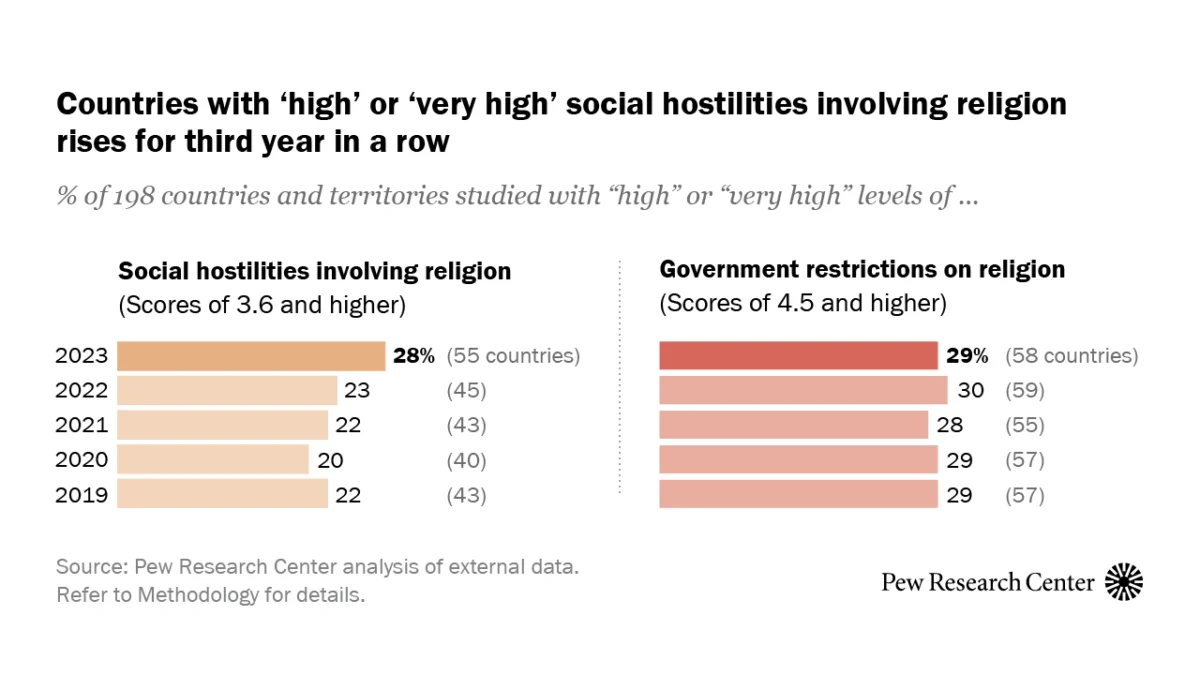
The global landscape of religious freedom continued to deteriorate in 2023, with a record-high 192 out of 198 countries and territories reporting incidents of government or social harassment against religious groups. This marks the 16th annual report from the Pew Research Center analyzing global restrictions on religion, revealing a persistent and widening trend of religiously motivated hostility. The number of nations experiencing such harassment has surged from 152 in 2007 to 192 in 2023, underscoring a significant escalation in religious restrictions over the past decade and a half.
The comprehensive study, meticulously compiled by Pew Research Center as part of the Pew-Templeton Global Religious Futures project, draws upon a wide array of publicly available and widely cited sources. These include official reports from the U.S. State Department and the U.S. Commission on International Religious Freedom, United Nations data, and assessments from prominent non-governmental organizations such as Freedom House, Amnesty International, and Human Rights Watch. Researchers employed two distinct indexes to quantify these restrictions, analyzing both government policies and societal hostilities.
Escalating Trends in Physical Harassment
The latest data highlights a disturbing rise in the most severe forms of religiously motivated conflict. In 2023, religious groups faced at least one type of physical harassment in 151 countries, an increase from 145 countries in the previous year. This category encompasses a range of egregious actions, including damage to religious property, physical assaults, detentions, forced displacements, and killings.
The study differentiates between government-led physical harassment and that perpetrated by non-governmental actors. In 2023, governments were implicated in physical harassment in 110 countries, a slight decrease from 111 in 2022. Conversely, non-governmental actors were responsible for physical harassment in 115 countries, marking an uptick from 111 countries in the prior year. This indicates a complex and multifaceted challenge, with both state and non-state actors contributing to the erosion of religious freedom worldwide.
Property Damage Remains the Most Prevalent Form of Physical Harassment
Across the globe, property damage emerged as the most frequently reported form of physical harassment against religious groups in 2023. Incidents of property damage, including vandalism, raids, closures, and denial of compensation for seized property, were documented in 120 countries, representing 61% of the total surveyed nations. This figure remained consistent with 2022.

The geographic distribution of property damage incidents reveals significant regional disparities. Europe reported the highest prevalence, with 78% of its countries experiencing such harassment, often linked to the ongoing conflict in Ukraine where religious sites have been targeted. The Middle East and North Africa region followed closely, with 75% of its nations reporting property damage. In Asia-Pacific, 58% of countries were affected, while Sub-Saharan Africa saw property damage in 52% of its nations, and the Americas in 46%.
Examples from Europe highlight the devastating impact of conflict on religious infrastructure. In Ukraine, repeated Russian missile strikes damaged significant religious sites, including Orthodox churches and synagogues. Beyond conflict zones, the repeated burning of the Quran, Islam’s holy book, in countries like Denmark, Norway, Sweden, and Russia also contributed to the tally of property damage. Furthermore, in Albania, religious groups reported governmental inaction in returning properties seized during the Communist era, underscoring systemic issues affecting religious communities.
Physical assaults against individuals due to their religious identity were reported in 96 countries (48% globally). The Middle East and North Africa region again showed a high incidence, with assaults occurring in 65% of its countries. In Sudan, the ongoing conflict between the Sudanese Armed Forces and the Rapid Support Forces led to the destruction of religious sites and casualties among worshippers, with one attack on a mosque reportedly killing 280 people. In Afghanistan, the de facto government enforced its interpretation of Sharia law through public floggings, a severe form of physical punishment. Ethiopia witnessed attacks on religious sites by government forces and other armed groups, resulting in significant loss of life and displacement, particularly affecting an Orthodox Christian monastery.
Detentions and Displacement: Widespread and Persistent Threats
Detentions, encompassing arrests and kidnappings, linked to religious affiliation, beliefs, or practices were a significant concern in 2023, occurring in 89 countries (45% globally). The Middle East and North Africa region recorded the highest rate, with detentions reported in 85% of its countries. Iran saw continued detentions of religious minorities, including Kurdish Sunni clerics, following protests related to dress codes. In Saudi Arabia, members of the minority Shiite community faced disproportionate scrutiny and harsher legal charges. The Americas also witnessed a concerning trend, with Nicaragua increasingly targeting Roman Catholic and evangelical churches, leading to the detention of numerous priests and seminarians, including the sentencing and subsequent exile of Bishop Rolando Alvarez.
Religion-related displacements, where individuals are forced to flee their homes due to religious tensions or violence, impacted 58 countries globally (29%). This figure includes ongoing displacements from previous conflicts. Turkey reportedly deported non-citizen Christians in an effort to curb the spread of Christianity. In India, significant displacements occurred in Manipur due to ethnic violence between Hindu Meitei and Christian Kuki communities, resulting in the destruction of churches and displacement of tens of thousands. The ongoing conflict in Myanmar continued to drive large-scale displacements, with Rohingya Muslims and Karenni Christians being among the most affected groups.
Killings: A Stark Indicator of Religious Persecution
Religion-related killings were reported in 48 countries (24% globally). Sub-Saharan Africa and the Middle East-North Africa region experienced the highest rates, with killings occurring in 38% and 45% of their respective countries. In Kenya, authorities exhumed over 400 bodies linked to a cult, where members allegedly starved themselves to death. Nigeria experienced numerous religion-related killings by nonstate actors, including attacks on mosques and villages, with the conflict over land and resources often exacerbating religious tensions between Christian and Muslim communities. In China, the State Department reported deaths of Falun Gong practitioners and members of the Church of Almighty God attributed to persecution and torture in prison.

Targeted Religious Groups: Christians, Muslims, and Jews Face Widespread Harassment
The Pew Research Center’s analysis also sheds light on which religious groups faced the brunt of harassment. Christians and Muslims, the two largest religious groups globally, were harassed in the highest number of countries. Christians faced harassment in 165 countries in 2023, a slight decrease from 166 in 2022, while Muslims were harassed in 143 countries, down from 148.
Notably, Jews, who constitute less than 1% of the world’s population, faced harassment in 98 countries, an increase from 90 in 2022. This rise is partly attributed to a surge in antisemitic statements following the October 7th attacks in Israel and the subsequent military campaign in Gaza. The study clarifies that hostile statements toward Jews, distinct from criticism of Israel, are counted as religion-related harassment.
While most religious groups saw a slight decrease in the number of countries where they experienced harassment in 2023 compared to 2022, adherents of folk religions and Hindus saw an increase. Folk religions were harassed in 50 countries, up from 49, and Hindus in 32 countries, up from 26. This underscores the diverse and pervasive nature of religious persecution, affecting a wide spectrum of faith traditions.
The study emphasizes that while it quantifies the number of countries where harassment occurs, it does not measure the severity or intensity of such persecution, nor does it identify which specific religious group faced the most severe persecution. The data serves as an indicator of the growing prevalence and geographic spread of religious hostilities worldwide.
Methodology and Funding
The Pew Research Center’s annual reports on religious restrictions are based on a rigorous methodology that involves annually reviewing publicly available, widely cited sources. This includes official reports from governments, international organizations, and reputable non-governmental organizations. The data is used to score 198 countries and territories on two indexes designed to measure government policies and social hostilities involving religion. The research is funded by The Pew Charitable Trusts and the John Templeton Foundation as part of the Pew-Templeton Global Religious Futures project, which examines religious change and its societal impact globally.