A comprehensive new report from the Pew Research Center reveals the intricate and often challenging landscape faced by working parents in the United States, highlighting the pervasive blurring of lines between professional responsibilities and family life. The study, based on a survey of 2,242 working parents conducted in March 2026, underscores the constant negotiation required to meet the demands of both spheres, with mothers disproportionately shouldering the "mental load" and experiencing greater feelings of inadequacy in either their careers or their parenting.
Pew Research Center’s In-Depth Look at Modern Parenthood

This extensive research initiative by the Pew Research Center aims to provide a nuanced understanding of how Americans manage the evolving dynamics of work and family, with a particular focus on the experiences of parents. The findings are particularly relevant in the current societal context, where work-life integration has become an increasingly complex issue for millions of households. The report draws on data from the Center’s American Trends Panel, a nationally representative group of U.S. adults, ensuring that the surveyed parents reflect a broad spectrum of experiences across the nation. The methodology, including the survey questionnaire and detailed responses, has been made publicly available, allowing for further scrutiny and analysis. In addition to the primary survey, the report incorporates analysis of labor force data from the U.S. Census Bureau’s Current Population Survey to provide a broader demographic context.
The Evolving Nature of Work and Family
The research underscores a significant shift in the traditional separation between work and home. For a substantial portion of full-time working parents, the boundaries have become indistinct, leading to a constant interplay between professional obligations and familial needs. This phenomenon is captured by the poignant sentiment of one mother surveyed: "I’m supposed to work like I don’t have kids and supposed to parent like I don’t have a job." This quote encapsulates the immense pressure many parents feel to perform at peak capacity in both arenas, often with conflicting demands.
Key Findings: A Deeper Dive into Parental Pressures
The Pew Research Center’s analysis reveals several critical takeaways regarding the challenges faced by working parents:
-
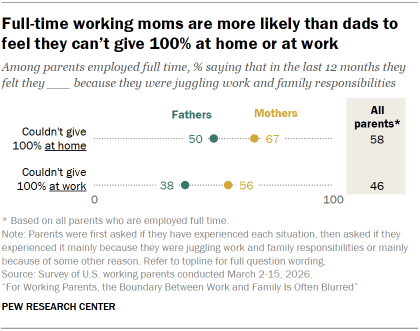
The "Mental Load" and Perceived Inadequacy: A significant finding is that working parents, particularly mothers, often carry a disproportionate "mental load"—the invisible labor of managing household logistics, appointments, and emotional needs. This constant juggling act contributes to a feeling, at times, of being unable to fully commit 100% to either their work or their home life. A visual representation of this sentiment shows that full-time working mothers are more likely than fathers to express this feeling.
-
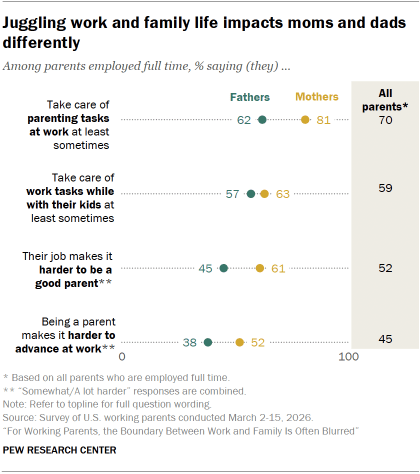
Blurred Boundaries in Practice: The study highlights how work tasks frequently intrude upon family time, and conversely, parenting responsibilities can surface during work hours. This overlap is particularly pronounced among mothers. A staggering 81% of full-time working mothers report engaging in parenting tasks while at work at least sometimes, with 38% doing so "extremely or very often." This is nearly double the rate for fathers, where only 17% report the same frequency. Fathers are not immune to this blurred reality, however, with 62% of full-time working dads admitting to handling parenting tasks during work hours, and 57% dealing with work tasks while with their children.
-
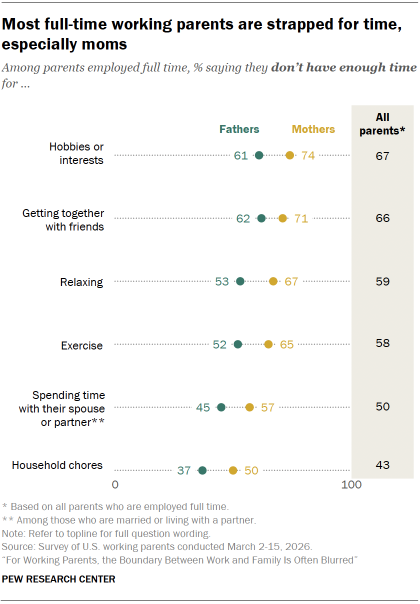
Work as an Obstacle to Parenting: A majority of full-time working parents (60%) believe they do not spend enough time with their children. The primary reason cited for this perceived deficit is work obligations, more so than any other factor. This sentiment is further amplified by the fact that nearly half (47%) of working parents report that their work responsibilities cause them to miss their children’s activities, such as school events or sports games, at least occasionally. The emotional toll of these missed moments is also significant, with 65% of mothers feeling "extremely or very upset" when missing such activities due to work, compared to 45% of fathers.
-
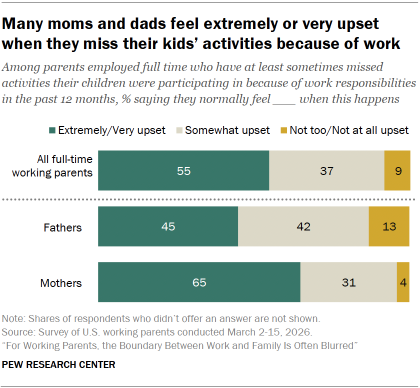
Sacrifices in Personal Time: The relentless demands of work and family leave little room for personal pursuits. Approximately half or more of both full-time working mothers and fathers report not having enough time for hobbies, socializing with friends, exercise, or simply relaxing. This time poverty is more acutely felt by mothers, who are more likely than fathers to express a lack of sufficient time for each of these activities. For instance, 65% of mothers report insufficient time for exercise, versus 52% of fathers. Similarly, 67% of mothers feel they lack adequate time for relaxation, compared to 53% of fathers.
-
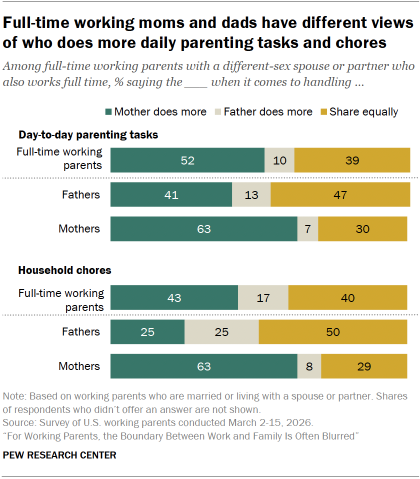
Division of Labor Within Families: The report also sheds light on the perceived division of responsibilities within dual-earner families, specifically focusing on couples where both partners are employed full-time. In these households, a majority of mothers (52%) believe they handle more parenting tasks than their partners, while 39% see the division as equal. A similar pattern emerges for household chores, with 43% of mothers indicating they do more and 40% perceiving an equal share. Dads, however, tend to report a more equitable distribution of these tasks, with higher percentages indicating tasks are shared equally compared to what mothers report. This divergence in perception is notable, especially when considering that even in families where mothers work more hours than fathers, parents are still more likely to assign more parenting and household duties to the mother.
The Experiences of Part-Time Working Parents
The study also provides valuable insights into the experiences of parents who work part-time. This group is predominantly female (79%) and often resides in lower-income households. While their work hours differ, they encounter many of the same challenges as their full-time counterparts. A significant portion of part-time working parents (51%) find it difficult to balance work and family life, a figure closely mirroring the 54% of full-time workers who report similar struggles. Furthermore, a substantial percentage of part-time workers (42%) and full-time workers (46%) have felt unable to give their full attention to work in the past year due to family responsibilities.
A key disparity for part-time workers lies in their access to crucial workplace benefits. Less than half of part-time working parents have access to benefits like health insurance, paid time off, or other paid leave through their employers. For example, only 37% of part-time working parents have access to health insurance through work, a stark contrast to the 87% of full-time working parents who do.
Implications and Broader Societal Impact
The findings of this Pew Research Center report have significant implications for individuals, families, and workplaces across the United States. The pervasive feeling of inadequacy and the constant pressure to excel in multiple demanding roles can contribute to parental burnout, impacting mental and physical well-being. The disproportionate burden carried by mothers suggests a continued need for greater societal and structural support, including more equitable distribution of domestic labor and more supportive workplace policies.
The data also points to a critical need for employers to re-evaluate their policies and workplace culture. The blurred lines between work and home are not merely an individual problem but a systemic one. Flexible work arrangements, robust paid family leave policies, and a culture that values work-life integration, rather than demanding constant availability, could significantly alleviate the pressures faced by working parents.
The disparity in benefits available to part-time workers also raises questions about economic equity and the foundational support systems for families. Ensuring access to essential benefits for all workers, regardless of their employment status, is crucial for the well-being of children and the stability of households.
As the nature of work continues to evolve, so too must our understanding of and support for the individuals who navigate its demands while raising the next generation. This research from the Pew Research Center serves as a vital resource, illuminating the realities of modern parenthood and providing a data-driven foundation for conversations and policy changes aimed at fostering a more supportive and sustainable environment for working families. The long-term implications for child development, parental well-being, and overall societal prosperity hinge on addressing these complex challenges effectively.