A comprehensive new report from the Pew Research Center, released in June 2026, paints a stark picture of the challenges facing working parents in the United States. The research, based on a survey of 2,242 working parents conducted in early March 2026, reveals a significant disconnect between the workplace benefits and flexible arrangements that parents deem essential for balancing their professional and family lives, and the availability of these provisions at their current jobs. This disparity is particularly acute for lower-income families, exacerbating existing inequalities.
The Pew Research Center, a non-partisan fact tank, undertook this extensive study as part of its ongoing commitment to understanding the evolving dynamics of work and family life in America. The report aims to equip the public, media, and policymakers with critical data to inform discussions and potential policy interventions. The research delves into how working parents navigate the dual demands of their careers and family responsibilities, the division of labor within households, and the profound impact of workplace policies on their overall well-being and ability to thrive.
Key Findings: A Chasm in Support Systems
The survey highlights that many of the most desired workplace supports are not widely accessible, with a particularly pronounced shortage for those in lower income brackets. The findings underscore a critical need for employers to re-evaluate their offerings and for policymakers to consider measures that expand access to essential benefits.
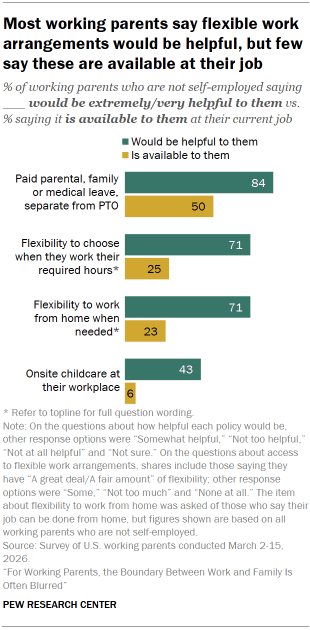
A striking example of this disparity is the demand for paid parental, family, or medical leave. Over 80% of working parents who are not self-employed identified this as extremely or very helpful. However, only half of these parents report having access to such a benefit. This indicates a substantial portion of the workforce is ill-equipped to handle significant life events, such as welcoming a new child or caring for a seriously ill family member, without jeopardizing their income or job security.
Flexibility in work arrangements also emerged as a paramount concern. A significant majority of working parents, 71%, stated that the flexibility to work from home would be highly beneficial. An equal percentage expressed the same sentiment regarding the flexibility to choose their working hours. Yet, the report indicates that far fewer parents have substantial autonomy in these areas.

Onsite Childcare: A Much-Desired but Rare Commodity
Perhaps one of the most significant gaps identified by the research is the availability of onsite childcare. A substantial 43% of all working parents, and a higher 59% of those with children aged five or younger, reported that onsite childcare would be extremely helpful. Despite this strong demand, a mere 6% of working parents have access to this benefit at their workplace. This finding is particularly relevant given the ongoing challenges parents face in securing affordable and reliable childcare, a critical factor in workforce participation. Pew Research Center’s related work on the challenges of finding childcare further contextualizes this significant unmet need.
In contrast to these areas of scarcity, benefits such as paid time off (PTO) and health insurance through employment are widely available and highly valued. The report notes that most working parents view these as helpful and, crucially, most report having access to them. This suggests that while some foundational benefits are broadly provided, more specialized and potentially impactful supports remain elusive for a large segment of the working parent population.
Income Disparities: A Two-Tiered System for Working Parents
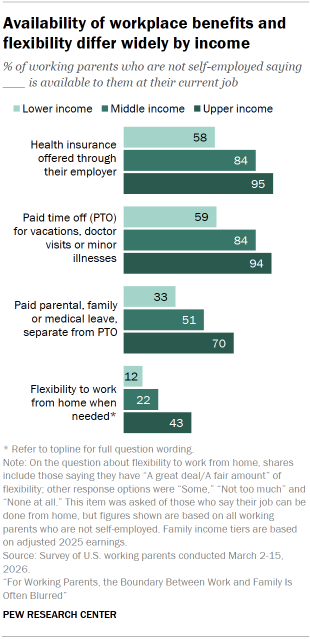
The Pew Research Center report meticulously details how access to workplace benefits and flexible arrangements varies significantly by income level. Parents with higher family incomes consistently report greater access to these crucial supports compared to their lower-income counterparts. This creates a bifurcated system where economic advantage translates directly into greater workplace support, potentially widening existing socioeconomic divides.
Among working parents who are not self-employed, those in upper and middle-income brackets are substantially more likely to have access to a range of benefits and flexible work options. For instance, paid parental, family, or medical leave, distinct from general PTO, is available to 70% of upper-income parents, compared to 51% of middle-income parents and only 33% of lower-income parents.
Similarly, flexibility to work from home is a reality for 43% of upper-income parents, whereas only 22% of middle-income parents and a mere 12% of lower-income parents can report this level of flexibility. While flexibility in choosing work hours showed less pronounced income-based disparities, the broader trend of unequal access to other forms of flexibility is undeniable.
Underlying Factors: Work Status and Pay Structure
The report acknowledges that these income-related differences are partly influenced by parents’ work status. Lower-income parents are more likely to work part-time, a status that generally correlates with reduced access to benefits and flexible arrangements. However, even when comparing full-time workers, lower-income parents still experience a deficit in the availability of these supports.
Furthermore, the prevalence of hourly wage structures among lower-income parents plays a significant role. A larger proportion of lower-income parents are paid by the hour, and hourly workers are historically less likely to benefit from comprehensive paid leave policies or flexible work schedules.
Predictable Schedules: A Foundation for Balance
The predictability of work schedules also emerges as a critical factor, with income disparities evident. Among lower-income parents not self-employed, 14% reported that their work hours are not at all predictable, compared to 9% of middle-income and 7% of upper-income parents. This lack of predictability has tangible consequences, with parents experiencing unpredictable hours being significantly more likely to report difficulties in balancing work and family responsibilities (71% versus 53% for those with at least somewhat predictable hours). This suggests that stable and predictable work schedules are not merely a convenience but a fundamental necessity for effective work-family integration.
Concerns About Unexpected Childcare Needs: A Source of Anxiety
The inherent unpredictability of life, particularly for parents, can be amplified by unexpected events such as a child’s illness or disruptions in childcare arrangements. The Pew Research Center report found that these situations generate significant anxiety, especially for lower-income working parents who often lack robust safety nets.
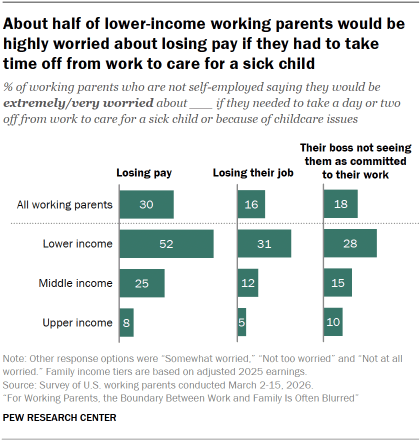
Nationally, 30% of working parents not self-employed expressed extreme or very high worry about losing pay if they had to take time off for such unforeseen circumstances. Smaller percentages voiced similar concerns about job loss (16%) or their employer’s perception of their commitment (18%).
These anxieties are magnified for lower-income families. Nearly half of lower-income working parents (49%) would be extremely or very worried about losing pay if they needed to care for a sick child. This concern is significantly higher than for middle-income (28%) or upper-income (16%) parents. The fear of financial repercussions underscores the precarious economic position many lower-income families occupy, where even a short absence from work can have severe consequences.
Single mothers, who often face greater financial pressures, reported even higher levels of worry. They were significantly more likely than married or cohabiting mothers to express extreme or very high concern about losing pay (55% vs. 27%), losing their job (27% vs. 11%), and their boss’s perception of their commitment (30% vs. 14%) in the event of unexpected childcare needs.
Racial and ethnic disparities are also evident. Black and Hispanic working parents (42% and 43% respectively) reported higher levels of worry about losing pay due to unexpected caregiving needs compared to White and Asian parents (22% and 26%). These findings suggest a complex interplay of economic, social, and potentially systemic factors contributing to heightened vulnerability among certain demographic groups.
Flexibility for Children’s Activities: A Measure of Work-Life Integration
The ability to participate in children’s school and extracurricular activities during work hours is another crucial aspect of work-life integration. The survey revealed that while a majority of working parents (75%) report having at least some flexibility to attend these events, a substantial quarter indicate limited or no such flexibility.
Again, income plays a significant role. Upper-income parents are more likely to report having a great deal or fair amount of flexibility (54%) to attend their children’s activities during work hours, compared to lower-income parents (40%). This disparity has tangible consequences for family engagement. Lower-income parents are the most likely to report having missed their children’s activities at least sometimes in the past 12 months due to work responsibilities, with 55% indicating this, compared to 44% of middle-income and 40% of upper-income parents.
Implications and Future Considerations
The Pew Research Center’s report provides compelling evidence that the current landscape of workplace benefits and flexible arrangements is not adequately serving the needs of a large segment of the American working parent population. The significant gaps, particularly for lower-income families, have profound implications for economic stability, child development, and overall societal well-being.
The findings suggest that employers who prioritize offering comprehensive paid leave, robust childcare support, and genuine flexibility are likely to see benefits in employee retention, productivity, and morale. As the report highlights, the desire for these supports is widespread, indicating a strong market demand.
From a policy perspective, the data points towards the need for further exploration of initiatives that could expand access to paid family and medical leave, potentially through federal or state-level mandates. Similarly, exploring incentives for employers to offer onsite childcare or subsidies for external childcare could address a critical need. The disparities in predictable work schedules also warrant attention, as unstable work can have ripple effects on families and communities.
The Pew Research Center’s research, conducted by a team including [mention key researchers or department if available, e.g., a team of researchers from Pew’s Social Trends division], relied on a rigorous methodology, including a survey administered to the American Trends Panel, a nationally representative group of U.S. adults. Supplementary analysis utilized data from the U.S. Census Bureau’s Current Population Survey. The detailed survey questionnaire, topline responses, and methodology are publicly available, allowing for transparency and further examination of the data. This comprehensive approach ensures the findings are robust and provide a valuable resource for understanding the complex realities of modern parenthood in the American workforce. The report serves as a crucial call to action for businesses and policymakers alike to address the growing chasm between the support working parents need and the support they actually receive.