A comprehensive new report from the Pew Research Center sheds light on the intricate realities faced by working parents in the United States, revealing a complex interplay between professional demands and family responsibilities. The study, released on June 16, 2026, underscores persistent challenges in balancing these two crucial spheres of life, even as flexible work arrangements become more prevalent. The research, based on a survey of 2,242 U.S. working parents conducted in March 2026, alongside analysis of U.S. Census Bureau data, aims to provide a deeper understanding of how modern parents manage their dual roles and how workplace structures influence their experiences.
The Shifting Tides of Remote and Hybrid Work
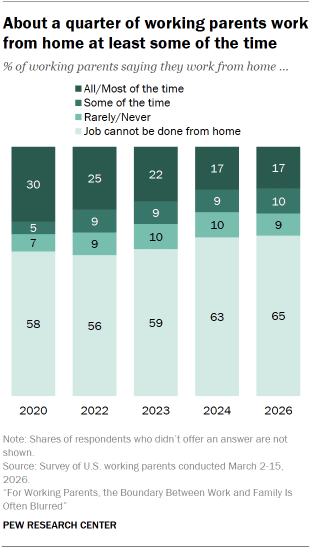
The report arrives at a time when many American workplaces are grappling with return-to-office mandates. However, a significant portion of working parents have managed to retain remote or hybrid work arrangements, offering a degree of flexibility that was less common prior to the COVID-19 pandemic. According to the Pew Research Center survey, a substantial 35% of working parents report that their jobs can, for the most part, be performed from home. This includes approximately 14% who work from home all or most of the time, 11% who work from home some of the time, and 10% who work from home rarely or never but whose jobs are still conducive to remote work.
While these figures represent a slight decrease from the peak telework experienced in 2020 and 2022, driven by pandemic-induced necessity, they remain significantly higher than pre-pandemic levels. This enduring shift in work modalities has prompted researchers to examine its impact on parents’ ability to reconcile their professional and familial obligations.
Work-Life Balance: A Persistent Challenge, Regardless of Location
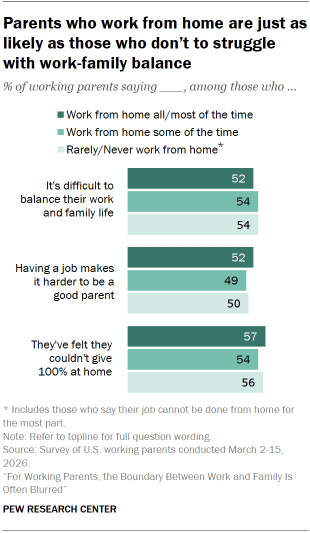
One of the most striking findings of the Pew Research Center report is that the ability to work from home does not necessarily translate into an easier path to work-life balance. The study reveals a near-equal likelihood for parents who work remotely to struggle with balancing work and family as those who do not.

When asked about experiencing difficulty in this area, similar proportions of parents across different remote work arrangements reported challenges:
- Parents who work from home all or most of the time: 62% reported difficulty.
- Parents who work from home some of the time: 63% reported difficulty.
- Parents who work from home rarely or never (including those whose jobs cannot be done from home): 61% reported difficulty.
This suggests that the fundamental demands of parenting and professional responsibilities create inherent tensions that are not solely alleviated by the physical location of work. The perceived boundary between work and family life, a common theme in discussions about remote work, appears to remain a significant area of concern for parents across the spectrum of work arrangements.
The Blurring Lines: Overlap Between Work and Parenting Tasks
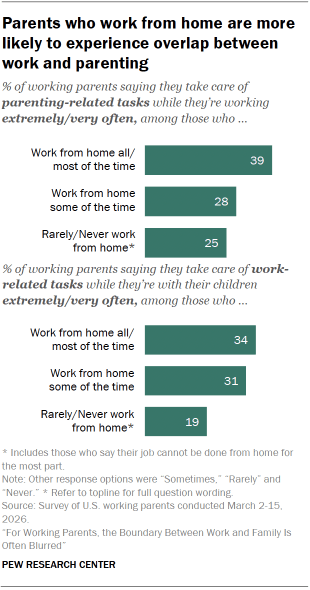
The report further indicates that parents who frequently work from home are more likely to experience an overlap between their work and parenting tasks. This manifests in several ways:
Parenting Tasks During Work Hours:
- Parents who work from home all or most of the time are the most likely to report often taking care of parenting-related tasks while working (38%).
- This is followed by parents who work from home some of the time (32%).
- Parents who work from home rarely or never are the least likely to report this overlap (26%).
This finding suggests that for those working remotely, the physical presence of children in the home can lead to a more fluid integration of childcare responsibilities into the workday. This can be a double-edged sword, offering the convenience of being present for children but potentially fragmenting work focus and increasing the feeling of being "always on."
Work Tasks During Family Time:
The pattern shifts slightly when examining the overlap of work-related tasks during time spent with children:
- Parents who work from home all or most of the time: 38% report often taking care of work tasks while with their children.
- Parents who work from home some of the time: 35% report this overlap.
- Parents who work from home rarely or never: 32% report this overlap.
While the percentages are closer, the trend still indicates that parents with more remote work flexibility are more prone to engaging with work responsibilities even when they are physically present with their children. This can contribute to a sense of diminished quality time with family and an inability to fully disconnect from professional duties.
Advantages for Remote-Working Parents: Flexibility and Family Engagement
Despite the challenges, the report does highlight distinct advantages for parents who work from home, particularly concerning their ability to participate in their children’s activities. This is an area where remote work arrangements appear to significantly ease logistical burdens and reduce the feeling of missing out on important family moments.
Attending Children’s Activities:
Parents who work from home all or most of the time report a considerably higher degree of flexibility in attending their children’s activities:
- Two-thirds (66%) of parents who work from home all or most of the time report having a lot of flexibility to attend their children’s activities during regular work hours.
- A similar proportion (64%) say they have rarely or never missed these activities due to work in the past year.
In contrast, parents who work from home less often or not at all experience more limitations:
- 55% or fewer among those who work from home less often or not at all report having a lot of flexibility to attend children’s activities.
- Similarly, 55% or fewer report rarely or never missing these activities due to work.
This disparity underscores a key benefit of remote work for parents: the ability to be more present and involved in their children’s extracurricular lives without the constraints of a traditional office setting. This can contribute to stronger family bonds and a greater sense of fulfillment for parents who value this involvement.
Background and Research Context
The Pew Research Center has a long-standing commitment to understanding the evolving dynamics of American families and the workplace. This particular report is part of an ongoing effort to explore how individuals navigate the intersection of work and family life, with a specific focus on the pressures and adaptations faced by parents. The research team is dedicated to providing data-driven insights that can inform public discourse, policy decisions, and the strategies of employers.
The methodology employed in this study is robust, drawing on a diverse sample of U.S. working parents. The primary data source is a survey conducted from March 2-15, 2026, involving 2,242 participants from the Pew Research Center’s American Trends Panel. This panel is designed to represent a broad cross-section of the U.S. population, ensuring the findings are broadly applicable to working parents nationwide. Complementary analysis of data from the U.S. Census Bureau’s Current Population Survey adds further depth by examining broader demographic trends in the labor force. The research team has made the survey questionnaire, detailed responses, and full methodology publicly available, adhering to principles of transparency and academic rigor.
Broader Implications and Future Outlook
The findings of this Pew Research Center report carry significant implications for how we understand the modern American family and the future of work. The persistent challenges in work-life balance, even with increased remote work options, suggest that structural changes within workplaces and societal expectations around parenting may be necessary.
For Employers: The data points to the continued value of flexible work arrangements. While not a panacea for all challenges, the ability to work remotely demonstrably improves parents’ capacity to engage with their children’s activities. Employers seeking to attract and retain talent, particularly among parents, may need to consider how to foster environments that acknowledge and support these dual roles. This could involve not just offering remote options but also promoting a culture that respects work-life boundaries and minimizes the pressure for employees to be constantly available.
For Policymakers: The report’s findings could inform discussions around policies related to parental leave, childcare support, and workplace flexibility. Understanding the specific pain points faced by working parents can help guide the development of legislation and programs that aim to alleviate these burdens. The persistent difficulties in balancing work and family life may necessitate a re-evaluation of existing support systems and a potential expansion of benefits that cater to the needs of working parents.
For Parents: The research offers a sense of shared experience, indicating that many parents are grappling with similar issues. It highlights the importance of open communication with employers about needs and challenges, as well as the strategic utilization of available flexibility. The findings also underscore the need for personal strategies to manage the blurring lines between work and home, such as establishing clear boundaries for work hours and dedicated family time.
The evolving nature of work, accelerated by recent global events, continues to reshape the landscape for working parents. As this Pew Research Center report demonstrates, while new flexibilities have emerged, the fundamental challenge of harmonizing professional ambitions with the profound responsibilities of raising children remains a central concern for a significant portion of the American workforce. Future research will undoubtedly continue to track these trends, offering further insights into how families and workplaces adapt to this dynamic environment.