Religious radio stations across the United States, broadcasting a diverse range of faith-based audio content, are a significant, yet often under-examined, component of the American media landscape. A comprehensive new report from the Pew Research Center, made possible by the Pew-Knight Initiative, delves into the characteristics of these stations, the nature of their programming, and crucially, the habits and motivations of their listeners. The research specifically explores how frequently political and social issues intersect with religious programming and how listeners perceive this content.
The Pew-Knight Initiative, a joint endeavor by The Pew Charitable Trusts and the John S. and James L. Knight Foundation, is dedicated to fostering new research into how Americans engage with civic information, shape their beliefs and identities, and participate in their communities. Pew Research Center itself operates as a nonpartisan, non-advocacy fact tank, committed to informing the public on critical issues, attitudes, and trends. The Knight Foundation, in turn, is a social investor focused on cultivating informed and engaged communities. This particular report builds upon the initiative’s ongoing commitment to understanding news consumption and media habits, recognizing that religious radio stations, accessible to a vast majority of Americans, play a notable role in this ecosystem.
A Deep Dive into Religious Radio Listenership
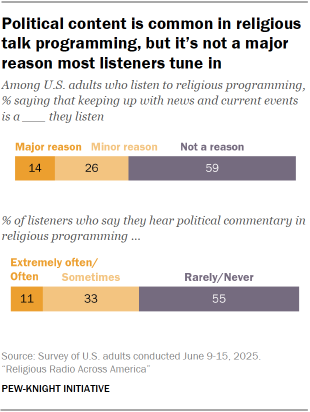
The findings reveal that approximately 45% of U.S. adults report listening to religious audio programming, which encompasses music, sermons, talk shows, and audio dramas, through either radio or online platforms. The primary drivers for tuning into this content are overwhelmingly spiritual upliftment, relaxation, and the desire for guidance in daily life. Notably, fewer listeners cite keeping up with news and current events as a significant motivation for engaging with religious broadcasts.
However, the research uncovers a more nuanced reality. Political and social issues do, in fact, surface in religious programming. Roughly four-in-ten listeners indicate that they encounter commentary on these topics at least some of the time. An in-depth analysis of one month of religious radio broadcasts from July 2025 further illustrated this point, revealing that some stations dedicate multiple hours daily to political and social issues, while others maintain a more limited engagement, primarily through brief news segments or incidental mentions. This analysis aims to explore the experiences of U.S. adults who listen to religious programming and are exposed to political discourse, and to understand their reactions to such content.
Chronology of Engagement and Analysis
The study’s methodology involved a multi-faceted approach to gather a comprehensive understanding of religious radio. Researchers utilized three primary data sources to map the geographical distribution of these stations, characterize their programming, and ascertain listener motivations. The data collection period for the survey was conducted over a specific timeframe in early 2026, building upon earlier analyses of broadcast content from the previous year. Detailed survey questions, topline responses, and the complete methodology are publicly available, allowing for transparency and further scholarly examination.
Encountering Political Content: A Varied Experience

A significant portion of individuals who tune into religious programming do not, however, find themselves immersed in political discussions through these channels. Approximately 35% of religious programming listeners report rarely encountering news and political discussions, while an additional 21% state they never do. This disparity is directly linked to the diverse types of religious programming available and the specific choices listeners make.
The Influence of Programming Type
The data clearly indicates a correlation between the type of religious programming and the presence of political commentary. For instance, among Americans who listen to religious talk shows, a substantial majority, about 56%, report hearing political or social commentary at least sometimes. This group also shows a higher inclination to use these shows for news and current events, with 59% indicating this as at least a minor reason for listening.
In contrast, when considering all religious programming listeners – not exclusively talk show audiences – the figure for tuning in to keep up with news and current events drops to 40%. For those who engage with other forms of religious programming but deliberately avoid talk shows, only 28% cite current events as a reason for listening. This suggests that while religious talk shows may serve as a conduit for political and social discourse for some, the broader landscape of religious audio content is largely oriented towards spiritual and personal enrichment.
Listener Perceptions of Political Content
The research further probes how listeners feel about encountering political and social commentary within their religious broadcasts. For those who do experience such content, their reactions are varied, though a prevailing sentiment emerges.
-
Overall Sentiment: When asked about their feelings regarding political or social commentary within religious programming they listen to, a significant portion of listeners express neutrality or a preference for other types of content. Approximately 44% of these listeners indicate that they neither like nor dislike the political content, while 34% express a dislike for it. A smaller, but significant, group, 22%, states that they like the political content they hear.
-
Political Affiliation and Opinion: Political affiliation plays a discernible role in these perceptions. Republicans are more likely than Democrats to express a strong liking for the political content encountered, with 10% of Republicans reporting they like it a lot compared to only 3% of Democrats. Conversely, Democrats are more inclined to express a strong dislike for the political content, with 20% of Democrats disliking it a lot, compared to 9% of Republicans.
This detailed breakdown highlights that while political discourse exists within religious radio, its reception is far from uniform. The majority of listeners who encounter it either remain indifferent or find it disagreeable, suggesting that the primary appeal of religious programming remains rooted in its spiritual and devotional aspects.
Broader Implications and Context
The findings from the Pew Research Center’s report on religious radio offer valuable insights into the intersection of faith, media, and civic life in contemporary America. The Pew-Knight Initiative’s ongoing support for research in this domain underscores the critical need to understand how diverse communities access and process information, particularly in an era marked by evolving media consumption patterns and increasing political polarization.
The existence of religious radio stations as a significant media channel provides a unique platform for religious messaging and, as the report indicates, can also become a venue for political and social commentary. The differing reception of this commentary across political lines suggests that the impact of such content on listeners can vary widely, potentially reinforcing existing beliefs or, for some, creating dissonance with their primary motivations for listening.
From a broader perspective, this research contributes to a more comprehensive understanding of the American media diet. It illuminates how individuals seek solace, guidance, and community through various audio channels, and how political discourse can, intentionally or unintentionally, seep into these spaces. The report serves as a reminder that the consumption of media is not monolithic, and that the motivations and reactions of audiences are complex and multifaceted.
As the media landscape continues to transform, with the rise of digital platforms and the fragmentation of traditional media, understanding the role of niche broadcasting, such as religious radio, becomes increasingly important for comprehending the full spectrum of how Americans stay informed and engage with the world around them. The Pew-Knight Initiative’s commitment to such research provides an essential foundation for informed public discourse and policy considerations related to media and civic engagement. The detailed methodology and data presented in the full report allow for further exploration by scholars, policymakers, and the public interested in the intricacies of religious media consumption in the United States.