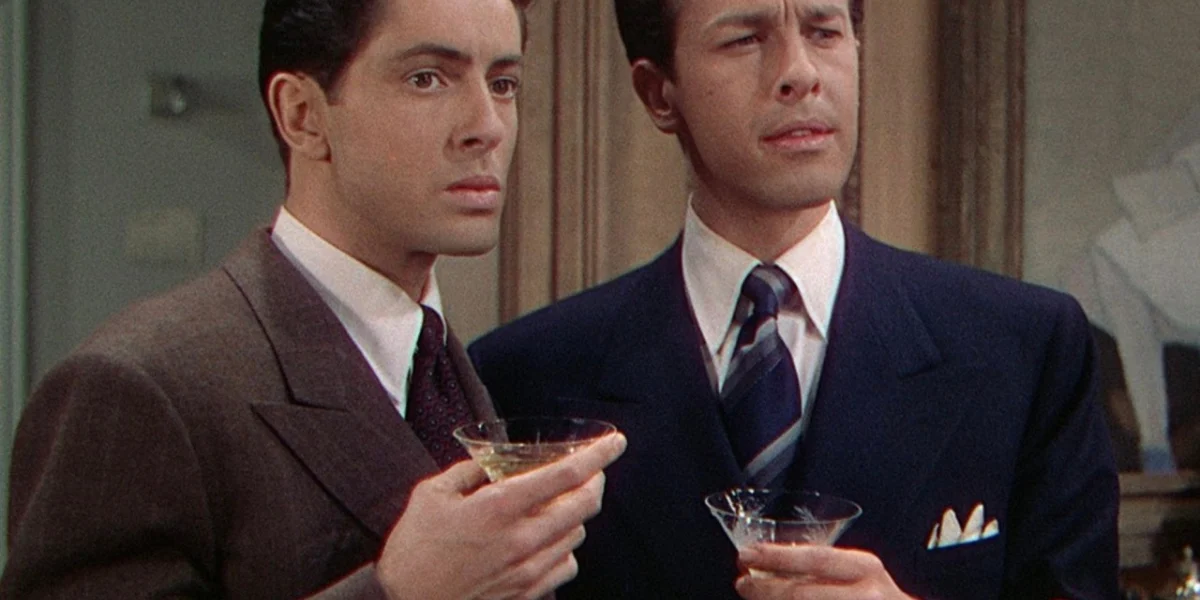
The historical analysis of Golden Age Hollywood has increasingly shifted toward identifying and reclaiming the queer narratives that existed beneath the surface of the Hays Code era. This process, often referred to within the LGBTQ+ community as looking for "family," involves a meticulous examination of background performers, subtextual scripts, and the private lives of stars who operated within a system of enforced heteronormativity. From the intricate footwork of background dancers like Bert May to the overt subtext in Alfred Hitchcock’s "Rope," the presence of queer identity in 20th-century cinema remains a significant area of cultural and academic interest.
The Cultural Significance of the "Family" Moniker
The term "family" has long served as a linguistic tool for queer individuals to identify one another in spaces where open expression was prohibited. In the context of film history, this search for kinship extends to the screen, where audiences look for cues—costuming, mannerisms, or career trajectories—that suggest a shared identity. A notable example is the career of Bert May, a prolific dancer in the Golden Age who appeared in landmark musicals such as "Guys and Dolls" and "Hello, Dolly!"
While May’s personal life remained largely out of the public eye, his frequent presence in dance solos and the specific "aesthetic markers" of his performances have made him a figure of interest for those seeking to map the queer geography of Hollywood’s background talent. This search for likeness is not merely a pursuit of trivia; it represents a fundamental human need for historical continuity. As noted in William J. Mann’s seminal work "Behind the Screen," the burden of proof for queer historical figures is often set impossibly high, yet the circumstantial evidence found in bachelorhood, long-term "roommate" arrangements, and industry gossip provides a framework for understanding a more inclusive Hollywood history.
The Hays Code and the Architecture of Censorship
To understand how queerness survived in early cinema, one must examine the constraints of the Motion Picture Production Code, commonly known as the Hays Code. Established in 1930 and rigorously enforced starting in 1934 under Will H. Hays, the code was a set of industry moral guidelines that governed the content of United States motion pictures.
The code explicitly prohibited the depiction of "sexual perversion," a term that encompassed any non-heterosexual behavior. Consequently, queer writers, directors, and actors were forced to utilize subtext to communicate identity. This era, lasting until 1968, created a unique cinematic language where intimacy was signaled through proximity, shared glances, and coded dialogue rather than explicit action.
Timeline of Cinematic Censorship and Queer Subtext
- 1927: The "Don’ts and Be Carefuls" list is issued by the Studio Relations Committee, laying the groundwork for formal censorship.
- 1930: The Motion Picture Production Code is adopted.
- 1934: The Production Code Administration (PCA) is established, requiring all films to obtain a certificate of approval before release.
- 1948: Alfred Hitchcock releases "Rope," a film that famously bypassed censors despite its central queer relationship.
- 1968: The Hays Code is officially replaced by the MPAA film rating system, allowing for more explicit depictions of diverse sexualities.
Case Study: The Subtextual Success of "Rope"
Alfred Hitchcock’s 1948 film "Rope" stands as a primary example of how queer identity was navigated during the height of the Hays Code. The film, based on the 1929 play by Patrick Hamilton, follows two young men, Brandon and Philip, who commit a murder to prove their intellectual superiority.
While the word "gay" is never uttered, the queer subtext is pervasive. The characters share a one-bedroom apartment, maintain a domestic life together, and exhibit a level of physical intimacy that suggests a romantic partnership. The production of "Rope" was itself an intersection of queer talent: lead actors John Dall and Farley Granger were gay and bisexual, respectively, and the screenplay was co-written by Arthur Laurents, who was in a relationship with Granger at the time.
The film’s ability to pass through the Production Code Administration is often attributed to the "plausible deniability" of its script. Censors were frequently more concerned with explicit language and overt physical contact than with the psychological implications of a domestic partnership. This "hiding in plain sight" allowed "Rope" to present a multidimensional, albeit villainous, queer couple to a mid-century audience.
The Asexual Appeal of the "Closed Door" Era
Recent analytical perspectives have highlighted how the restrictions of the Hays Code provided an unintended form of representation for the asexual (ace) community. Because the code mandated a "closed door" policy regarding sexual activity, the focus of romantic films shifted toward emotional intimacy, witty banter, and romantic tension.
For asexual audiences, the cinema of the 1940s and 50s often feels more relatable than contemporary media, which frequently relies on explicit sexual scenes to validate romantic connections. The "Hitchcockian" tension or the "screwball" chemistry found in the films of Cary Grant and Katharine Hepburn emphasizes a form of intimacy—such as the "Philadelphia Story" breath-away proximity—that prioritizes the emotional and aesthetic over the physical. This omission of sex, mandated by censors, created a space where romantic stories could be told through soft kisses on the shoulder, fingers tangling in hair, and the intensity of a shared gaze, providing a blueprint for intimacy that remains highly valued by the ace and aro-ace communities.
Reclaiming the Stars: Confirmed and Suspected Identities
The effort to document queer Hollywood involves a spectrum of evidence, ranging from public coming-out stories in later years to well-documented historical records. The list of "confirmed" or widely accepted queer figures from the Golden Age has grown as historians gain access to private letters and estate records.
Key figures include:
- Farley Granger and John Dall: The stars of "Rope" whose identities were well-known within industry circles.
- Marlene Dietrich and Greta Garbo: Icons who challenged gender norms and had documented relationships with women.
- Cary Grant and Randolph Scott: Whose long-term cohabitation in "Bachelor Hall" has been a subject of historical analysis for decades.
- Supporting Players: Actors like Edward Everett Horton, Franklin Pangborn, and Marjorie Main, who often played coded "typecast" roles that signaled queerness to savvy audiences.
The search for these identities is described by cultural critics as an "urgent need for likeness." It serves as a reminder that queer individuals have always been part of the cultural fabric, achieving success and glamour despite systemic efforts to erase their existence.
Broader Impact and Modern Reimagining
The enduring fascination with queer Hollywood history has transitioned from academic study to creative inspiration. This is evidenced by the upcoming release of new literary works that reimagine the Golden Age through a "queernormative" lens. On June 25, authors such as S.O. Callahan are set to release titles like "When I’m in Your Arms" and "Together on Parade," which blend historical detail with queer romance.
These works represent a growing trend in historical fiction: the desire to give past generations the "happily ever after" that was denied to them by the social and legal constraints of their time. By weaving film lore with queer narratives, these authors provide a form of restorative justice for the "family" members of the past.
Implications for Future Historical Analysis
The study of queer subtext in film is moving toward a more formalized methodology. Historians are no longer just looking for "proof" in the traditional sense but are analyzing the "semiotics of queerness"—how certain lighting, camera angles, and costume choices were used as a secret shorthand.
The success of figures like Tyrone Power, Burt Lancaster, and Marilyn Monroe—whose lives and words are often re-examined for bisexual or aro-ace identities—demonstrates that the "Golden Age" was far more diverse than the marketing of the era suggested. Recognizing this diversity does not diminish the art of the period; rather, it enriches it, revealing a complex layer of human experience that survived under the most stringent censorship.
In conclusion, the quest to identify "family" in the archives of Hollywood is an essential component of modern film scholarship. It acknowledges that while the Hays Code could censor the screen, it could not eliminate the presence of queer creators and performers. Their legacy is one of defiance, hidden in the shadows of a dance solo or the subtext of a murder mystery, waiting to be recognized by future generations.