Pollsters often emphasize that surveys offer a snapshot, not a prophecy, capturing public sentiment at a specific moment. However, the Pew Research Center’s global research team has pioneered methods to observe how these sentiments can shift dynamically, even in real-time, when major world events unfold during the extended fieldwork of their annual surveys. This year, an annual snapshot of global views became a compelling flipbook, revealing how a significant geopolitical event – the joint U.S.-Israeli airstrikes against Iran on February 28, 2026 – appeared to influence public perceptions of the United States and national economies across dozens of countries.
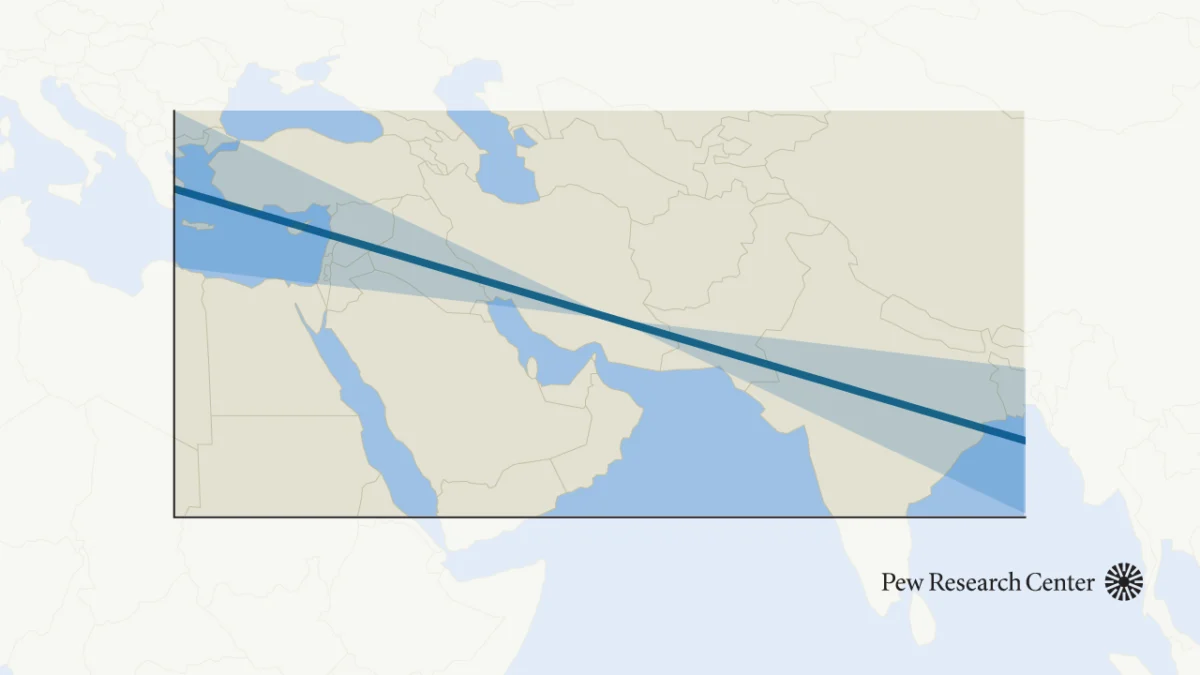
The very nature of comprehensive international polling necessitates lengthy data collection periods. In most participating nations, fieldwork spans several weeks, involving either phone interviews or in-person interactions. This extended timeframe, while crucial for ensuring national representativeness, inadvertently creates an opportunity to witness public opinion morphing in response to unfolding global developments. As the Pew Research Center aptly describes, it’s akin to a camera capturing motion while its shutter is open – an image that encompasses both the subject and its movement. This year’s survey, which commenced fieldwork shortly before the airstrikes, provided a unique lens through which to observe this phenomenon.
The airstrikes, launched jointly by the United States and Israel against targets within Iran, marked a significant escalation in regional tensions. While the specific objectives and immediate outcomes of these strikes were subject to rapid developments and varying official accounts, their occurrence on the cusp of extensive international polling immediately presented researchers with a critical question: how would this aggressive action reverberate through global public opinion? Were those individuals surveyed in the weeks and months following the strikes more likely to hold different views of the U.S. and its role in international affairs compared to those who participated earlier in the fieldwork?
The Challenge of Real-Time Sentiment Analysis
Observing opinion shifts during an active fieldwork period is far from a simple data extraction process. The sample size in each country, typically around 1,000 adults, further subdivides when considering the number of respondents interviewed within a single week. A straightforward comparison of weekly averages, for instance, comparing sentiment in the first week of fieldwork against the second, would yield margins of error too substantial to reliably detect genuine attitudinal changes. Such uncertainty could easily mask subtle yet significant shifts in public perception.
Furthermore, the sampling methodology itself presents inherent challenges to granular temporal analysis. The demographic composition of respondents interviewed in successive weeks can exhibit minor variations. This is attributable to a multitude of factors, including the geographical areas targeted by face-to-face interviewers on different days, the varying accessibility of individuals via telephone in initial contact attempts, and other logistical complexities inherent in large-scale field operations. These demographic divergences, even if slight, could inadvertently influence reported opinions, making direct weekly comparisons potentially misleading.

To overcome these methodological hurdles and to rigorously analyze changes occurring within the fieldwork window, the Pew Research Center employed a sophisticated statistical technique: regression analysis. This approach allows researchers to examine the entire sample collectively, modeling the relationship between the date of an interview and the probability of a respondent expressing a particular viewpoint. By treating the interview date as a continuous variable, the analysis can identify trends and shifts across the entire survey period, mitigating the statistical noise that would plague simpler comparative methods. This method effectively transforms the data from discrete snapshots into a flowing narrative, akin to a meticulously crafted animation rather than a series of still frames.
Observing Shifting Views of the United States
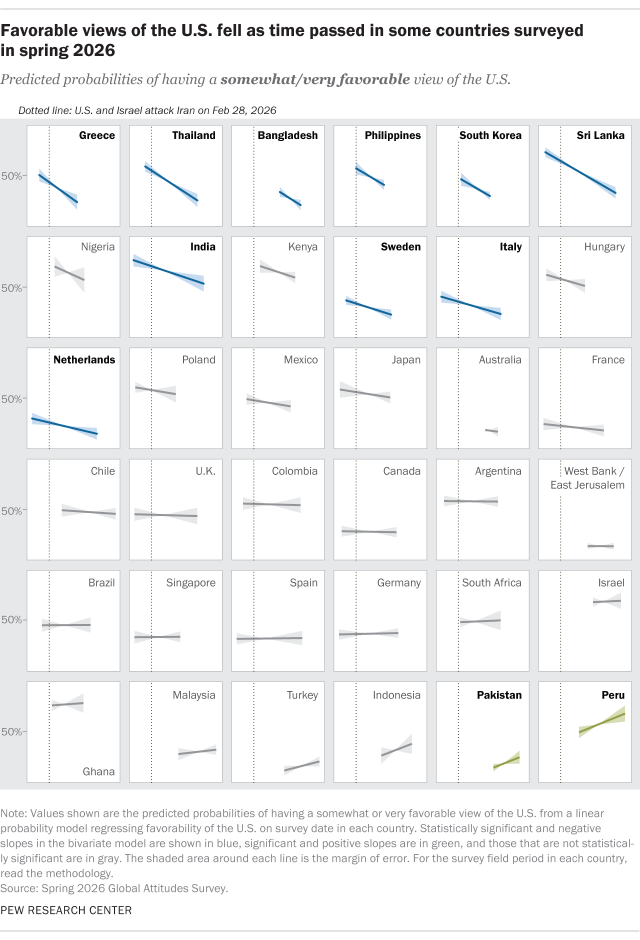
The regression analysis revealed a discernible trend in several countries: a gradual decline in favorable views of the United States as the survey period progressed following the airstrikes on Iran. While the patterns were not uniform across all surveyed nations, the overarching tendency suggested a negative correlation between the passage of time post-strike and positive perceptions of American foreign policy and influence.
In Greece and Thailand, for instance, favorability ratings for the U.S. experienced a notable and statistically significant decrease throughout the fieldwork. Conversely, in countries like Spain and Germany, where pre-existing negative sentiment towards the U.S. was already entrenched from the previous year’s surveys, the impact of the airstrikes on overall favorability ratings appeared to be less pronounced during the observed fieldwork period. This suggests that the airstrikes may have had a more significant effect in countries where perceptions of the U.S. were more fluid or less ideologically fixed.
Crucially, the regression models were further refined to control for potential confounding variables. Researchers incorporated demographic factors such as age, gender, and education level, along with, where available, political ideology. These variables are known to be significant determinants of attitudes towards the U.S. in many global contexts. Even after accounting for these demographic and ideological influences, the finding that favorability toward the U.S. declined as the survey progressed persisted in a significant number of countries.
The data indicated statistically significant decreases in favorability, even after the implementation of these controls, in countries including Greece, India, Italy, Kenya, South Korea, Sri Lanka, Sweden, and Thailand. In some nations where no significant temporal shift was detected, the fieldwork commenced several weeks after the airstrikes. This temporal lag meant that any initial shockwave of opinion might have already subsided, or views may have stabilized before data collection began. This was particularly true for a majority of Muslim-majority countries surveyed, where fieldwork initiation was delayed until after Ramadan. In these regions, prior to the airstrikes, views of the U.S. were often already characterized by a degree of skepticism or negativity. An interesting exception was Pakistan, where favorability towards the U.S. saw a slight increase during the survey period. This anomaly coincided with Pakistan hosting the initial rounds of peace talks between the U.S. and Iran in Islamabad, a development that could have temporarily boosted perceptions of the U.S. as a facilitator of diplomacy.
Beyond general favorability, the analysis also illuminated shifts in more specific perceptions of U.S. global engagement. The results indicated that respondents interviewed later in the survey period were less likely to assert that the U.S. contributes positively to global peace and stability. Furthermore, there was a noted decrease in the perception of the U.S. as a reliable international partner. While the impact was not uniform, there was also a discernible, albeit slight, decline in confidence regarding U.S. President Donald Trump’s capacity to manage world affairs effectively. This suggests that the airstrikes may have fostered a sense of unease or distrust regarding the U.S.’s approach to international security and diplomacy.
Economic Sentiment and Geopolitical Events
The impact of the geopolitical events was not confined solely to perceptions of the United States. The analysis also revealed that in several countries, public sentiment regarding their own national economies deteriorated over the course of the survey period, often mirroring the trends observed in views of the U.S. This correlation suggests a potential interplay between global events and domestic economic outlooks.
South Korea, for example, serves as a compelling case study. The nation’s economy is heavily reliant on energy imports transiting through the Strait of Hormuz. The increased geopolitical tensions in the region, exacerbated by the airstrikes, contributed to a sharp rise in energy prices during the survey’s fieldwork. Consequently, South Koreans’ assessments of their national economy showed a significant decline throughout the period, a trend that ran parallel to the decrease in their favorability towards the U.S.
Similar patterns of worsening economic sentiment were observed in Canada, Chile, the Netherlands, Thailand, and other nations. The bivariate regression analysis, as well as the subsequent regressions controlling for demographic factors, confirmed these findings. In approximately one-third of the surveyed countries, a statistically significant trend of declining positive views towards the national economy persisted even after accounting for variables such as age, gender, education, and political ideology. This suggests that global instability, whether perceived or actual, can have a tangible and widespread impact on domestic economic confidence.
Broader Implications and Conclusion
The findings from this dynamic survey analysis underscore a fundamental truth: major global events do not occur in a vacuum. They resonate across populations, influencing how individuals perceive not only the actors directly involved but also their own national circumstances and the broader international order. The ability of the Pew Research Center’s methodology to capture these shifts in near real-time offers invaluable insights into the complex and interconnected nature of global public opinion.
The extended fieldwork periods, initially conceived to ensure robust and representative data, have inadvertently become a powerful tool for understanding how populations react to unforeseen crises and significant geopolitical developments. By employing advanced statistical techniques, researchers can move beyond static snapshots to observe the ebb and flow of public sentiment, providing a more nuanced and dynamic understanding of how world events shape perceptions.
In conclusion, this year’s global survey has provided more than just a static picture of public opinion; it has offered a dynamic narrative, a flipbook of evolving attitudes. The joint U.S.-Israeli airstrikes against Iran served as a critical catalyst, revealing how such events can subtly yet significantly alter public perceptions of global powers and impact national economic outlooks. This methodological innovation by the Pew Research Center not only advances the science of public opinion research but also offers a vital window into the collective consciousness of a globally interconnected world, demonstrating that the "snapshot" of public opinion can indeed capture the "motion" of a changing world. The implications for international relations, foreign policy, and economic forecasting are profound, highlighting the importance of continuous, nuanced analysis in an era of rapid global change.