More than 100 nations have implemented policy changes to mitigate the economic fallout from the ongoing conflict in the Middle East, according to a comprehensive report by the International Energy Agency (IEA). As of the latest update on June 12, 2026, a significant 113 countries, alongside the European Commission, have enacted at least one policy measure aimed at addressing the persistent rise in energy costs and other repercussions stemming from the war. This global response underscores the widespread economic vulnerability triggered by the geopolitical instability in the region.
Global Policy Response to Energy Crisis
The conflict, which began with escalating tensions in the Middle East, has significantly disrupted global energy markets, leading to price volatility and supply chain concerns. In response, governments worldwide have adopted a multifaceted approach, encompassing measures designed to support consumers, encourage energy conservation, and implement structural changes to enhance energy security. The IEA’s "2026 Energy Crisis Policy Response Tracker" meticulously documents these interventions, providing a granular view of the policy landscape.
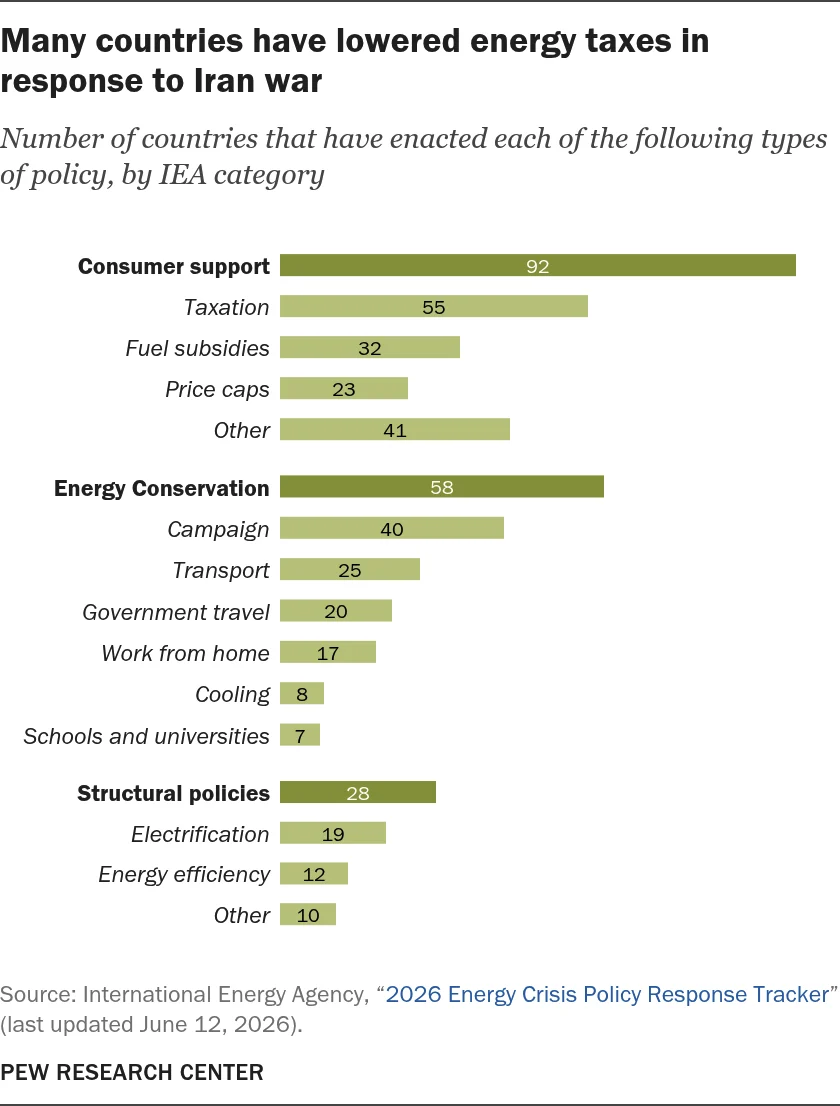
The data reveals that consumer support has been a primary focus for many nations, with 92 countries implementing at least one form of direct assistance. This category includes a range of measures such as tax reductions, fuel subsidies, and price caps. Taxation adjustments, specifically lowering energy taxes, have been a prevalent strategy, adopted by 55 countries. This approach directly aims to reduce the burden on households and businesses by making fuel and electricity more affordable. Furthermore, 32 countries have resorted to fuel subsidies, a measure that directly lowers the cost of fuel at the pump, while 23 nations have implemented price caps to limit the maximum price consumers can be charged for energy.
Beyond direct consumer support, a significant number of countries, 58 in total, have prioritized energy conservation efforts. These initiatives are designed to reduce overall energy demand, thereby lessening reliance on volatile global markets and contributing to environmental sustainability. Conservation campaigns have been launched in 40 countries, urging citizens and industries to reduce their energy consumption. Specific sectors have also been targeted: 25 countries have introduced measures related to transport, such as promoting public transportation or optimizing fuel efficiency; 20 countries have restricted government travel; and 17 countries have encouraged work-from-home policies to reduce commuting-related energy use. Other conservation measures include adjustments to cooling standards (8 countries) and energy usage in educational institutions (7 countries).
Structural policies aimed at long-term energy resilience have been adopted by 28 countries. These policies focus on fundamental shifts in energy infrastructure and consumption patterns. Electrification, promoting the transition to electric vehicles and other electric-powered technologies, has been pursued by 19 countries. Similarly, 12 countries have focused on improving energy efficiency through stricter building codes, appliance standards, and industrial process optimizations.
Asian and European Leadership in Policy Implementation
The Asia-Pacific region has emerged as a significant hub for energy policy responses, with 29 countries enacting a total of 124 policy changes. This high level of activity reflects the region’s substantial energy demand and its vulnerability to global price fluctuations. For instance, Bangladesh has implemented four distinct policy changes: limiting air conditioning temperatures in public buildings, closing universities to conserve energy, urging individuals and businesses to save energy, and capping fuel purchases for vehicles while simultaneously promoting public transportation.

Laos stands out as the country with the most extensive policy interventions, having enacted nine different types of measures to address the energy crisis. Other Asian nations, including Cambodia, India, Indonesia, Laos, Malaysia, Pakistan, the Philippines, Singapore, South Korea, Sri Lanka, Thailand, and Vietnam, have each implemented at least six types of energy-focused policy changes. This concentrated effort in Asia highlights a proactive and comprehensive strategy to navigate the economic challenges posed by the conflict.
In Europe, 30 countries, in addition to the European Commission, have collectively introduced 86 energy policy changes. Sweden, for example, has implemented a four-pronged approach: halving the price of public transport passes to encourage modal shifts, extending reductions on gas taxes, accelerating the electrification of public vehicles such as police cars, and providing critical crisis support for the farming and fishing industries, along with assistance for electricity bill payments. The European Commission itself has enacted three specific policies to bolster the bloc’s energy security and affordability.
United States’ Position Amidst Global Action
In contrast to the widespread policy implementation in Asia and Europe, the United States has not enacted nationwide energy policy changes directly in response to the Iran war. However, there have been discussions and limited actions at the state level. In May 2026, President Donald Trump reportedly considered suspending the federal gas tax, a measure that could offer some relief to consumers. Several states, including Georgia, Indiana, Kentucky, and Utah, have implemented their own forms of relief by reducing state gas taxes. This decentralized approach in the U.S. contrasts with the coordinated and extensive policy responses seen in other major global economic blocs.
Background and Chronology of the Crisis
The current energy market challenges are largely a consequence of escalating geopolitical tensions and subsequent military actions in the Middle East, particularly involving Iran. While the exact timeline of policy responses varies by country, the intensification of the conflict in late 2025 and early 2026 is widely cited as the primary catalyst for the surge in global energy prices and the subsequent policy interventions.
- Late 2025 – Early 2026: Growing geopolitical tensions in the Middle East, including increased military posturing and localized conflicts, begin to impact oil and gas supply routes and investor confidence.
- Early 2026: Escalation of direct military actions in the region leads to significant disruptions in oil production and transportation. Global oil prices experience sharp increases, exceeding previous benchmarks. Natural gas prices also become highly volatile.
- Spring 2026: Governments worldwide begin to assess the economic impact of soaring energy costs on their populations and industries. Reports from international bodies like the IEA highlight the growing crisis.
- April – June 2026: A wave of policy announcements and implementations begins across numerous countries. The IEA’s "2026 Energy Crisis Policy Response Tracker" is initiated to monitor these global efforts, with its first major update released on June 12, 2026, detailing the widespread policy adoptions.
- Ongoing: The conflict continues to influence global energy markets, prompting ongoing monitoring and potential adjustments to national energy policies.
Analysis of Implications and Future Outlook
The broad spectrum of policy responses indicates a global recognition of the interconnectedness of energy security, economic stability, and geopolitical events. The emphasis on consumer support, particularly through tax reductions and subsidies, provides immediate relief but may strain national budgets and could potentially disincentivize long-term conservation efforts if not carefully managed.
The significant push towards energy conservation, encompassing measures from public transport promotion to energy efficiency standards, signals a growing understanding of the need for demand-side management. Countries that successfully integrate these conservation strategies into their long-term energy frameworks are likely to be more resilient to future market shocks.

Structural policies, such as electrification and energy efficiency investments, represent a crucial long-term strategy. While these may have higher upfront costs, they promise greater energy independence, reduced reliance on fossil fuels, and significant environmental benefits. The varied pace of adoption of these structural changes across different regions suggests an uneven path towards a more sustainable and secure energy future.
The contrast between the proactive and extensive policy interventions in Asia and Europe and the more limited, state-level responses in the United States raises questions about differing national priorities and economic vulnerabilities. The U.S. economy, while impacted by energy prices, may have a different structure of energy dependence and consumer vulnerability compared to many Asian nations that are heavily reliant on energy imports.
As the situation in the Middle East remains fluid, global energy markets will continue to be influenced by geopolitical developments. The effectiveness of the implemented policies will be subject to ongoing evaluation. Nations that have diversified their energy sources, invested in domestic production (where applicable), and fostered robust energy efficiency programs are better positioned to weather future volatility. The long-term implications of these policy choices will shape not only national economies but also the global transition towards a more sustainable and secure energy landscape.
The IEA’s continued monitoring of these policy responses will be critical in understanding the evolving dynamics of the global energy market and informing future strategies for economic resilience in the face of geopolitical challenges. The data collected provides a valuable resource for policymakers, researchers, and the public alike, offering insights into the complex interplay between international conflict, energy markets, and national governance.