
As the United Kingdom edges closer to the formal commencement of Section 1 of the Equality Act 2010, a fierce ideological battle is unfolding across the British political landscape. Often referred to as the Socio-Economic Duty (SED), this dormant legal provision is designed to place the reduction of socio-economic disadvantage at the heart of strategic public sector decision-making. Yet, more than a decade after it was passed into law, the mechanism remains a lightning rod for controversy. A comprehensive critical discourse analysis conducted jointly by researchers at the Equality Trust and the University of York Law School reveals a stark divide in how the duty is perceived, contested, and understood across parliament, the news media, academia, public sector practitioners, civil society organizations, and the communities it aims to protect.
Background and Legislative History
The legislative genesis of the Socio-Economic Duty dates back to the Labour government of 2010, championed by then-Minister for Women and Equalities Harriet Harman as part of the landmark Equality Act. Section 1 of the Act mandates that specified public authorities—such as local councils and government departments—must, when making strategic decisions, "have due regard to the desirability of exercising them in a way that is designed to reduce the inequalities of outcome which result from socio-economic disadvantage."
While the broader provisions of the Equality Act 2010 were swiftly brought into force, Section 1 was left without a commencement date. Following the 2010 general election, the incoming Conservative-Liberal Democrat coalition government announced that the duty would be scrapped, arguing it represented unnecessary bureaucratic red tape and state overreach. Although the clause was never formally repealed through a dedicated democratic repeal bill, it remained dormant on the statute books in Westminster for over a decade.
Despite its paralysis at the UK central government level, the devolved administrations demonstrated that the duty could be operationalized. Scotland activated Section 1 in 2018, followed by Wales in 2021. Meanwhile, a growing number of local authorities in England have voluntarily adopted the principles of the duty as a matter of good governance. The political momentum shifted once again following the election of the Labour government in 2024, which included a manifesto commitment to revive the clause. With statutory guidance currently being drafted and public consultations underway, the debate over the scope, intent, and practical implications of the duty has intensified significantly.
Methodology of the Discourse Analysis
To understand the friction surrounding the SED, researchers utilized Interpretive Policy Analysis (IPA) combined with Norman Fairclough’s three-dimensional model of Critical Discourse Analysis (CDA). This approach examines textual samples from parliamentary records, news media articles, academic literature, and stakeholder submissions to evaluate how language reproduces or challenges unequal power relations and reveals underlying class interests. The findings are categorized across six distinct sites of discourse, highlighting a striking disconnect between political rhetoric and the everyday realities of public administration.
Parliamentary Debate: From Legislative Hostility to Re-emergence
A comprehensive review of Hansard records spanning from 2009 to 2026 reveals that parliamentary engagement with the SED peaked during its initial passage and subsequent shelving by the coalition government. Activity remained subdued for years until the return of a Labour administration in 2024.
During parliamentary debates, opponents of the duty—concentrated largely on the Conservative front bench—characterized the provision using polarized language. Critics argued the duty was simultaneously too vague to be legally meaningful and excessively onerous, labeling it "left-wing tosh," social engineering, and an assault on the middle classes. Opponents frequently framed disadvantage through an individualistic economic lens, attributing poor outcomes to personal or familial failures rather than structural inequalities. Conversely, supporters from across multiple political parties, including the Liberal Democrats, Greens, and the SNP, as well as crossbench peers, have consistently championed the duty as an essential tool to address soaring child poverty, regional health disparities, and the widening wealth gap. High-profile reviews, including Baroness Doreen Lawrence’s assessment of Covid-19 disparities and findings from the UK Covid-19 Inquiry, have similarly underscored the necessity of the SED in tackling intersecting structural inequalities.
News Media Coverage and Ideological Framing
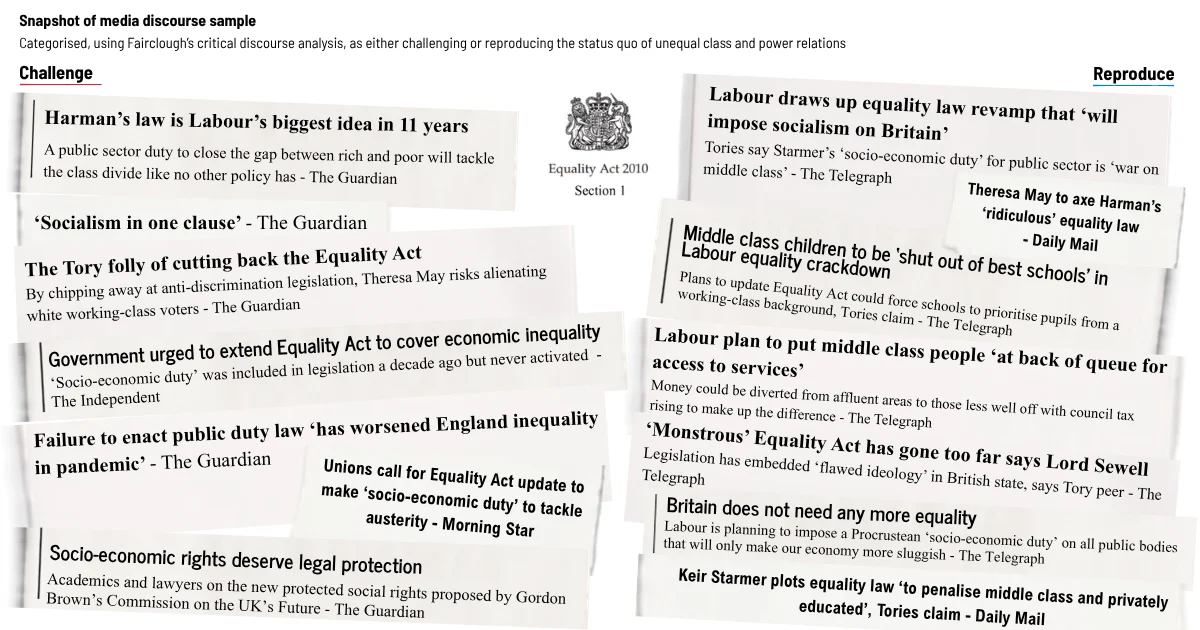
The framing of the SED within the British press exhibits a distinct partisan divide, with right-wing outlets dominating the narrative. An analysis of 27 national news articles shows that negative portrayals account for more than 60% of the sample, concentrated heavily in publications such as The Telegraph, the Daily Mail, and the Express.
Right-wing media coverage frequently deploys emotive terminology, framing the duty as "class warfare" and a "war on the middle class." Commentators and opposition politicians have asserted that the implementation of Section 1 will lead to the systematic diversion of public resources away from affluent communities, penalize privately educated or middle-class families, and plunge the public sector into ideological paralysis.
In contrast, center- and left-leaning publications, such as The Guardian and The Independent, have highlighted the empirical reality of UK inequality, citing data showing that the wealth gap in Britain exceeds that of almost all other advanced economies. Notably, polling data highlighted in academic and media reviews—such as an Opinium survey commissioned during previous legislative debates—indicated that 57% of voters supported activating the clause, with only 6% opposed, suggesting a wide divergence between tabloid rhetoric and public sentiment.
Academic Perspectives and Scholarly Consensus
While legal and sociological scholarship concerning the socio-economic duty is relatively sparse compared to other equality strands, prominent legal scholars have analyzed its potential and limitations. Leading equality law experts, including Professor Sandra Fredman, have argued that the duty provides a vital mechanism to bridge the gap between formal legal equality and substantive socio-economic justice. Scholars have suggested that the proactive nature of the duty could have mitigated the harshest impacts of post-2010 austerity policies if it had been enacted nationwide.
Furthermore, academic analyses drawing on comparative lessons from Scotland and Wales emphasize that successful implementation relies heavily on adequate institutional resourcing, robust data collection, comprehensive staff training, and the integration of socio-economic factors into standard Equality Impact Assessments (EIAs). However, researchers note that academic output has largely remained confined to specialized legal and policy journals, failing to penetrate mainstream public discourse.
Practitioners and Civil Society Support
Public sector workers and local government officers tasked with implementing policy operate with a pragmatic perspective that contrasts sharply with Westminster rhetoric. Feedback gathered from civil servants in England reveals broad institutional support tempered by concerns regarding administrative capacity. Many practitioners view the duty as long overdue, noting that socio-economic status deeply intersects with and compounds other protected characteristics. However, workers expressed anxiety that without adequate central funding and clear, standardized guidance, the duty risks devolving into a burdensome "tick-box exercise."
This administrative caution stands in stark contrast to grassroots and local government action. Research by organizations such as Resolve Poverty indicates that approximately 10% of local authorities in England have already formally adopted the socio-economic duty, while over 50% operate within its spirit. Practical applications—such as the Merseyside Fire & Rescue Service removing driving licence requirements to broaden recruitment pools—demonstrate tangible successes in dismantling structural barriers.
Civil society organizations have formed robust coalitions, such as the 1 for Equality campaign co-chaired by Just Fair and the Equality Trust, alongside the Trades Union Congress (TUC) and the Institute for Health Equity. These groups have consistently lobbied for statutory implementation, pointing to international pressure from United Nations bodies criticizing the UK’s delayed enforcement of economic and social rights.
The Omission of Lived Experience
A critical finding of the research is the near-total exclusion of the intended beneficiaries—individuals with direct, lived experience of socio-economic disadvantage—from mainstream parliamentary and media debates. While grassroots networks, community peer researchers, and place-based collectives (such as the APLE Collective and Thrive Teesside) actively work to incorporate marginalized voices into policy dialogues, these perspectives remain largely marginalized in national coverage. Policy analysts argue that bridging this gap is essential to ensuring that the statutory guidance currently being formulated delivers genuine, measurable improvements to life outcomes across the United Kingdom.




