A new comprehensive report released by the Pew Research Center sheds light on the deeply polarized sentiments regarding the possibility of peaceful coexistence between Israel and an independent Palestinian state. Drawing on nationally representative surveys conducted in the spring of 2026, the study provides a granular view of how citizens in Israel, the West Bank, and East Jerusalem perceive the future of the region in the wake of prolonged conflict. The findings highlight not only a divide between the two populations but also significant internal variance regarding the feasibility of a two-state solution, diplomatic pathways, and the fundamental nature of the ongoing territorial struggle.
Survey Methodology and Scope
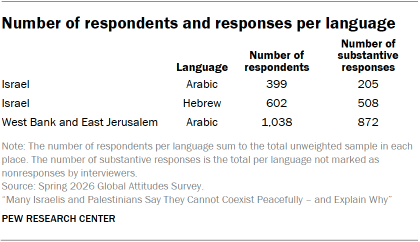
The data for this report were gathered through face-to-face interviews directed by Gallup. Between April 5 and May 6, 2026, researchers surveyed 1,001 Israeli adults, while 1,038 Palestinian adults in the West Bank and East Jerusalem were surveyed between March 30 and April 28, 2026. To ensure accuracy and inclusivity, all responses were weighted to reflect the demographics of the adult populations in these territories.
The survey centered on a pivotal question: "Do you think a way can be found for Israel and an independent Palestinian state to coexist peacefully with each other, or not?" Participants who provided a substantive response were invited to explain their reasoning in their own words. More than 1,500 of these open-ended responses, originally captured in Hebrew and Arabic, were professionally translated by cApStAn to facilitate a rigorous thematic analysis. Researchers employed an open-coding method to categorize these perspectives, ensuring that the qualitative data captured the complex emotional and political landscape of the region.
Contextualizing the Conflict
The survey takes place against the backdrop of significant historical and recent trauma that has reshaped the geopolitical landscape. The events of October 7, 2023, and the subsequent war in Gaza serve as primary reference points for many respondents. The collective memory of these events has profoundly influenced public discourse, moving discussions of "peaceful coexistence" from theoretical diplomatic frameworks to immediate questions of security, existential threat, and historical grievances.

Historically, the peace process has faced numerous setbacks, from the failure of the Oslo Accords to the recurring cycles of violence that have defined the early 21st century. The 2026 survey results reflect a public that is, in many ways, weary of traditional diplomacy and deeply skeptical of political leadership on both sides. The mention of specific leaders and the lack of political will emerge as recurring themes in the qualitative responses, suggesting that for many, the hurdle to peace is not just a lack of a plan, but a perceived absence of credible partners.
Categorizing Public Sentiment: A Thematic Analysis
The research team developed a comprehensive codebook to classify the responses, dividing them into those who believe coexistence is possible and those who do not.
Arguments for Potential Coexistence
For those who answered affirmatively, the arguments generally fell into four distinct categories:
- Interest in Peace: Many respondents emphasized a fundamental human desire for stability, the economic benefits of peace, and the potential for positive interpersonal relationships. Some cited past eras of coexistence as proof that the two peoples are capable of living alongside one another.
- Inevitability: A pragmatic segment of the population argued that because neither group is going to disappear, the only logical path is to find a way to minimize harm. This viewpoint often includes the belief that all wars eventually conclude in negotiation.
- Diplomatic Solutions: These responses focused on the necessity of a formal, internationally recognized border and the rejection of a single-state reality.
- Conditional Peace: A large portion of the "Yes" group provided conditional answers, stipulating that peace is only possible if there is a fundamental change in leadership, a new approach to education for the younger generation, or significant international intervention.
Arguments Against Potential Coexistence
The "No" responses were equally robust and highlighted the profound psychological and physical barriers to peace:
- Territorial Claims: A central theme among dissenters is the belief that the land cannot or should not be divided. This is often framed through the lens of historical or religious right of ownership.
- Material Conditions and Occupation: For Palestinian respondents, the daily realities of life—such as checkpoints, house demolitions, and the presence of settlers in the West Bank—were frequently cited as insurmountable obstacles to peace.
- Existential Threats and Violence: The trauma of the October 7 attacks and the ongoing war in Gaza have hardened public opinion in Israel. Many respondents expressed that a Palestinian state would inherently pose a security threat, creating a cycle of distrust.
- Fundamental Incompatibility: Some respondents pointed to irreconcilable religious, cultural, and ideological differences, arguing that the two national identities are fundamentally at odds.
Item Nonresponse and Demographic Nuance
The survey data also reveals a notable variance in "item nonresponse"—the tendency for participants to say they "don’t know" or to decline to answer entirely. In Israel, 20% of respondents did not provide an answer to the core question of coexistence. A demographic breakdown shows that 14% of Jewish respondents declined to answer, compared to 46% of Arab respondents. This disparity suggests that for certain groups, the political climate may discourage open participation in surveys regarding the state of the nation. In the West Bank and East Jerusalem, the nonresponse rate was 10%, indicating a slightly higher willingness to engage with the question, even if the outlook remains pessimistic.
Implications and Expert Observations
The findings from this study carry significant implications for international stakeholders and policymakers. The prevalence of the "distrust" and "violence" categories suggests that any future peace initiative will face a massive "trust deficit" that cannot be resolved through top-down diplomacy alone.
Analysts note that the reliance on qualitative, open-ended responses provides a "human face" to the statistics. By allowing citizens to describe their reasoning, the Pew report underscores that peace is not merely a bureaucratic agreement but a social consensus. The fact that many respondents conditioned their belief in peace on "leadership changes" or "international intervention" highlights a widespread feeling of powerlessness among the general public.
The Path Forward
As the international community continues to monitor the region, the 2026 Pew report serves as a critical baseline for understanding the psychological toll of the conflict. It suggests that while the desire for peace persists, it is currently heavily constrained by the realities of security, historical memory, and deep-seated structural issues.
The methodology of using direct quotes ensures that the report captures the raw sentiment of the populations involved, acknowledging that the survey respondents are the ultimate stakeholders in any peace process. By moving beyond numerical estimates, the researchers have provided a detailed map of the obstacles that any future diplomatic effort must address. Whether or not these views will shift in the coming years remains contingent upon the evolving security situation and the potential for a renewed, credible political dialogue that can address the foundational concerns identified by both Israelis and Palestinians.
In conclusion, the report does not offer a solution to the conflict, but it provides the most essential data point for any potential solution: a clear-eyed look at the hearts and minds of the people living in the region. Without addressing the themes of distrust, the reality of occupation, and the existential fears that define the daily lives of these citizens, the prospect of peaceful coexistence remains a distant, albeit persistent, hope. As the international community seeks to facilitate a path forward, these findings will likely serve as a foundational document for understanding the scale of the challenge that lies ahead.