The American political landscape in 2026 is defined not only by the deep chasm between the two major parties but also by the complex and often fractured ideological identities of the voters who comprise them. A recent comprehensive survey conducted by the Pew Research Center, encompassing 5,103 U.S. adults between April 20 and April 26, 2026, reveals that Americans increasingly see themselves and their respective parties as existing in a state of misalignment. While polarization between the Democratic and Republican parties has reached a ten-year high, the internal cohesion of these coalitions remains tenuous, with significant numbers of partisans feeling ideologically detached from the organizations they support.
The Ideological Spectrum: Measuring Self-Perception
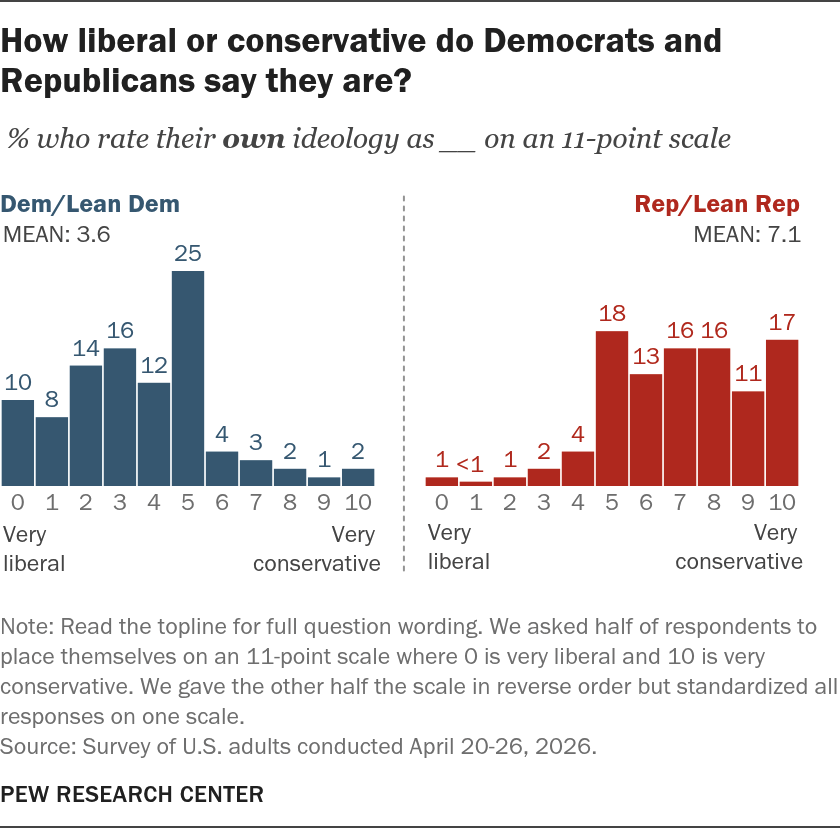
To gauge the shifting ideological currents of the electorate, researchers utilized an 11-point scale, ranging from zero (very liberal) to 10 (very conservative). The findings indicate that while partisan affiliation remains a strong predictor of self-identified ideology, the alignment is rarely absolute.
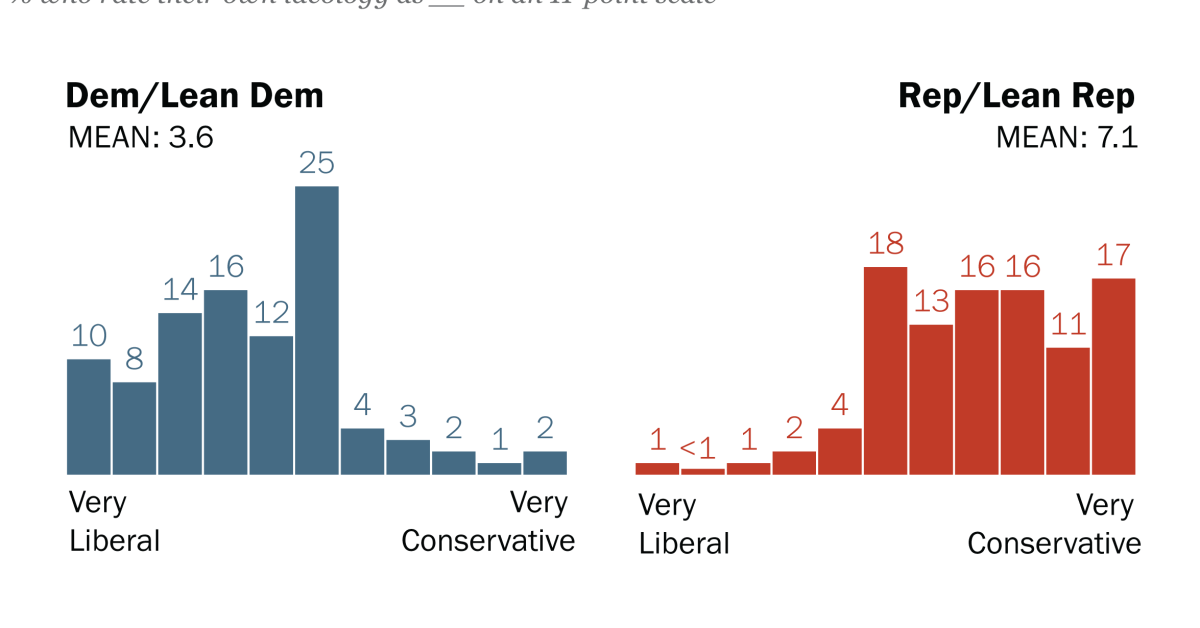
Among Democrats and those who lean toward the Democratic Party, 60% identify as left-of-center. However, the average placement for the cohort—3.6—suggests that the party’s base, on aggregate, sees itself as moderately liberal rather than firmly at the extreme end of the spectrum. Conversely, the Republican coalition shows a stronger lean toward their respective pole; 73% of Republicans and GOP-leaning independents place themselves to the right of center, with an average score of 7.1.
These figures are particularly illuminating when contrasted with how these individuals perceive their parties. Most respondents perceive a gap between their personal beliefs and the perceived ideological trajectory of their party. Only about one-quarter of members in each coalition place themselves in perfect alignment with their party’s position on the 11-point scale, highlighting a persistent "ideological friction" that permeates modern American politics.
The Cost of Disalignment: Favorability and Internal Criticism
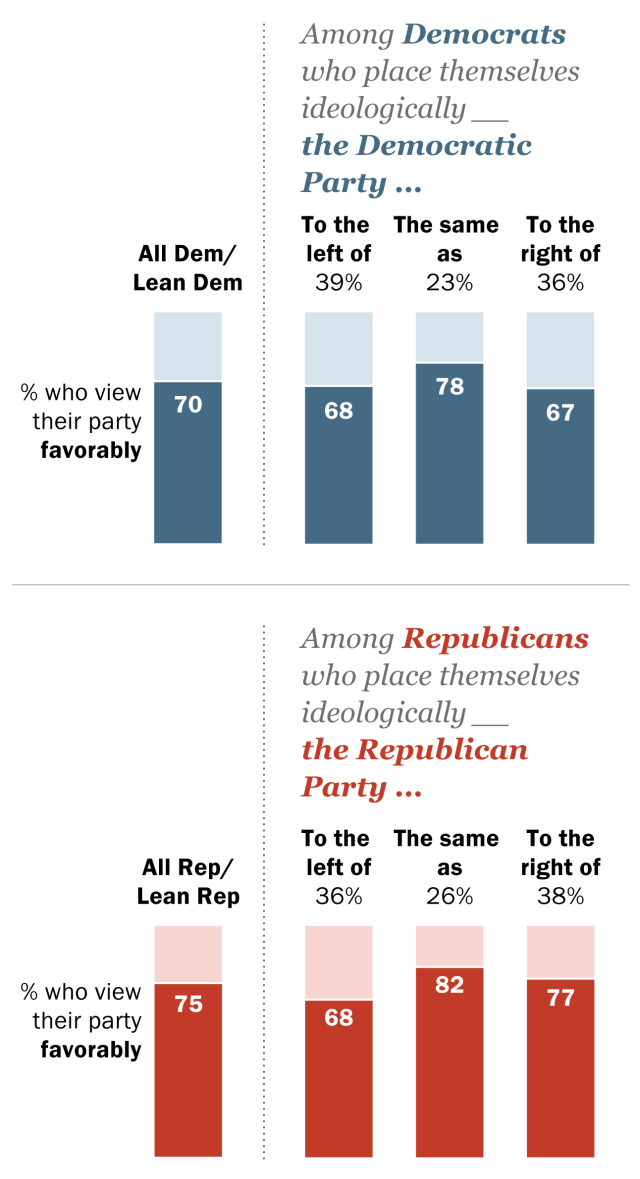
One of the most significant takeaways from the 2026 data is the correlation between ideological alignment and party loyalty. Data suggests that when voters perceive their own ideology as being out of step with their party’s platform, their favorability toward that party diminishes.
Among Democrats, those who rate their ideology as identical to that of the Democratic Party express high levels of satisfaction, with 78% viewing the party favorably. This support drops notably among those who consider themselves "more liberal" than the party (68% favorable) or "more conservative" than the party (67% favorable).
The pattern is mirrored within the GOP. Republicans who identify with the party’s ideological positioning show an 82% favorability rating. However, those who perceive themselves as more moderate or liberal than the current Republican establishment show lower levels of enthusiasm, with only 68% viewing the party favorably. This trend suggests that party leadership faces a dual challenge: they must appeal to a base that is increasingly critical of ideological drift, while also attempting to maintain a broad coalition that inherently contains conflicting viewpoints.
Historical Context: A Decade of Increasing Polarization
The 2026 findings are best understood when placed against the backdrop of the last decade of American political evolution. Over the past ten years, the distance between the two parties, as perceived by the average American voter, has widened. In 2016, the perceived ideological distance between the Democratic and Republican parties was substantial, but today, that divide has deepened.
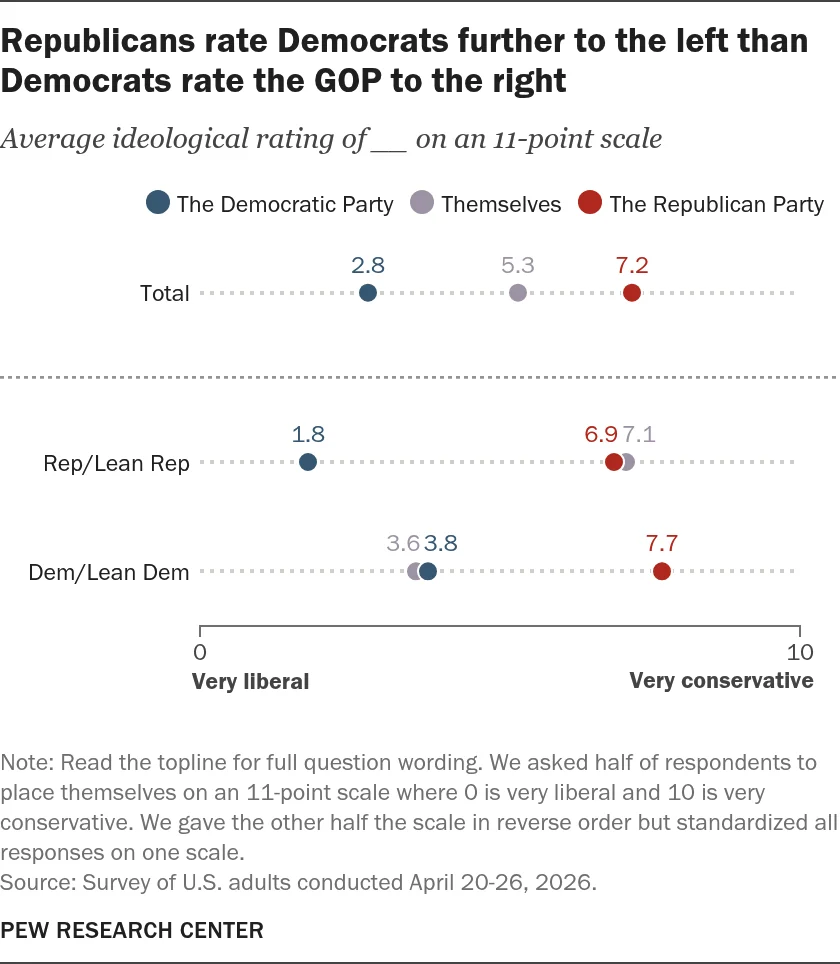
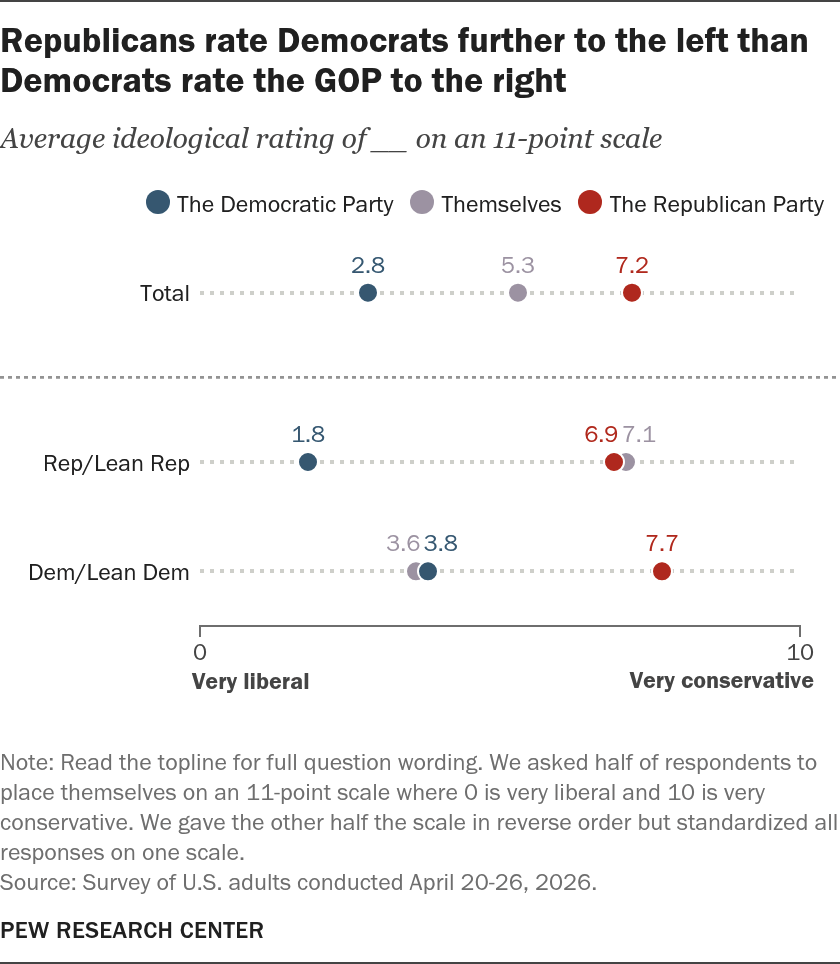
Historical analysis of the Pew Research Center’s longitudinal data shows a distinct "pulling apart" of the parties. The average ideological rating of the Republican Party has shifted rightward, moving from 6.9 in 2016 to 7.2 in 2026. Simultaneously, the Democratic Party has seen its perceived position move further to the left, shifting from 3.1 to 2.8 on the same scale.
This trend is not merely a reflection of rhetoric but a fundamental change in how voters categorize their political environment. The phenomenon of "negative partisanship"—whereby voters are motivated more by opposition to the rival party than by enthusiasm for their own—appears to be accelerating. Both sides now consistently rate the opposing party as being further from the center than they rate their own, a perception that reinforces the narrative of an increasingly radicalized political landscape.
Analyzing the Data: Beyond the Binary
The methodological approach taken in the April 2026 survey provides a more nuanced look at these trends by utilizing a standardized scale, even when rotating the order of the survey questions to mitigate bias. By asking half of the respondents to view the scale from "liberal to conservative" and the other half from "conservative to liberal," researchers ensured that the results were robust.
The data reveals that the perception of the opposition is particularly stark. Republicans rate the Democratic Party at an average of 1.8 on the 0–10 scale, pushing them deep into the "very liberal" territory. Democrats, by contrast, rate the Republican Party at 7.7, placing them firmly on the "very conservative" end. Interestingly, the average voter views themselves at 5.3, suggesting that the vast majority of Americans perceive themselves as more moderate than either of the two major parties they are tasked with choosing between in electoral cycles.
Implications for the Future of Party Governance
What does this mean for the future of American governance? The data suggests that party platforms are currently navigating a treacherous middle ground. Because the "center" of the party is often viewed as being slightly at odds with the "center" of its voters, the potential for internal party conflict remains high.
For the Democratic Party, the 39% of the coalition that identifies as being to the left of the party’s perceived center represents a persistent pressure to adopt more progressive policies. For the Republican Party, the 38% who identify as being to the right of the party’s perceived center represent a constant pull toward more traditional or hardline conservative positions.
Political scientists often refer to this as the "primary problem." Because the most ideologically distinct members of a party are often the most likely to vote in primary elections, they exert a disproportionate amount of influence on the candidate selection process. The survey data supports this, showing that those who are most "in sync" with the party are the ones most likely to hold favorable views, while the "dissenters" who feel the party is too far in one direction or another remain the most critical.
The Role of Independent Leaners
The study notably includes "leaners"—those who do not officially register with a party but lean toward one in practice. These voters are often the most critical of party ideology. Because they are not bound by the same levels of institutional loyalty as registered partisans, their ideological disagreement with the party’s trajectory is a key metric for understanding potential electoral shifts.
When a party loses the support of these "leaners" due to perceived ideological distance, it often signals a looming electoral defeat. The fact that only 70% of Democrats and 75% of Republicans view their own party favorably—even when including leaners—highlights the fragile nature of these broad-tent coalitions.
Conclusion: A Nation in Search of Equilibrium
As the 2026 data demonstrates, the American public is not a monolith. While the media and political discourse often focus on the extreme poles of the ideological spectrum, the reality is that the average voter remains caught between a desire for representation and a feeling of alienation from the parties that currently occupy the national stage.
The widening gap between parties, combined with the increasing critical stance of their own members, points to a period of ongoing political turbulence. Whether the parties will attempt to moderate their platforms to recapture the "middle" or continue to push further toward their respective ideological poles remains the central question of the current political era. As these trends continue to develop, the ability of both Democrats and Republicans to synthesize these internal ideological tensions will likely determine their success in upcoming election cycles and, ultimately, the stability of the American governing process.