As the United States approaches Constitution Day on September 17, a date set aside to commemorate the signing of the nation’s founding document in 1787, the inherent rigidity of the American legal framework has come under renewed scrutiny. While public opinion polls frequently reveal broad consensus among Americans regarding potential systemic reforms—ranging from the imposition of term limits for members of Congress and the judiciary to stringent new regulations on campaign finance—the mechanism for enacting these changes remains arguably the most cumbersome in the democratic world.
For 237 years, the U.S. Constitution has served as the bedrock of American governance. Yet, its endurance is matched only by its resistance to alteration. Since its inception, the document has been formally amended just 27 times. This infrequency is not merely a byproduct of political stability, but a direct consequence of the demanding structural hurdles embedded within Article V of the Constitution itself.
The Anatomy of an Amendment: A High Bar for Change
The process of amending the U.S. Constitution is designed to require a supermajority, effectively ensuring that any change reflects a profound national consensus rather than the fleeting whims of a partisan majority. The most common path requires two distinct, high-level hurdles: first, a two-thirds vote in both the U.S. House of Representatives and the U.S. Senate; and second, ratification by three-quarters of the individual state legislatures, or 38 out of 50 states.
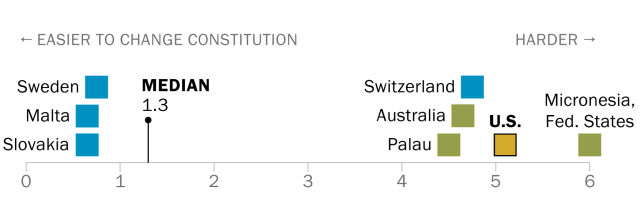
This dual-layer requirement stands in stark contrast to the governance models of most other modern democracies. Pew Research Center’s latest analysis, which utilizes a rigorous scoring system developed by political scientist Donald S. Lutz, ranks the United States as having the second-most difficult constitutional amendment process among 101 surveyed democracies. The research highlights that the only nation with a more restrictive framework is the Federated States of Micronesia (FSM). In the FSM, amendments require a multi-step process involving supermajorities in their national legislature, presidential approval, and a complex geographic mandate involving voters across its four constituent states.
A Global Comparison of Constitutional Flexibility
The divergence between the American approach and international norms is significant. Many peer nations utilize what political scientists call “flexible” or “quasi-flexible” constitutions. In countries with unicameral, or single-chamber, legislatures, the amendment process often mirrors the standard legislative process, albeit with a higher required threshold for passage—such as a simple three-fifths or two-thirds majority in the national assembly.
For instance, countries like Slovakia and Malta occupy the lower end of the difficulty spectrum, where constitutional changes can be enacted with relative ease compared to the American model. This accessibility allows these nations to adapt their governing documents to reflect contemporary social, economic, and political shifts. By contrast, the American system—which requires state-level buy-in regardless of population density or regional party dominance—effectively grants a minority of states the power to block changes that may have broad, nationwide support.

Historical Context and the 27 Amendments
To understand the rarity of constitutional change, one must look at the historical timeline. The first ten amendments, known collectively as the Bill of Rights, were ratified in 1791, just four years after the Constitutional Convention. These were essentially a prerequisite for the document’s initial adoption.
The subsequent history of amendments is marked by long periods of dormancy punctuated by bursts of social upheaval. The 13th, 14th, and 15th Amendments, known as the Reconstruction Amendments, were passed in the wake of the Civil War to abolish slavery and secure civil rights. The early 20th century saw another flurry of activity, with four amendments passed between 1913 and 1920 alone, covering the federal income tax, direct election of senators, Prohibition, and women’s suffrage.
Since the ratification of the 26th Amendment in 1971—which lowered the voting age to 18—the pace of constitutional change has slowed to a crawl. The 27th Amendment, concerning congressional pay, was famously introduced in 1789 but not ratified until 1992, highlighting the erratic and lengthy timeline that even non-controversial measures can face under the current rules.
Political Polarization and the "Locked" System
The current era of intense political polarization has turned the already high barrier of Article V into an almost insurmountable wall. In a climate where the House and Senate are frequently divided by razor-thin margins, achieving a two-thirds majority in both chambers is increasingly rare.
Political scientists and constitutional scholars argue that this "locked" system has forced reformers to seek alternative routes. Often, instead of amending the Constitution, policymakers look to the judiciary. The Supreme Court’s interpretation of existing constitutional text—often referred to as "judicial amendment"—has become the primary vehicle for updating the document’s application to modern life. However, this method remains controversial, as it relies on the evolving composition of the Court rather than a direct democratic mandate.
Critics of the current system point to the "tyranny of the minority" as a byproduct of the ratification process. Because 13 states can effectively block an amendment, a coalition of sparsely populated states can stall initiatives that are favored by a vast majority of the national population. This, they argue, contributes to a growing disconnect between public sentiment and government action, fueling the very political dissatisfaction that leads citizens to call for reform in the first place.
Official Responses and the Debate on Reform
While there is no organized movement within the federal government to amend Article V, the discourse surrounding the subject is active. Supporters of the current structure argue that the difficulty of the amendment process is a "feature, not a bug." They contend that the framers intentionally created a stable, durable document that prevents the government from being swayed by the volatile, short-term pressures of populist movements.
"The Constitution was designed to be the anchor of our republic," noted one constitutional scholar. "If we were to make the document as easy to change as a standard statute, we would risk losing the fundamental principles that define the American identity. The struggle to amend it is a necessary filter that ensures only the most vital, widely accepted changes take root."
Conversely, advocates for reform argue that a document that cannot evolve is a document that will eventually be discarded or ignored. They point to the declining public trust in institutions as evidence that the system needs to be more responsive to the needs of the 21st century.
Broader Implications for Democracy
The implications of this rigidity are profound. As the United States moves further into the 2026 election cycle, the debate over how to reform the political system will likely intensify. Should the nation continue to rely on judicial interpretation to modernize its legal framework, or is it time to reconsider the rules for constitutional amendment?
The data provided by the Pew Research Center serves as a vital touchstone for this discussion. By situating the U.S. experience within a global context, it clarifies that the American difficulty in updating its governing document is not a global standard but a unique, historical choice. As the nation celebrates Constitution Day this September, the conversation will likely pivot away from mere celebration toward a more analytical assessment of the document’s longevity.
Whether the United States will ever see a 28th amendment remains an open question. For now, the Constitution remains a static monument to the 18th century, serving as both a pillar of stability and a source of significant political friction in a rapidly changing world. The challenge for the future, as it has been for the past two centuries, will be balancing the need for institutional permanence with the democratic necessity of being an adaptable, self-correcting society.