
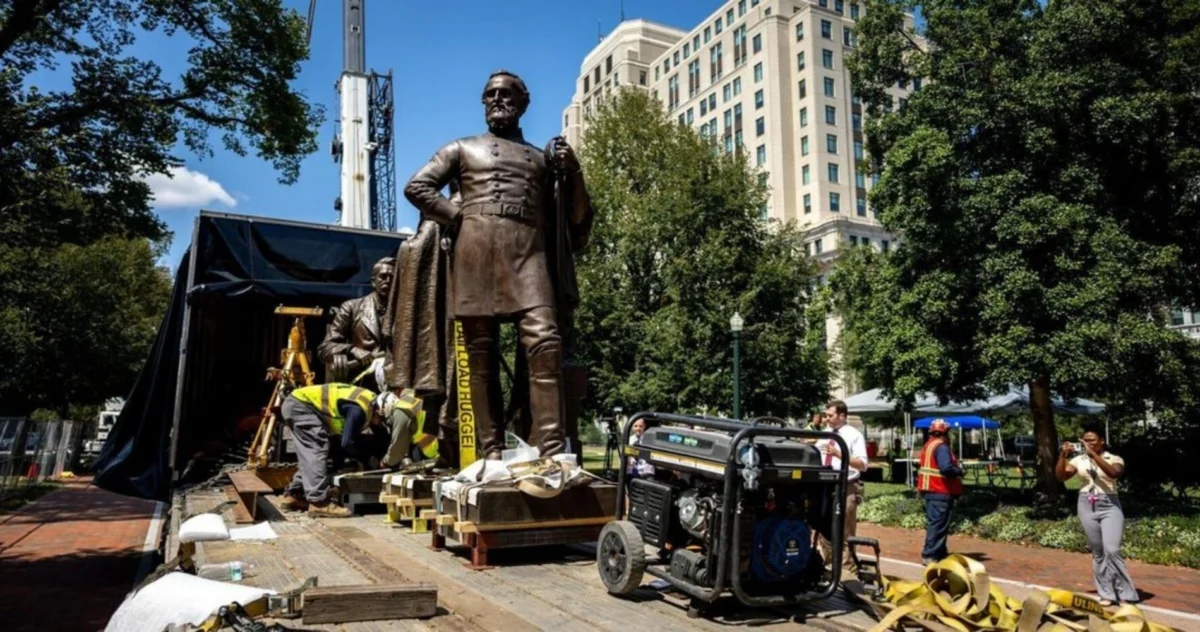
In a definitive shift for the Commonwealth of Virginia, state officials successfully removed the final three Confederate monuments from Capitol Square in Richmond this past Friday. This action, mandated by legislative requirements enacted earlier this year, effectively ends the public display of Confederate statues on state-owned property within the former capital of the Confederacy. The removal of these figures—long-standing fixtures of the civic landscape—serves as a symbolic conclusion to a tumultuous, years-long effort to reconcile Virginia’s public space with its history of racial injustice, slavery, and civil war.
The statues, which included a prominent likeness of Stonewall Jackson, were dismantled quietly, signaling a transition in how the Commonwealth intends to memorialize its complex past. This development follows a period of intense public scrutiny, legislative debate, and grassroots advocacy that accelerated significantly after the 2020 national protests against racial inequality.
A Legacy of Revisionism: The Origins of the Monuments
To understand the weight of these removals, one must look at the historical context in which these statues were erected. Contrary to the narrative that these monuments were simple memorials to fallen soldiers, historians point to two distinct waves of construction that were explicitly tied to the maintenance of white supremacy.
The first wave occurred at the turn of the 20th century, roughly three decades after the conclusion of the Civil War. During this period, the South was undergoing a process of "redemption" by former Confederates who sought to re-establish white political and social dominance. By erecting statues of figures like Robert E. Lee and Stonewall Jackson, proponents of the "Lost Cause" ideology sought to romanticize the Confederacy, framing the preservation of slavery as a noble defense of states’ rights and local autonomy.
The second wave of monument construction occurred during the 1950s and 1960s, a period marked by the burgeoning Civil Rights Movement. As federal courts and activists pushed for desegregation and the end of Jim Crow, many local and state governments installed Confederate imagery as a form of overt resistance. By branding these monuments as heritage, segregationists were able to present themselves as defenders of Southern identity, effectively weaponizing history to oppose racial equality.
Chronology of the Removal Effort
The dismantling of Virginia’s Confederate iconography has been a staggered, multi-year process. The timeline below illustrates the escalation from localized debate to systemic state-wide removal:
- 2017: The white supremacist rally in Charlottesville, centered on the proposed removal of a Robert E. Lee statue, resulted in the death of a peaceful counterprotester. This tragedy brought the issue of Confederate monuments to the forefront of national consciousness.
- July 2020: House Speaker Eileen Filler-Corn ordered the removal of a life-sized statue of Robert E. Lee and seven other Confederate busts from the interior of the Virginia Capitol.
- June 2020: Protesters in Richmond toppled the statue of Confederate President Jefferson Davis, signaling a decisive shift in public sentiment.
- July 2021: The City of Charlottesville officially removed its contentious Robert E. Lee statue, as well as a second statue honoring Confederate figures.
- December 2022: Richmond removed its final city-owned Confederate statue, that of A.P. Hill, effectively clearing the city’s public streets of such monuments.
- Early 2026: Governor Abigail Spanberger signed legislation aimed at rescinding tax advantages for organizations that have historically funded the installation and maintenance of Confederate monuments.
- August 2026: The final three Confederate monuments are removed from Capitol Square, completing the Commonwealth’s mandate.
Supporting Data and the EJI Findings
The Equal Justice Initiative (EJI) has documented that Virginia holds the highest concentration of Confederate monuments in the United States. For decades, Richmond, as the final capital of the Confederacy, functioned as the epicenter of this memorialization. At its peak, the city’s famous "Monument Avenue" served as a grand stage for five massive statues dedicated to the leadership of the rebellion.
The prevalence of these statues was not accidental. Research shows a direct correlation between the geographic placement of these monuments and areas where the history of racial terror and disenfranchisement was most acute. By dominating the civic landscape of the state capitol, these statues were designed to signal who held power and whose history was considered worthy of public veneration.
Official Responses and Legislative Action
The recent removals are the culmination of a political climate that has shifted toward acknowledging the systemic harm caused by these symbols. Former Richmond Mayor Levar Stoney, whose administration oversaw the removal of more than a dozen statues, described the process as a long-overdue reckoning. "Richmond had more Confederate monuments than any other city in the United States," Stoney noted during the removal of the A.P. Hill statue. "This wasn’t just two years of work; this was a hundred years of difficult work."
State-level officials have echoed this sentiment, emphasizing that the removal of statues is not the erasure of history, but a clarification of it. Speaker Eileen Filler-Corn stated at the time of the initial capitol removals that Virginia possesses a story that extends far beyond the glorification of the Confederacy. The objective, she argued, is to provide context that reflects the Commonwealth’s entire history, rather than a curated version designed to uphold racial hierarchies.
Governor Spanberger’s recent legislative action—reversing a segregation-era tax carve-out that benefited the United Daughters of the Confederacy—further demonstrates a shift in state policy. By cutting off financial incentives that have sustained these pro-Confederate groups since the 1950s, the state is effectively ending its institutional support for the revisionist narratives these groups propagate.
Broader Impact and Implications
The removal of these statues has not occurred in a vacuum. It stands in direct contrast to recent federal trends where there have been attempts to rename military bases in ways that honor the Confederacy or move to re-install monuments that had been removed. By taking this step, Virginia has positioned itself as a leader in the movement to decouple state identity from the defense of slavery.
The implications of this move are twofold. First, it addresses the long-standing grievance of marginalized communities who have viewed these monuments as active symbols of racial trauma. By removing the statues from the seat of government, the state is effectively neutralizing the "monumental" influence that these figures held over public policy and civic life.
Second, the move invites a new chapter in how Virginia tells its story. Without the presence of these monuments on Capitol Square, the space is now open to reflect a more inclusive history. Advocates for the removals have suggested that the space previously occupied by Confederate figures should be replaced with markers or memorials that recognize the contributions of African Americans, the victims of slavery, and those who fought for civil rights in the Commonwealth.
The Path Forward
The removal of these monuments is likely to be viewed by historians as a transformative moment in Virginia’s post-Civil War history. While the debate over the interpretation of the Civil War remains a point of contention in American politics, the physical presence of Confederate statues on government land is no longer a reality in Virginia.
As the state moves forward, the focus will likely shift to the "difficult work" of education and preservation. The challenge for the Commonwealth now is to ensure that the removal of these statues serves as a catalyst for deeper systemic change. The erasure of these icons from the public square is, as many local leaders have suggested, merely the beginning of a broader effort to turn the page on a century of racial division. With the statues gone, the focus of the public eye in Richmond and across the state is now redirected toward how to accurately teach, interpret, and memorialize a history that is no longer shielded by the romanticized stone figures of the past.




