
As the United Kingdom edges closer to the formal implementation of Section 1 of the Equality Act 2010—known widely as the socio-economic duty (SED)—a fierce ideological battle is unfolding across the British political landscape. The provision, which mandates that public authorities have due regard to reducing inequalities of outcome resulting from socio-economic disadvantage when making strategic decisions, has spent over a decade languishing in statutory limbo. Originally championed by Labour minister Harriet Harman and passed into law in 2010, the clause was swiftly shelved by the incoming Conservative-led coalition government, who labeled it an unnecessary bureaucratic burden. While devolved administrations in Scotland and Wales activated the duty in 2018 and 2021 respectively, England has left the provision dormant. However, with the current Labour administration taking concrete steps toward drafting statutory guidance for its commencement, public discourse has fractured into competing narratives, drawing intense scrutiny from parliamentarians, the national press, legal scholars, civil servants, and grassroots organizations.
Background and Legislative Origins
The legislative architecture of the socio-economic duty is contained within Section 1 of the Equality Act 2010. It requires specified public bodies—primarily local authorities and government departments—to consider how their strategic decisions, such as high-level priority setting, broad policy formulation, budgetary allocations, and large-scale commissioning, might exacerbate or alleviate socio-economic hardship. Unlike operational decisions made on a daily basis, these strategic choices carry the potential to profoundly alter regional life chances, health outcomes, and educational attainment gaps.
Despite receiving royal assent in April 2010, the incoming coalition government under David Cameron and Theresa May announced later that year that Section 1 would not be commenced. While successive Westminster governments chose not to repeal the law through a formal democratic vote, the clause remained legally inactive in England. Proponents argue that leaving the measure dormant has denied local policymakers a vital regulatory tool to combat systemic regional inequalities, skyrocketing child poverty, and widening wealth-health gaps. Conversely, critics have historically viewed the clause through a lens of skepticism, arguing that it represents an overreach of state intervention that fails to deliver tangible solutions.
Chronology of a Delayed Implementation
The trajectory of the socio-economic duty spans over a decade and a half of political friction, punctuated by critical policy milestones:
- 2009–2010: Section 1 of the Equality Act is debated and passed through Parliament under the Labour government, championed by Harriet Harman, only to be shelved by the incoming Conservative-Liberal Democrat coalition.
- 2018: The Scottish Government formally commences the socio-economic duty, embedding it into Scottish public sector operations.
- 2021: The Welsh Government follows Scotland’s lead, bringing the socio-economic duty into legal force across Wales.
- 2024: The Labour Party returns to government with a clear manifesto commitment to revive and implement the dormant clause in England, prompting a wave of renewed public consultations and stakeholder engagement.
- 2025–2026: As the government drafts statutory guidance and advances toward commencement, opposition rhetoric intensifies in right-wing media outlets, while civil society coalitions and local authorities push for comprehensive resource allocation and training.
Analytical Breakdown Across Six Sites of Discourse
To understand the modern debate surrounding the SED, researchers from the Equality Trust and the University of York Law School—led by Vanessa Boon and Dr. Jed Meers—conducted an interim critical discourse analysis utilizing Fairclough’s three-dimensional model. Their findings categorize the public conversation into six distinct arenas, each harboring its own ideological underpinnings.
1. Parliamentary Debate and Political Polarization
Discussions in Hansard reveal a stark polarization along partisan lines. During the initial passage of the Equality Bill, right-wing opponents characterized the duty as a vague, toothless measure incapable of solving complex societal problems, while simultaneously attacking it as excessive social engineering and "left-wing tosh" that discriminated against the middle classes. In contrast, supporters pointed to structural inequalities, intergenerational poverty, and the findings of major inquiries—such as Baroness Doreen Lawrence’s review into the disproportionate impact of COVID-19 on racialized communities—to argue that the duty is essential for holistic policymaking. Cross-party support has periodically emerged from figures across the political spectrum, including early day motions backed by more than 80 MPs and recommendations from select committees and the recent COVID-19 Inquiry.
2. News Media Coverage and Editorial Framing
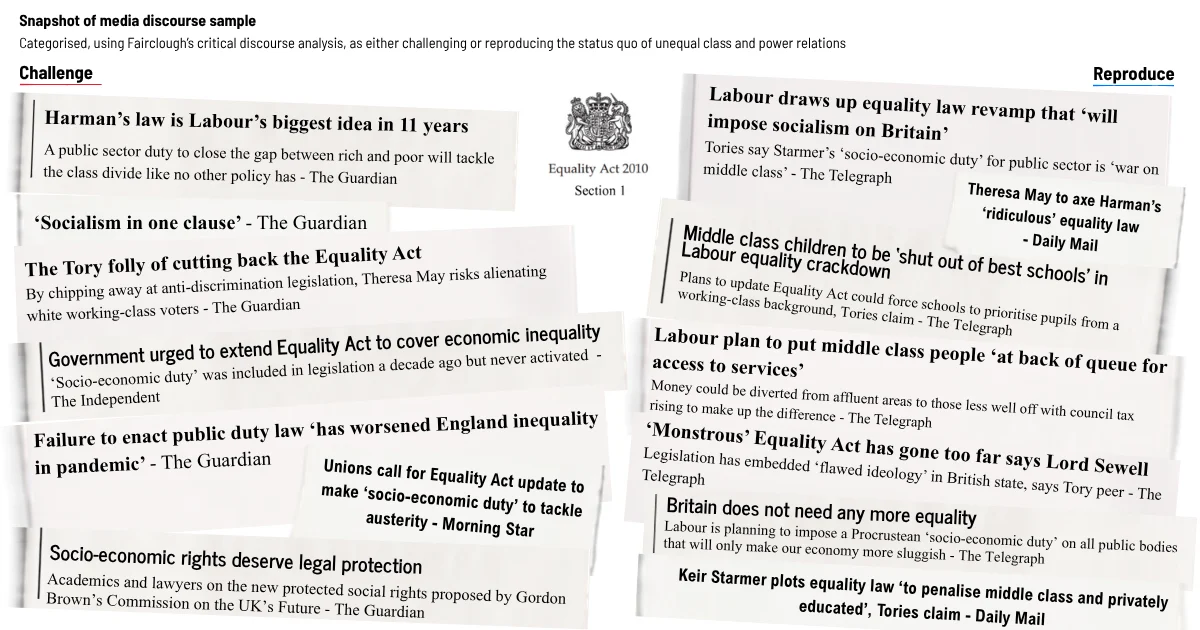
The national news media has played a major role in shaping public perception, often splitting along ideological fault lines. Right-wing publications, including The Telegraph, the Daily Mail, and the Express, have consistently framed the SED as a direct threat to hard-working families and the middle classes, deploying emotive headlines that warn of "class warfare" and the imposition of "socialism by stealth." Conversely, center- and left-leaning outlets like The Guardian and The Independent have highlighted independent polling—such as an Opinium survey indicating that 57% of voters support activating the clause while only 6% oppose it—to argue that public demand for poverty reduction is high.
3. Academic and Legal Scholarship
Academic engagement with the SED has been relatively sparse but theoretically robust. Legal scholars such as Professor Sandra Fredman have argued that the duty provides a proactive framework capable of strengthening substantive equality when integrated with existing anti-discrimination protections. Other researchers, including Dr. Jed Meers and Dr. Fernando Casla, have suggested that active implementation of the duty could have mitigated the harshest impacts of post-2010 austerity measures and provided public servants with a structured mechanism to address housing shortages and educational disparities. However, academic output remains largely confined to specialized legal and socio-legal journals, struggling to penetrate mainstream public discourse.
4. Practitioner Perspectives and Public Sector Reality
Public sector workers who would be tasked with enforcing the duty exhibit a mixture of professional support and operational skepticism. Surveys of civil servants reveal concerns regarding institutional capacity, with many practitioners warning that the duty risks becoming a superficial "tick-box exercise" if introduced without adequate training, funding, and clear statutory guidance. Nevertheless, practical evidence from Resolve Poverty demonstrates that approximately 10% of English local authorities have already voluntarily adopted the duty, while over 51% operate within its spirit. Success stories—such as the Merseyside Fire & Rescue Service removing arbitrary driving licence requirements to broaden recruitment pools—demonstrate that the framework can successfully unlock untapped talent and address localized barriers.
5. Civil Society and Coalition Advocacy
Civil society organizations have emerged as the most vocal champions of the SED. Coalitions such as the 1 for Equality campaign—co-chaired by Just Fair and the Equality Trust alongside organizations like Amnesty International UK, the Trades Union Congress (TUC), and the Runnymede Trust—have consistently lobbied Westminster for prompt implementation. International bodies, including the United Nations, have similarly criticized successive UK governments for failing to activate the duty during periods of rising destitution. These groups emphasize that effective implementation requires leadership buy-in, rigorous equality impact assessments, and a strong intersectional approach that links socio-economic disadvantage to race, gender, and disability.
6. The Marginalization of Beneficiaries
A critical finding of the discourse analysis is the near-total omission of the intended beneficiaries—individuals with direct, lived experience of socio-economic deprivation—from mainstream parliamentary and media debates. While grassroots networks such as Thrive Teesside, Poverty2Solutions, and the APLE Collective actively amplify community voices through peer-led research and participatory reporting, these perspectives rarely reach national newspapers or parliamentary committees, leaving the debate dominated by institutional and political elites.
Implications for Policy and Governance
As the government moves closer to operationalizing Section 1 of the Equality Act 2010, the implications of this divided discourse are profound. For the socio-economic duty to succeed in England, policymakers must bridge the gap between abstract legislative theory and the day-to-day realities of local government administration. Without ring-fenced resources, comprehensive training, and robust monitoring mechanisms, the duty risks fulfilling the worst fears of its critics by devolving into an administrative formality. Conversely, if implemented with genuine institutional commitment and community involvement, the socio-economic duty offers a powerful structural instrument to realign public sector decision-making, ensuring that the reduction of socio-economic disadvantage remains a permanent priority in the architecture of British governance.




