The proliferation of sports betting in the United States, particularly amplified by the fervor of the NCAA Men’s College Basketball Tournament, known colloquially as March Madness, has brought the nation’s evolving attitudes toward gambling into sharp focus. While betting on college sports and other athletic events has seen a significant surge across the U.S. in recent years, a comprehensive global survey reveals that Americans are uniquely positioned in their views on the morality of gambling, demonstrating a notably higher degree of acceptance compared to populations in many other countries.
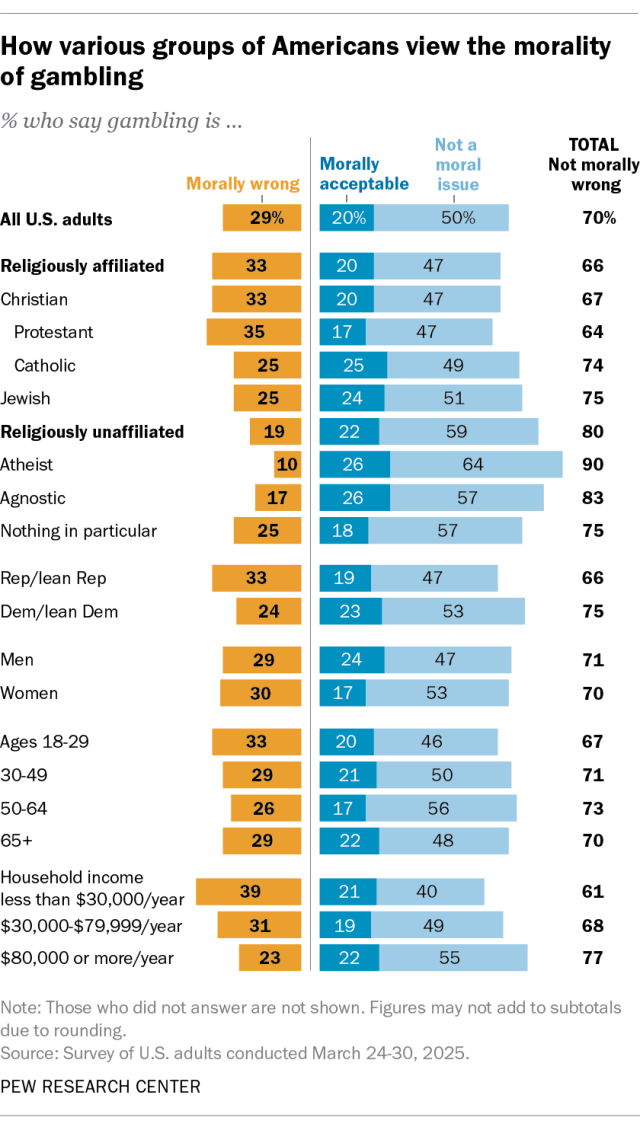
A landmark 2025 Pew Research Center survey, encompassing 25 nations, has illuminated a distinct American perspective on gambling. The findings indicate that a relatively small proportion of U.S. adults, precisely 29%, perceive gambling as morally wrong. This stands in stark contrast to numerous other surveyed nations where approximately half or more of the adult population holds a negative moral stance on gambling. For instance, in Indonesia, a staggering 89% of respondents considered gambling immoral, followed by India (83%), Italy (71%), and Brazil (61%).
The survey presented respondents with three distinct choices: that gambling is morally acceptable, morally unacceptable, or not a moral issue. In the United States, while 20% of adults subscribe to the view that gambling is morally acceptable, a more striking observation is that a substantial 50% of Americans categorize gambling as "not a moral issue." This segment of the population, which views gambling outside the purview of moral judgment, is larger in the U.S. than in any other country surveyed. This suggests a cultural decoupling of gambling from traditional moral frameworks for a significant portion of the American populace.

The trend of increasing acceptance, or at least disengagement from moral condemnation, is not entirely new in the U.S. A comparative analysis with a similar Pew Research Center survey conducted in 2013 shows a slight, yet discernible, shift. In that earlier study, 24% of U.S. adults deemed gambling immoral. The incremental increase from 24% to 29% in the latest survey suggests a gradual, yet consistent, movement towards a less morally critical view of gambling activities.
The Landscape of Legalized Sports Betting in the U.S.
The surge in sports betting activity in the United States is a phenomenon deeply intertwined with legislative changes and technological advancements. Historically, sports betting was largely confined to Nevada, with a few exceptions like the limited pari-mutuel betting on horse racing. However, the Supreme Court’s 2018 decision in Murphy v. NCAA, which overturned the Professional and Amateur Sports Protection Act of 1992 (PASPA), fundamentally altered the legal landscape. This landmark ruling effectively removed the federal ban on sports betting, allowing individual states to legalize and regulate it.
Since 2018, a rapidly expanding number of states have moved to permit sports wagering, both online and at brick-and-mortar establishments. This legislative wave has been fueled by the potential for significant tax revenue for states and the growing demand from consumers eager to participate in betting markets. The NCAA Men’s and Women’s Basketball Tournaments, commonly known as March Madness, have become particularly lucrative periods for sportsbooks. The sheer volume of games, the widespread popularity of college basketball, and the allure of bracket challenges create an unparalleled betting environment. This year’s tournament, like those in recent years, has seen an unprecedented volume of bets placed, reflecting the maturation and widespread accessibility of the sports betting industry in the U.S.
Global Divergence in Moral Perceptions of Gambling
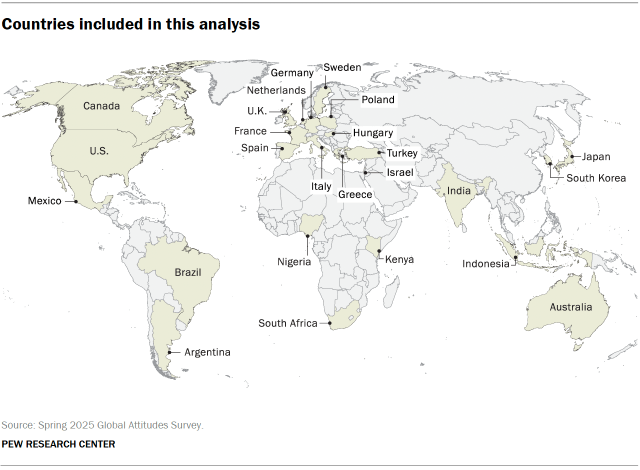
The Pew Research Center’s expansive survey, conducted between January 8 and April 26, 2025, involved nationally representative samples of 28,333 adults across 25 countries. The methodology employed ensures a robust comparison of attitudes. The data clearly illustrates a global divide in how societies grapple with the moral implications of gambling.
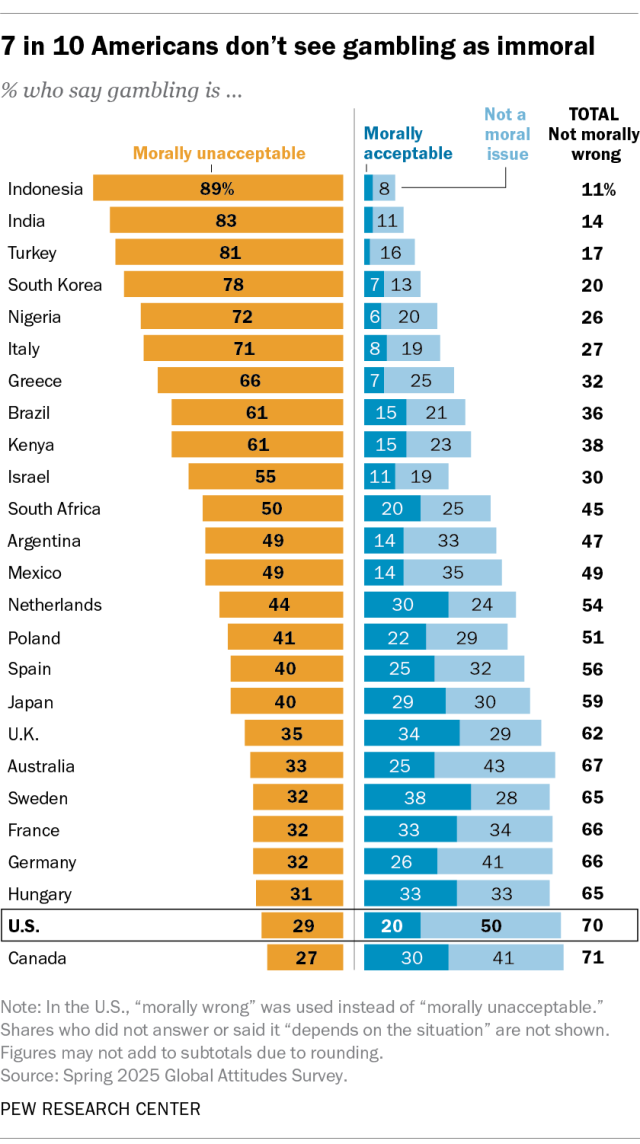
Countries with predominantly Islamic populations, such as Indonesia and India, exhibit the highest levels of moral condemnation towards gambling. This is often rooted in religious tenets that prohibit or strongly discourage such activities. In contrast, European nations like Italy and South American countries like Brazil show varying degrees of moral disapproval, with a significant portion of their populations still viewing gambling as unacceptable.
The unique position of the United States, with its substantial segment of adults considering gambling "not a moral issue," suggests a cultural context that may prioritize individual liberty and personal choice over collective moral judgments on such activities. This perspective could be influenced by a variety of factors, including the historical emphasis on individual freedoms, the pervasive influence of commercialized entertainment, and the increasing normalization of gambling through media and accessible platforms.
Demographic and Religious Variations within the U.S.
Delving deeper into the American perspective, the Pew Research Center survey also uncovered demographic and religious variations in attitudes toward gambling’s morality. While men and women in the U.S. are nearly equally likely to label gambling as morally wrong, a discernible gender gap emerges when considering those who find it morally acceptable. Men, across various age groups, are more inclined to express the view that gambling is morally acceptable. For instance, among Americans under 30, 24% of men hold this view, compared to 16% of women in the same age bracket. A similar disparity is observed among older Americans, with 26% of men aged 65 and over finding gambling morally acceptable, versus 19% of women in that demographic.
Conversely, the survey highlighted demographic differences in the perception of gambling as morally unacceptable. A higher proportion of women (33%) than men (26%) in the U.S. consider gambling to be morally wrong. Age also plays a role, with older Americans being more likely to view gambling negatively. Specifically, 37% of those aged 65 and older find gambling morally unacceptable, compared to 24% of adults under 30. This suggests a generational shift, with younger Americans generally exhibiting more permissive attitudes towards gambling.
Religious affiliation also correlates with views on gambling’s morality. Those who identify as religiously unaffiliated are the most likely to see gambling as not a moral issue, with 64% holding this view. This contrasts with individuals who identify with a religion, among whom only 44% express the same sentiment. Among specific religious groups, evangelical Christians and Mormons are the most likely to consider gambling morally unacceptable, at 42% and 39% respectively. Conversely, Jews are the least likely among major religious groups to deem gambling immoral, with 23% expressing this view, and are instead more likely to consider it morally acceptable (27%) or not a moral issue (45%).
Broader Implications and Future Considerations
The findings from the Pew Research Center survey have several significant implications for American society and its policy considerations. The widespread acceptance, or at least neutrality, towards gambling’s morality in the U.S. could embolden further expansion of the industry. As more states legalize sports betting and other forms of gambling, the cultural landscape is likely to continue shifting, potentially normalizing these activities even further.
The increasing accessibility of online betting platforms, coupled with sophisticated marketing campaigns, means that gambling is becoming more integrated into daily life. This normalization, however, raises concerns about potential increases in problem gambling. While a significant portion of Americans may not view gambling as inherently immoral, the societal costs associated with addiction, financial distress, and related issues remain a critical concern for public health officials and policymakers.
The divergence in views between the U.S. and other nations also presents an interesting case study in cultural evolution and the impact of economic incentives on societal norms. The U.S.’s approach, characterized by a large segment deeming gambling "not a moral issue," suggests a pragmatic embrace of a legal industry that generates revenue and consumer engagement, perhaps at the expense of deeper moral scrutiny.
As the sports betting market continues its rapid expansion, particularly around major events like March Madness, understanding these deeply embedded societal attitudes is crucial. The data suggests that while the debate over the morality of gambling continues, the prevailing sentiment in the United States is one of increasing permissiveness and a growing tendency to view it as a matter of personal choice rather than a moral failing. This trend is likely to shape future policy debates, marketing strategies, and the ongoing societal conversation about the role of gambling in American life. The comparative global data underscores the unique cultural context within which these debates are unfolding in the United States, highlighting a distinct American approach to the complex and evolving world of legalized gambling.