
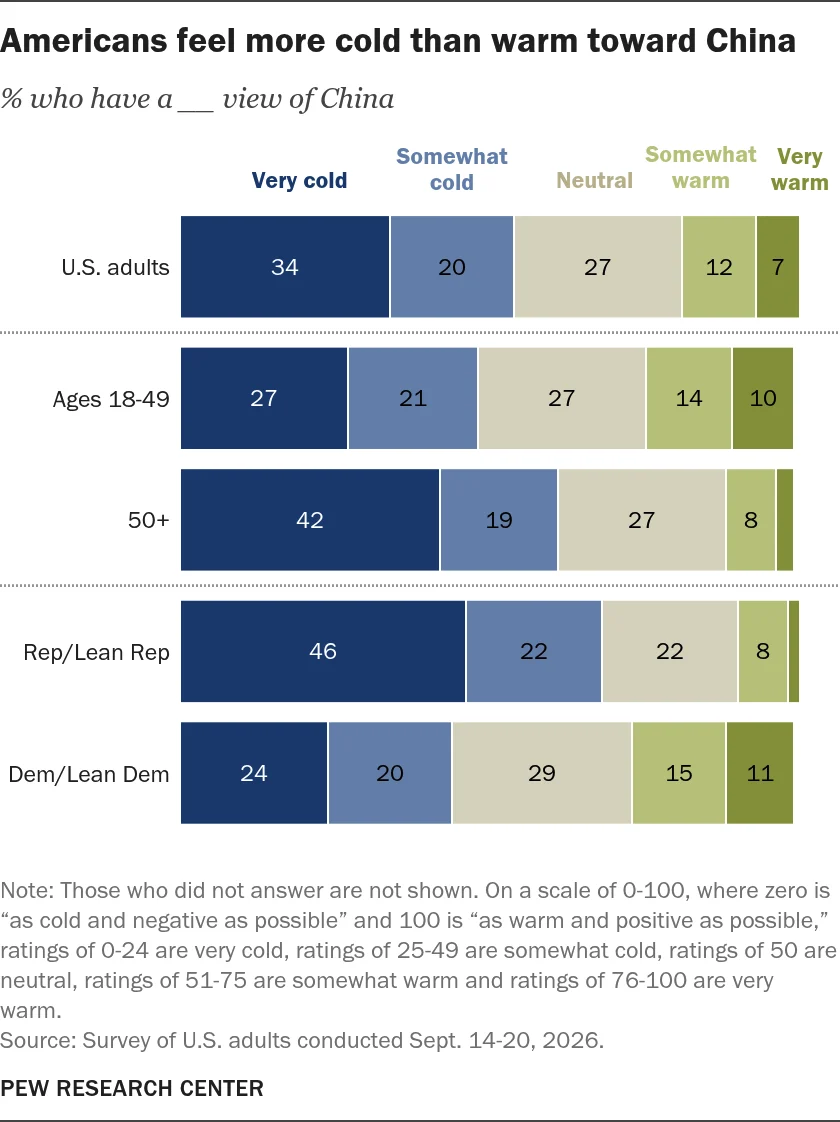
As President Donald Trump prepares to host Chinese President Xi Jinping in Washington this week, the bilateral relationship faces a complex backdrop of shifting public sentiment. Recent data from the Pew Research Center indicates that while American attitudes toward China remain largely critical, there has been a measurable warming in public opinion compared to the lows observed in 2021. This diplomatic encounter arrives at a pivotal moment, as both leaders navigate domestic pressures and a global geopolitical landscape that has grown increasingly interconnected yet competitive.
The upcoming summit, which is expected to focus on trade negotiations, economic policy, and regional stability, takes place as the American public attempts to reconcile deep-seated skepticism with the realities of an integrated global economy. According to a survey of 5,193 U.S. adults conducted between September 14 and 20, 2026, the average American rating for China on a 100-point "feeling thermometer" now sits at 37. While this represents a significant increase from the 28-point average recorded in 2021, it remains well below the neutral midpoint of 50, underscoring that the thawing of relations is occurring from a position of profound, long-standing coldness.
A Decade of Fluctuating Sentiment
To understand the current state of public opinion, it is necessary to examine the trajectory of U.S.-China relations over the past decade. In 2016, the average rating for China was 39, a period characterized by relative stability in diplomatic exchanges and trade. However, as trade disputes intensified and geopolitical competition expanded throughout the late 2010s, public sentiment began to shift.

By 2018, the average rating reached 42, reflecting a period of intense public focus on the U.S.-China trade war. This was followed by a sharp decline in 2021, when public opinion plummeted to an average of 28. Analysts suggest that this decline was driven by a combination of factors, including the global fallout from the COVID-19 pandemic, heightened rhetoric surrounding technological competition, and concerns over human rights and national security. The recovery to 37 in the latest 2026 data indicates a slight, albeit cautious, softening of these sentiments, though the majority of the population continues to view the nation through a critical lens.
The Dynamics of the Feeling Thermometer
The Pew Research Center utilizes a "feeling thermometer" as a methodological tool to gauge public sentiment with greater precision than traditional four-point favorability scales. By allowing respondents to rate a country on a scale from zero (as cold and negative as possible) to 100 (as warm and positive as possible), researchers can capture the nuance of public feeling.
In the 2026 survey, 54% of Americans categorized their view of China as "cold" (0-49), while 27% felt neutral (50) and only 19% expressed a "warm" view (51-100). This stands in contrast to 2021, when 68% of respondents held cold views and only 11% reported warmth. The shift toward a larger neutral middle ground suggests that a segment of the American public may be moving away from active hostility, perhaps in response to diplomatic efforts or a cooling of the more aggressive public discourse that dominated the early 2020s.
Partisan Divides and Demographic Variations
Public opinion regarding China is not monolithic; it is deeply segmented by political affiliation and age. The data reveals a stark contrast between Democratic and Republican perspectives. Democrats and Democratic-leaning independents reported an average rating of 43, whereas Republicans and Republican-leaning independents provided an average rating of 29.

This partisan gap is further reflected in the intensity of these views. A 68% majority of Republicans view China through a cold lens, compared to 44% of Democrats. Conversely, roughly one-quarter (26%) of Democrats express a warm view, a sentiment shared by only 10% of Republicans. These figures suggest that the political identity of an American voter is a strong predictor of their geopolitical outlook, with domestic political discourse playing a significant role in shaping perceptions of foreign rivals.
Age also acts as a critical demographic differentiator. Adults under the age of 50 consistently view China more favorably than their older counterparts. Those in the younger bracket provided an average rating of 42, while Americans aged 50 and older gave an average rating of 31. Despite this, the youth demographic is not immune to skepticism; adults under 50 are still twice as likely to harbor cold views as they are to express warm ones. The consistency of this 10-point gap over the last decade suggests that generational shifts in perspective remain stable, regardless of the broader political climate.
Contextualizing the Washington Summit
The meeting between President Trump and President Xi is the centerpiece of a week of intense diplomatic activity. The agenda is expected to be dominated by the status of international trade agreements, the future of manufacturing supply chains, and the ongoing dialogue regarding artificial intelligence and cybersecurity.
From the perspective of the White House, the summit is an opportunity to re-establish a "managed competition" framework. For the Chinese delegation, the meeting serves as a platform to signal economic stability and encourage investment. However, officials on both sides are aware that public opinion serves as a constraint on their negotiating power. A public that is largely cold toward the opposing nation limits the political capital available to leaders who might seek to pursue deeper integration or cooperative agreements.

Economic and Global Implications
The implications of these findings extend far beyond the ballot box. As the U.S. and China remain the world’s two largest economies, their bilateral relationship dictates the health of global markets. Financial analysts have noted that the "thaw" observed in the data could lead to a more predictable environment for international businesses, provided that the current diplomatic summit results in tangible policy outcomes.
However, the fact that a majority of Americans still hold cold views remains a significant barrier to long-term policy shifts. Trade barriers, tariffs, and restrictions on technology transfers are often popular with a public that views China as a primary competitor. Any movement to roll back these measures would likely require a sustained period of diplomatic success and a visible improvement in the way the American public perceives the bilateral relationship.
Analyzing the Future Trajectory
The slight improvement in sentiment since 2021 may be attributed to a variety of factors. Increased diplomatic engagement, the resumption of high-level talks, and the maturation of post-pandemic global relations have all likely contributed to a less volatile atmosphere. Nevertheless, the persistence of "cold" sentiment at 54% indicates that the underlying structural tensions—ranging from intellectual property concerns to regional maritime disputes—remain unresolved.
The challenge for policymakers in both Washington and Beijing is to balance the domestic requirement to be "tough on China" with the practical necessity of managing a complex, intertwined global relationship. As the summit commences, observers will be watching not just for the agreements signed, but for the tone of the rhetoric employed by both leaders. If the public perceives the meeting as a success, it could provide the political runway necessary for more constructive engagement in the coming years. If, however, the summit is seen as a failure, it could harden public opinion further, making future diplomatic breakthroughs increasingly difficult to achieve.

Methodology and Research Scope
This analysis is based on data from the American Trends Panel, an ongoing, nationally representative survey of U.S. adults. The 2026 data reflects a robust methodology, ensuring that the findings account for the nuances of American public sentiment. By using the feeling thermometer, the Pew Research Center has provided a high-resolution view of a complex issue, allowing policymakers and the public to move beyond binary "favorable vs. unfavorable" labels to understand the intensity and direction of national sentiment.
As this research shows, while the mercury may be rising slightly on the feeling thermometer, the relationship between the two nations remains profoundly chilly. The upcoming Washington summit represents a critical test of whether high-level diplomacy can bridge the gap between the cautious, critical public sentiment and the necessity of stable, functional state-to-state relations in a modern, multipolar world. The coming days will provide a clearer picture of whether this recent trend of warming sentiment can be translated into substantive, lasting policy progress.




