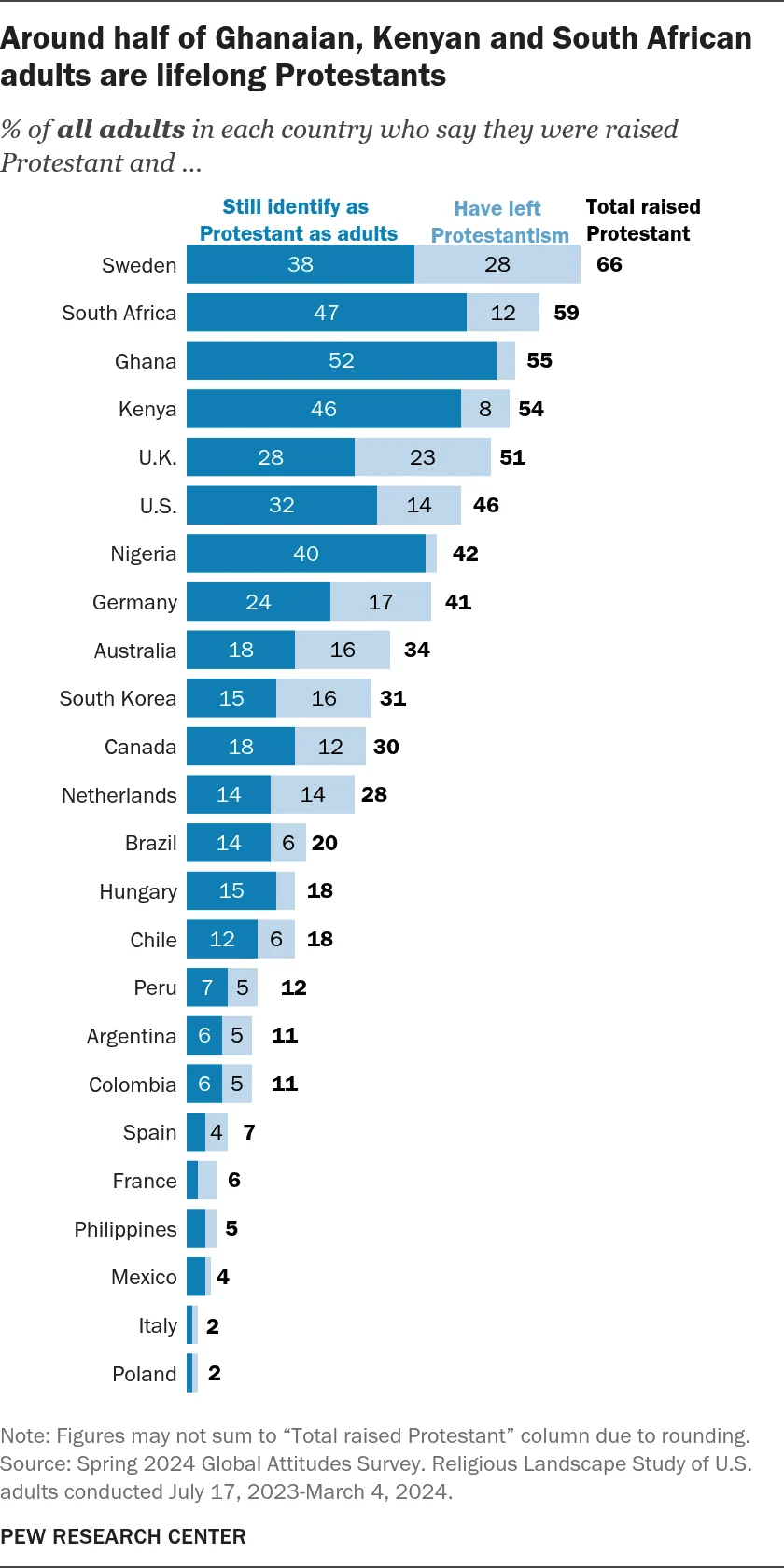
Christianity has experienced some of the most significant global shifts in religious affiliation, with a notable portion of individuals leaving their childhood faiths, according to comprehensive 2024 surveys conducted by the Pew Research Center across 24 countries. Religious switching, defined as a change in religious identity from childhood to adulthood, reveals distinct patterns within Christianity’s two largest branches: Catholicism and Protestantism. This analysis delves into the intricate dynamics of movement into, out of, and between these denominations, drawing upon extensive survey data from diverse regions including Asia and the Pacific, Europe, Latin America, North America, and sub-Saharan Africa.
Understanding Religious Switching
Religious switching encompasses a broad spectrum of changes in faith identity. It is not solely about formal conversion processes but includes shifts from a religious upbringing to identifying as religiously unaffiliated, or moving between different religious traditions. The Pew Research Center’s methodology distinguishes between an individual’s religion of upbringing and their current religious identification, providing a clear framework for analyzing these demographic movements. The current analysis focuses on the flow of individuals into, out of, and between Catholicism and Protestantism.
Research Methodology and Funding
This in-depth study on religious switching within Christianity is part of the Pew-Templeton Global Religious Futures project, an initiative dedicated to understanding the evolving landscape of religion and its societal impact worldwide. The project is funded by The Pew Charitable Trusts and the John Templeton Foundation (grant 63095). The data for this analysis comes from Pew Research Center surveys conducted in the spring of 2024, supplemented by the Center’s 2023-24 U.S. Religious Landscape Study for American data. Some countries were excluded from the international analysis if they did not differentiate between Protestant and Catholic populations or if these groups constituted less than 1% of the population. Detailed survey questions, methodologies, and data tables are available through Pew Research Center’s publications.
The Shifting Landscape of Catholicism
Catholicism, historically a dominant religious force in many parts of the world, is experiencing significant flux due to religious switching. In 12 of the 24 surveyed countries, the majority of the adult population was raised Catholic. These figures range from 59% in Hungary to an overwhelming 96% in Poland, where lifelong adherence remains exceptionally high, with 92% of all Polish adults identifying as Catholic throughout their lives.

However, a substantial number of adults who were raised Catholic no longer identify with the faith. In 15 of the surveyed countries, former Catholics constitute 10% or more of the total population. This trend indicates a significant outflow from Catholicism. Furthermore, the influx of new adherents into Catholicism from other faiths or from non-religious backgrounds is relatively limited across the studied regions.
Key Trends in Catholic Religious Switching:
- Significant Losses: In 21 out of 24 countries, more individuals have left Catholicism than have joined it through switching. This net loss is particularly pronounced in European and Latin American nations.
- Net Gain in Hungary: Hungary stands out as the sole country among those surveyed where more individuals have joined Catholicism (5%) than have left it (2%) through switching.
- Mixed Movement in Kenya and South Korea: Kenya and South Korea show a relatively balanced movement, with similar proportions of people entering and exiting Catholicism via religious switching.
- Destinations of Former Catholics: Individuals leaving Catholicism most commonly transition to Protestant denominations or become religiously unaffiliated (identifying as atheist, agnostic, or "nothing in particular"). This disaffiliation is especially prevalent in Europe and Latin America. For example, in Chile, 19% of all adults are former Catholics who now identify with no religion. In contrast, in regions like Kenya, Brazil, Ghana, Nigeria, and the Philippines, former Catholics are more likely to embrace Protestantism than to become religiously unaffiliated.
- Enduring Majorities: Despite these shifts, Catholicism remains the majority religion in eight of the 24 surveyed countries. Poland leads with 92% of its adult population identifying as Catholic, followed by the Philippines (80%) and Italy (69%).
Implications for Catholicism:
The data suggests a long-term demographic challenge for Catholicism, particularly in regions with historically strong Catholic traditions. While adherence remains high in some areas, the net outflow in many countries necessitates strategic engagement and retention efforts. The trend of former Catholics joining Protestant communities also indicates a shift in the Christian landscape, potentially influencing theological discourse and community structures.
The Evolving Landscape of Protestantism
Protestantism presents a more varied picture regarding religious switching, with instances of both net gains and net losses across the surveyed countries. While former Protestants are a notable demographic in many nations, Protestantism has also experienced net gains from religious switching in a significant number of countries, nearly as many as those experiencing net losses.

Key Trends in Protestant Religious Switching:
- Sizable Former Protestant Population: Similar to Catholicism, former Protestants constitute a considerable segment of the population in various countries. In nine of the 24 surveyed nations, this group represents 10% or more of the population.
- Net Gains in Several Regions: Protestantism has seen net gains from religious switching in several countries, most notably in Latin America. In Brazil, for example, 15% of adults have joined Protestantism after not being raised in the faith, compared to 6% who have left it. This results in a 9-point net gain, with many of these new adherents being former Catholics.
- Major Outflows in European Nations: Conversely, countries like Sweden, the United Kingdom, and Germany are experiencing the largest net losses from Protestantism.
- Destinations of Former Protestants: Adults leaving Protestantism predominantly become religiously unaffiliated. In Australia, 15% of adults are former Protestants who now identify with no religion, with very few transitioning to Catholicism or other faiths.
- Majority Status: Protestantism accounts for a majority of the population in two of the surveyed countries: Ghana (62%) and Kenya (55%). In most other analyzed countries, Protestants represent no more than approximately a quarter of the total population.
Implications for Protestantism:
The mixed results for Protestantism suggest a dynamic and adaptive religious environment. The ability of Protestant denominations to attract individuals from other faiths and from non-religious backgrounds in certain regions highlights their perceived relevance and appeal. The data also points to the significant role of Protestantism as a destination for individuals leaving Catholicism, contributing to its growth in specific geopolitical contexts. The trend of former Protestants becoming religiously unaffiliated underscores the broader societal shift towards secularization in some parts of the world.
Broader Societal and Religious Implications
The findings from the Pew Research Center’s surveys underscore a global trend of religious fluidity. The substantial numbers of individuals switching faiths indicate that religious identity is increasingly a matter of personal choice and evolution rather than solely a product of childhood upbringing. This phenomenon has profound implications for the future of religious institutions, their demographic stability, and their influence on public life.
Factors Influencing Switching:
While this analysis focuses on the patterns of switching, underlying drivers likely include socioeconomic changes, urbanization, globalization, access to information, and evolving cultural norms. The varying rates of switching across different countries and regions suggest that local contexts play a crucial role in shaping individuals’ religious journeys.

The Rise of the Religiously Unaffiliated:
The data consistently shows that a significant portion of individuals leaving established religions, both Catholic and Protestant, are becoming religiously unaffiliated. This growing segment of the population represents a distinct demographic and cultural force that warrants further study.
Interdenominational Dynamics:
The movement between Catholicism and Protestantism highlights the ongoing, complex relationship between these major Christian traditions. The fact that former Catholics are frequently becoming Protestants suggests a degree of doctrinal or cultural overlap that facilitates such transitions, or perhaps a perception of greater suitability for individuals seeking a particular form of religious expression.
Future Trajectories:
The Pew Research Center’s ongoing research into religious trends will be critical in tracking these shifts. The patterns observed in 2024 suggest a continued evolution of the global religious landscape, with Christianity, particularly its Catholic and Protestant branches, undergoing significant internal redistribution. Understanding these dynamics is essential for comprehending the future role of religion in societies worldwide.
The comprehensive data collected by the Pew Research Center provides an invaluable snapshot of religious switching, revealing a complex tapestry of movement, adherence, and disaffiliation across Catholicism and Protestantism. These trends are not static and will continue to shape the religious and social fabric of nations for decades to come.