In an increasingly volatile, uncertain, complex, and ambiguous (VUCA) world, marked by global pandemics, geopolitical shifts, rapid technological advancements, and economic fluctuations, the imperative for robust and adaptive organisational structures has never been more pronounced. Amidst these pervasive uncertainties, the composition of an organisation’s teams emerges as a critical determinant of its capacity to navigate challenges, innovate, and sustain growth. While discussions around diversity, equity, and inclusion (DEI) have rightfully gained significant traction, often centring on demographic representation such as gender, race, and ethnicity, a growing body of research underscores the often-overlooked yet profoundly impactful dimension of cognitive diversity. This distinct form of diversity, focusing on the varied ways individuals perceive, process, and apply information, is increasingly recognised as a pivotal differentiator for teams striving for enhanced innovation, superior problem-solving, and robust risk mitigation.
The established consensus within modern business literature is that a broad spectrum of thinking styles and diverse perspectives serves as a potent catalyst for organisational excellence. When coupled with inclusive leadership practices, this intellectual heterogeneity not only fosters innovation and sharpens problem-solving capabilities but also significantly reduces the incidence of unforeseen risks. Furthermore, an environment that genuinely values and integrates varied viewpoints leads to smoother implementation of decisions, bolstered by increased buy-in and trust across the team. Despite these well-documented benefits, many organisations and their DEI initiatives continue to predominantly emphasise achieving demographic parity and representation. While these efforts are undeniably crucial for social justice and creating equitable workplaces, they frequently fall short of fully harnessing the profound potential embedded within the diverse cognitive profiles of their workforce. The true harvest of diversity’s benefits materialises when attention extends beyond visible characteristics to encompass the intricate tapestry of human thought processes.
Understanding Cognitive Diversity: Insights from Decades of Research
For decades, prominent professors, researchers, and authors Alison Reynolds and David Lewis have dedicated their work to meticulously studying how individuals engage with new, uncertain, and complex situations. Their extensive investigations have sought to identify the defining characteristics of the most effective and efficient problem-solving teams. Their findings consistently and unanimously point to two critical factors: cognitive diversity and psychological safety. Teams excelling in these areas typically demonstrate high levels of curiosity and a propensity for experimentation. Conversely, teams lacking in either of these traits often succumb to the pitfalls of group conformity or become overly combative, impeding progress and fostering an unproductive environment.
Reynolds and Lewis, drawing upon an assessment tool initially developed by psychiatrist Peter Robertson, categorise cognitive diversity into two primary dimensions: information processing style and expertise facilitation. These dimensions provide a structured framework for understanding the nuances of how individuals contribute intellectually to a team.
-
Knowledge and Information Processing: This dimension assesses an individual’s preferred approach when confronted with novel situations, uncertainty, or complex issues. It gauges the extent to which a person prefers to consolidate and implement existing knowledge and proven methodologies versus their inclination to generate entirely new knowledge, explore uncharted territories, and devise innovative solutions. A balance here ensures both stability and adaptability.
-
Perspective and Expertise Facilitation: This dimension evaluates an individual’s preference regarding the application of expertise. It differentiates between those who primarily prefer to apply their own specialized knowledge and insights and those who are more inclined to orchestrate, synthesise, and leverage the diverse ideas and expertise of other team members. Teams thrive when both approaches are present and effectively integrated.
The researchers’ studies unequivocally demonstrate that teams comprising members with a high degree of diversity across both these parameters consistently outperform their less diverse counterparts, particularly when navigating new, uncertain, and complex scenarios. Such teams inherently access a broader spectrum of knowledge, perspectives, and potential solutions. When this cognitive richness is combined with a culture of psychological safety—where individuals feel safe to voice ideas, challenge assumptions, and make mistakes without fear of punitive repercussions—it cultivates behaviours and collaborative dynamics that encourage constructive conflict and deep exploration. This environment fosters a willingness to engage with differing viewpoints, leading to more rigorous analysis and ultimately, superior outcomes.
Beyond these two core dimensions, cognitive diversity also encompasses a broader array of individual personality styles and mental frameworks. This includes traits such as extroversion and introversion, varying approaches to risk assessment, preferred processes for task execution, differing capacities for handling complexity, and much more. The inherent variance in these attributes across individuals underscores the need for complementary team members, ensuring that a team’s collective intelligence is greater than the sum of its individual parts.
The logical rationale for embracing cognitive diversity in addressing unknown issues is compelling: effectively tackling novel challenges requires both the judicious application of existing knowledge and the proactive exploration of what is yet unknown. However, achieving this delicate balance in team composition remains a significant challenge for many organisations. The current prevailing emphasis on demographic diversity, while fundamentally important, frequently overshadows the critical need to intentionally cultivate cognitive diversity. This is not to diminish the importance of demographic diversity, which plays a vital role in representation and equity, but rather to highlight the necessity of also actively leveraging the benefits derived from diverse ways of processing information, applying expertise, and adopting varied perspectives.
The Evolution of Diversity Research: From Demographics to Deep-Level Differences
The journey of diversity research in the workplace has seen a significant evolution over the past few decades. Initially, the focus was largely on surface-level diversity, driven by legal mandates and social equity movements. The 1960s and 70s saw the rise of affirmative action in many Western countries, aimed at correcting historical injustices and ensuring equal opportunities for underrepresented groups. This era prioritised visible characteristics like race, gender, and age, primarily focusing on fair representation and non-discrimination.
By the 1990s, the conversation began to shift from mere compliance to the "business case" for diversity. Early studies started to link demographic diversity to improved organisational performance, albeit often through indirect mechanisms like enhanced market understanding or brand reputation. Organisations began to understand that a diverse workforce could better serve a diverse customer base and bring varied perspectives to the table. Landmark reports from consulting firms like McKinsey & Company consistently highlighted a correlation between diverse leadership teams (demographically speaking) and stronger financial performance, spurring further corporate investment in DEI initiatives. For instance, a 2015 McKinsey report found that companies in the top quartile for racial and ethnic diversity were 35% more likely to have financial returns above their respective national industry medians. This provided a powerful economic incentive for companies to pursue demographic diversity goals.
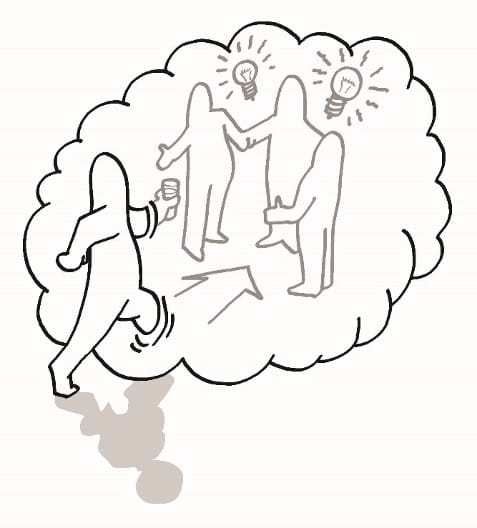
However, as the field matured, researchers began to probe deeper. While demographic diversity can often lead to cognitive diversity, it is not a direct guarantee. Two individuals of the same gender or race can have vastly different cognitive styles, just as two individuals of different genders or races can share similar cognitive approaches. This realisation paved the way for the emergence of "deep-level diversity" as a critical area of study, with cognitive diversity at its core. Researchers like Reynolds and Lewis, building on foundational work in cognitive psychology and team dynamics, began to systematically unpack how different thinking styles directly influence team effectiveness, innovation rates, and problem-solving speed. Their decades of work, particularly in the 2000s and 2010s, provided empirical evidence to demonstrate that while demographic diversity opens the door to varied perspectives, it is the deliberate inclusion and leveraging of cognitive differences that truly unlock a team’s full potential. This shift represents a maturation of the diversity dialogue, moving beyond mere representation to a strategic understanding of how different minds working together create superior outcomes.
Fostering an Inclusive Environment: The Role of Leadership and Culture
The mere presence of cognitive diversity within a team is insufficient to guarantee its benefits. Without an inclusive environment, diverse thoughts can remain unspoken, leading to frustration, disengagement, and underperformance. This is where the practice of inclusive leadership and the cultivation of an inclusive culture become paramount. Inclusive leadership ensures that team members perceive fairness and respect in their treatment, feel valued for their contributions, experience a genuine sense of belonging to the group, are actively invited and encouraged to voice their perspectives, and feel empowered to act on their ideas.
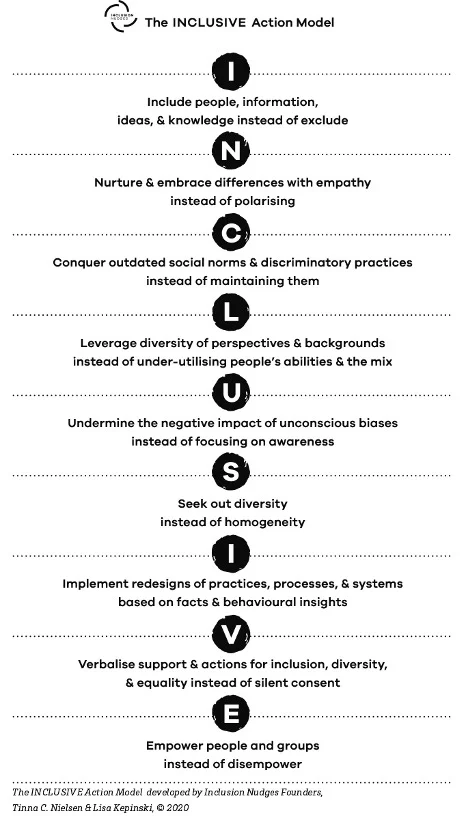
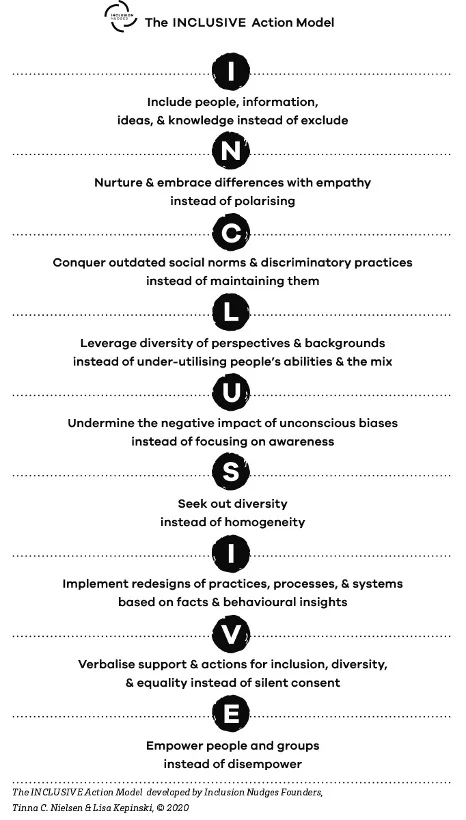
Achieving such an environment demands a multifaceted approach, requiring simultaneous effort from both leaders and team members across various dimensions. Recognising this complexity, Tinna C. Nielsen and Lisa R. Nielson created the Inclusion Nudges Inclusive Action Model. This comprehensive framework offers a holistic approach to building inclusive cultures, structures, and behaviours within organisations, integrating insights from behavioural science and psychology.
Despite a noticeable increase in support and advocacy for diversity, equity, and inclusion from CEOs and global leaders in recent years, a significant challenge persists in cascading this executive-level commitment across all layers of management within organisations and ensuring tangible action is taken. True cultural change, which underpins the effective harnessing of cognitive diversity, only materialises when these intentions translate into consistent, daily behaviours and practices at every level.
The profound impact of leadership behaviour on inclusion is well-documented. Research by Deloitte Australia, for instance, indicates that the behaviours exhibited by leaders can account for up to a 70 percentage point difference between the proportion of employees who report feeling highly included and those who do not. This disparity is even more pronounced for members of minority groups, for whom inclusive leadership behaviours have an even greater, often transformative, effect on their sense of belonging and engagement.
However, a critical barrier to widespread inclusive action remains: many leaders, despite their willingness, express feeling "ill-equipped" to act inclusively. They frequently articulate a lack of knowledge regarding how to implement inclusive practices, particularly when it comes to navigating sensitive conversations and facilitating dialogues about issues related to exclusion and discrimination. This self-reported deficit in capability often stems from a fear of saying or doing the wrong thing, leading to inaction or superficial efforts.
To address this critical gap, Lisa and Tinna authored the "Inclusion Nudges for Leaders" Action Guide, which offers 30 easy-to-apply inclusive actions. This resource provides leaders across diverse organisations and sectors with practical, evidence-based behavioural designs to make inclusion the default and the norm in their leadership styles. The guide’s effectiveness lies in its step-by-step action descriptions, which empower leaders to confidently apply proven designs in their daily work. This practical application not only enhances their understanding of inclusive practices but also significantly boosts their confidence, encouraging them to take further actions and thereby spark a broader, more profound cultural transformation. The motivation behind creating this and other Inclusion Nudges guidebooks was to dismantle the dynamic where leaders felt paralysed by uncertainty, fearing blame or shame if they openly admitted their lack of expertise in fostering inclusion. By providing clear, actionable pathways, these resources aim to accelerate the journey towards truly inclusive and cognitively diverse workplaces.
Broader Impact and Strategic Implications
The strategic implications of embracing cognitive diversity extend far beyond internal team dynamics, influencing an organisation’s market position, innovation pipeline, and long-term sustainability. In a rapidly evolving global economy, companies that actively cultivate and leverage diverse thinking styles are better positioned to anticipate market shifts, identify emerging opportunities, and respond effectively to competitive threats. They are more likely to develop breakthrough products and services, enter new markets successfully, and build resilient business models capable of weathering economic downturns and unforeseen disruptions.
Moreover, a commitment to cognitive diversity enhances an organisation’s employer brand, making it a more attractive destination for top talent. In an era where skilled professionals increasingly seek purpose-driven work environments and opportunities for intellectual growth, companies known for valuing diverse perspectives gain a significant edge in the talent wars. This, in turn, creates a virtuous cycle: diverse talent brings more diverse thinking, which fuels innovation, leading to greater success and further attracting top talent.
Conversely, organisations that neglect cognitive diversity risk stagnation. Homogeneous teams, even if demographically diverse, are prone to "groupthink," where a desire for conformity leads to a failure to critically evaluate alternatives or consider dissenting viewpoints. This can result in poor decision-making, missed opportunities, and a reduced capacity for innovation, ultimately undermining competitiveness and long-term viability. The cost of such oversight can manifest in significant financial losses, reputational damage, and a decline in employee morale and productivity.
In conclusion, while demographic diversity remains a cornerstone of equitable and just workplaces, the strategic imperative for the modern organisation lies in actively seeking, nurturing, and leveraging cognitive diversity. By understanding and valuing the myriad ways individuals think, process information, and solve problems, and by empowering leaders with the tools and confidence to foster truly inclusive environments, organisations can unlock unparalleled levels of innovation, resilience, and sustained success in an ever-complex world. The journey towards this deeper form of diversity is not without its challenges, but the rewards—in terms of enhanced performance, competitive advantage, and a more engaged workforce—are profoundly transformative.