While global population growth is projected to decelerate in the latter half of this century, Africa is emerging as a dynamic counterpoint, characterized by a remarkably young and rapidly expanding populace. This demographic trajectory, meticulously analyzed by the Pew Research Center utilizing data from the United Nations’ World Population Prospects, signals a profound shift in the global demographic landscape, with far-reaching implications for economic development, resource management, and geopolitical influence. The latest available data, from 2023, serves as a crucial benchmark, with subsequent figures representing projections based on intricate demographic modeling.
The Unfolding African Demographic Narrative
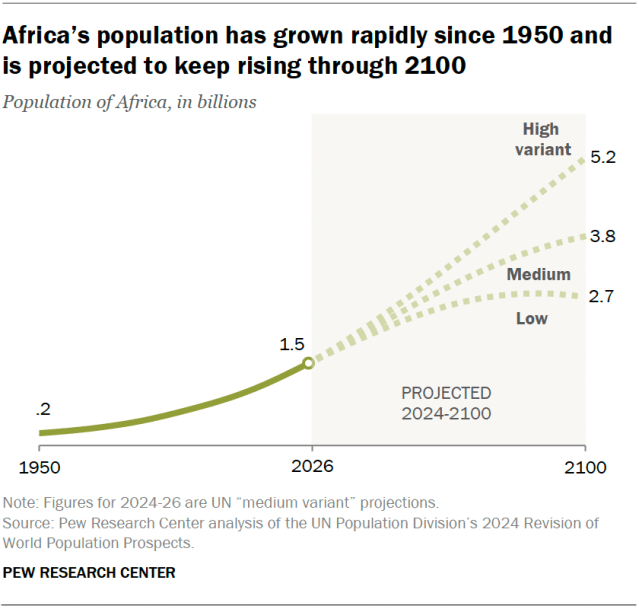
The foundational data reveals a dramatic expansion of Africa’s population. Since 1950, the continent’s inhabitants have increased more than sixfold, a testament to sustained high fertility rates and declining mortality. This surge amounts to an addition of approximately 1.3 billion people over the past seven decades. The United Nations’ "medium variant" projection anticipates this growth will continue unabated through the end of the century, estimating Africa’s population to reach a staggering 3.8 billion by 2100.

The UN’s projection methodology, which employs probabilistic models accounting for historical trends and the experiences of comparable nations, offers a nuanced view of potential future scenarios. Under a "high variant" scenario, where total fertility rates are projected to be 0.5 births per woman higher than the medium variant, Africa’s population could surge to 5.2 billion by 2100. Conversely, even a "low variant" scenario, with a projected fertility rate 0.5 births per woman lower than the medium variant, still forecasts a substantial population of 2.7 billion by 2100, with a peak population of 2.8 billion around 2087. This consistent upward trend underscores the unique demographic momentum of the African continent.
A Youthful Continent Shaping the Future
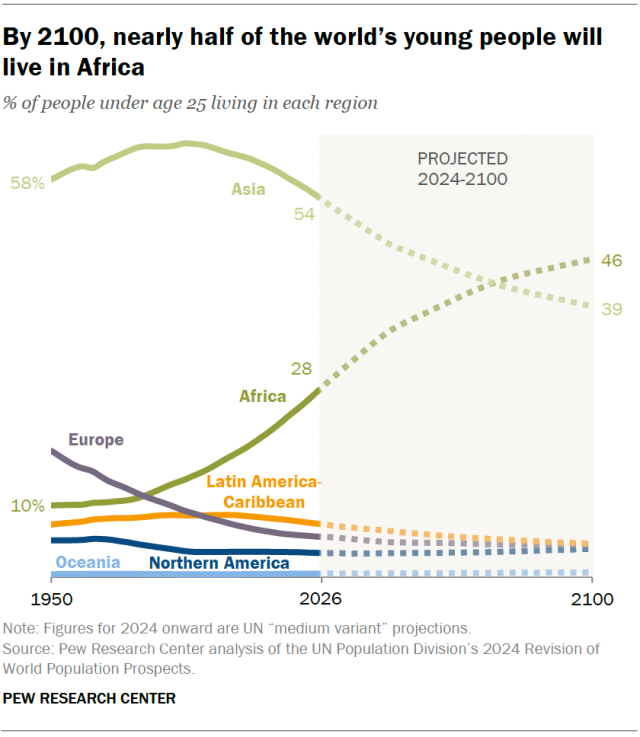
Africa’s demographic dynamism is most vividly illustrated by its extraordinarily young population. Currently, 28% of all individuals under the age of 25 reside in Africa, and this age group constitutes 19% of the continent’s total population. This youthful demographic profile has been a consistent feature since 1950 and is projected to intensify significantly.
In 1950, Africa was home to only 10% of the world’s young people, with Asia being the dominant region. By 2026, this proportion has more than doubled to 28%. The projections indicate that by 2073, Africa is expected to surpass Asia as the continent with the largest share of the global youth population under the medium variant scenario. By 2100, the demographic shift will be even more pronounced, with an estimated 46% of all individuals under 25 predicted to live in Africa, compared to 39% in Asia. This concentration of youth will undoubtedly shape the continent’s future workforce, consumption patterns, and political landscape.
Shifting Global Power Dynamics: Africa’s Ascendancy in Population Metrics
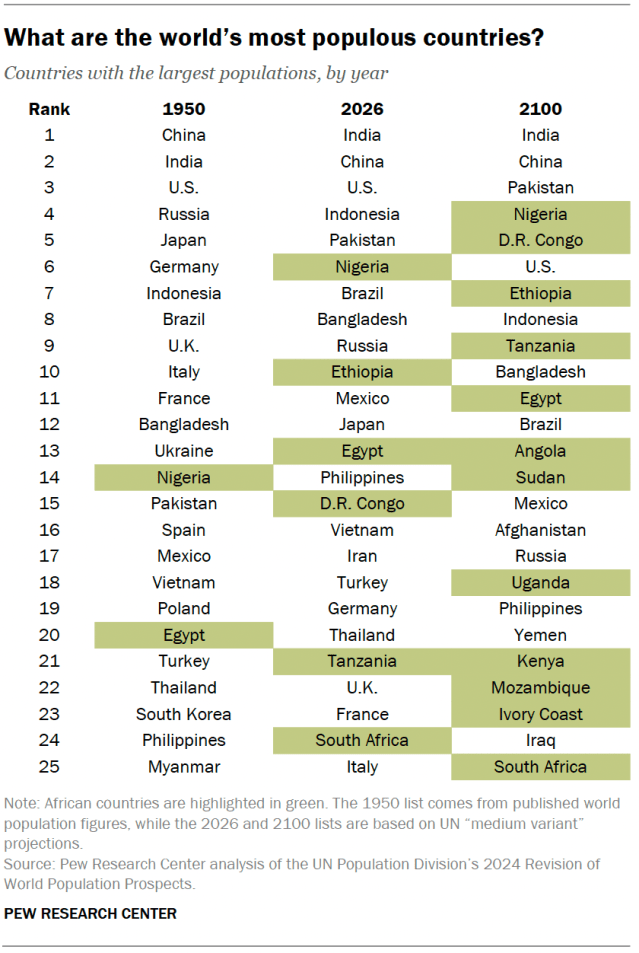
The dramatic population growth in Africa is not only a continental phenomenon but is also poised to reshape global demographic rankings. By 2100, it is projected that 12 of the world’s 25 most populous countries will be located in Africa.
Nigeria, currently the most populous nation on the continent and the sixth most populous globally, is expected to climb to the fourth position by 2100. Other African nations set to feature prominently in global population rankings include the Democratic Republic of the Congo, projected to be the fifth most populous country, Ethiopia at seventh, and Tanzania at ninth.
This African ascendancy in population figures stands in stark contrast to demographic trends in other regions. Europe, for instance, is expected to see a decline in its population share. By 2100, Russia is anticipated to be the sole European country among the world’s top 25 most populous nations, a significant drop from its current ninth position, with its population projected to contract. Meanwhile, India and China are expected to retain their status as the two most populous countries globally. This redistribution of population will inevitably influence global economic power, political influence, and demand for resources.
Sustained Fertility and Evolving Demographics
A key driver of Africa’s population growth is its fertility rate, which remains above the replacement level of approximately 2.1 births per woman – currently averaging around 3.9 births per woman across the continent. This contrasts sharply with other global regions where fertility rates have fallen below replacement levels.
However, significant variations exist within Africa. Chad, for example, has a current fertility rate of 5.8 births per woman, while Tunisia’s stands at 1.8. Despite the overall continental trend, Africa is experiencing a decline in fertility. The UN projects a fall in the continent’s fertility rate from 3.9 to 2.8 births per woman by 2050, and further to 2.0 by the end of the century. This represents a substantial decrease from the peak fertility rate of 6.7 births per woman recorded in 1972. This decline, while gradual, signifies a long-term demographic transition that will shape the age structure of the population.
The Maturing African Population: A Shift in Age Structure
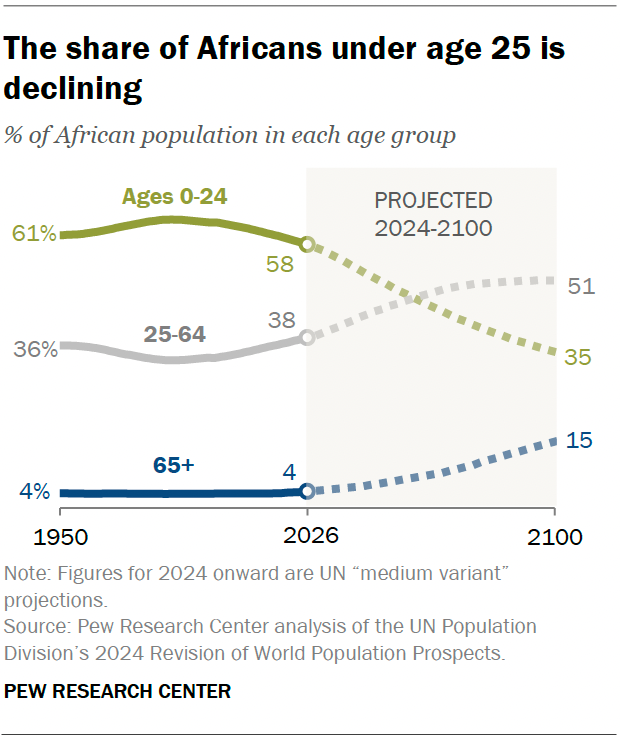
While Africa will continue to be characterized by a large youth population, its median age is projected to rise significantly. Currently at approximately 19 years, the median age in Africa is expected to reach 35 by 2100. This demographic evolution is a consequence of both falling fertility rates and increasing life expectancies.
Consequently, the proportion of Africa’s population under the age of 25, which has historically constituted around 60%, is projected to decline to approximately 35% by 2100. Concurrently, the share of the working-age population (25 to 64 years) is expected to increase to 51%, and the proportion of individuals aged 65 and older is projected to more than triple its current share, reaching 15% of the continent’s population by 2100. This shift will bring Africa’s demographic profile more in line with global trends, where adults aged 25 to 64 have long been the largest age cohort. This evolving age structure will present both opportunities and challenges for social services, healthcare systems, and labor markets.
Context and Methodology: Understanding the Projections
This comprehensive analysis is rooted in the United Nations’ 2024 Revision of World Population Prospects, a leading source for global demographic data and projections. The Pew Research Center’s examination, conducted ahead of Africa Day on May 25th, aimed to illuminate the significant demographic transformations on the continent since 1950 and those anticipated through 2100.
The UN’s projections are built upon sophisticated methodologies that incorporate estimates of population size, birth rates, death rates, and international migration. Recognizing the inherent uncertainties in forecasting future demographic trends, the UN employs probabilistic methods, generating a range of scenarios (low, medium, and high variants) based on thousands of simulations. Unless otherwise specified, this analysis utilizes the UN’s "medium variant" scenario, representing the mean outcome across these simulations, providing a balanced perspective on future demographic trajectories. The research underscores the Pew Research Center’s commitment to providing data-driven insights into global population dynamics and their societal implications.
Broader Implications and Future Outlook
The demographic trends unfolding across Africa carry profound implications for the continent and the world. The burgeoning population, coupled with a youthful demographic, presents an immense potential workforce and consumer market, offering opportunities for economic growth and innovation. However, it also necessitates substantial investments in education, healthcare, infrastructure, and job creation to harness this demographic dividend effectively.
The increasing concentration of the world’s youth in Africa will likely amplify the continent’s geopolitical significance. As other regions face aging populations and declining birth rates, Africa’s demographic vitality will position it as a key player in global economic and political affairs. Managing this demographic transition will require proactive policy-making, regional cooperation, and sustainable development strategies to ensure that Africa’s growing population translates into widespread prosperity and stability. The coming decades will be critical in shaping whether this demographic surge becomes a catalyst for unprecedented progress or a source of significant challenges.