
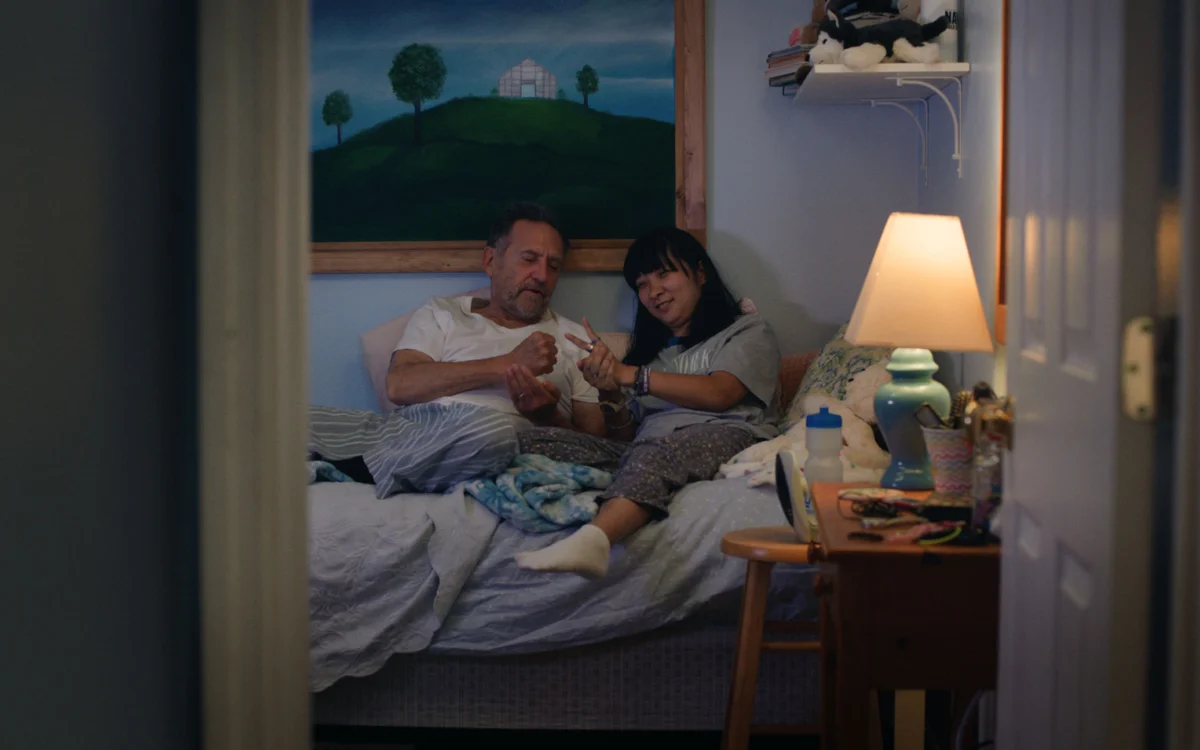
The intersection of personal trauma, family devotion, and systemic critique has long served as fertile ground for independent cinema, but few modern features achieve the radical intimacy of Liz Sargent’s critically acclaimed narrative debut, Take Me Home. Set against the humid, sun-bleached backdrop of suburban East Orlando, Florida, the 90-minute film examines the crushing weight of familial caregiving, the labyrinthine failures of the American medical system, and the fragile beauty of a blended family navigating cognitive disabilities and cognitive decline.
What elevates Take Me Home from a standard domestic drama into a remarkable cinematic achievement is its unflinching commitment to authenticity. The film is shot inside the filmmaker’s childhood home and stars her 37-year-old sister, Anna Sargent, who lives with cognitive disabilities. While professional actors—including Victor Slezak and Marceline Hugot as the parents, Bob and Joan, and Ali Ahn as sister Emily—step into fictionalized versions of the family dynamic, the emotional core remains intensely autobiographical. The narrative follows Anna as she struggles to adapt to the sudden loss of her mother, manage her father’s advancing memory loss, and renegotiate her relationship with her siblings.
The Genesis of a Movement: From Personal Anxiety to Cinematic Vision
The seeds of Take Me Home were planted during a period of profound personal crisis for Liz Sargent. In her twenties, the filmmaker found herself grappling with existential anxiety regarding the future of her family. As one of seven children adopted by her parents—joining four biological children—Sargent watched as her aging parents approached the twilight of their caregiving years, leaving an uncertain roadmap for her youngest sister, Anna.
"There was a time in my 20s where I just felt this extreme anxiety about what the future held for my family, for my parents, and for my youngest sister—but also where I belonged with my own hopes and dreams and goals," Liz Sargent reflected. "I was drowning in the medical system trying to fight for my sister who has mental illness and getting her health care, and finding guardianship for Anna, and thinking about my parents aging out of their role as caregivers… It became this film of capturing that moment and talking about how we make those decisions and what’s available in this country."
This sense of entrapment and love translated into a deliberate artistic choice regarding the film’s setting. Choosing to film in Florida in August was not merely an aesthetic decision, but a thematic one. The grueling heat and oppressive humidity mirror the psychological pressure cooker of the family’s daily existence, punctuated by sudden, dramatic tropical downpours that wash the landscape in an ethereal, glowing light.
"We shot in August. It’s the worst. It’s the hottest. But the downpours are sort of magical in a way," Sargent said. "Suddenly it disappears, and there’s this beautiful light that shines through, and everything’s glowing around it from the water. I feel like there’s something about that Florida that I wanted to capture, like this is the American dream. There’s also the harshness of the environment and these people trying to survive within it."
A Chronological Leap: From a 16-Minute Short to International Acclaim
The journey of Take Me Home is a testament to the tenacity of independent filmmakers and the growing appetite for stories centering marginalized narratives. The project initially took shape as a 16-minute short film, which captured the attention of programmers and audiences alike, earning a coveted premiere at the prestigious Sundance Film Festival in 2023.
Following a successful circuit across dozens of regional and national showcases—including the Florida Film Festival—Sargent’s vision caught the eye of major industry heavyweights. She was awarded a transformative $1 million production grant through the Tribeca Film Festival and AT&T Untold Stories initiative, a partnership designed to champion underrepresented voices in cinema.
Within a single year, Sargent successfully expanded the short film into a fully realized feature-length narrative. The trajectory of the completed film over the subsequent months underscored its universal resonance:
- January 2026: The feature-length version of Take Me Home premiered at the Sundance Film Festival, where Sargent was honored with a prominent screenwriting award.
- Early 2026: The film secured its international premiere at the Berlin International Film Festival, introducing European audiences to the nuances of American eldercare and disability rights.
- Mid-2026: The production made its New York premiere at the Tribeca Film Festival, paving the way for commercial distribution.
- Late September 2026: The film officially opens in New York City theaters on Wednesday, followed by a Los Angeles theatrical release on September 30.
Redefining Accessibility on Set with Caring Across Generations
Achieving an award-winning performance from a first-time lead actor with cognitive disabilities required a radical reimagining of traditional film set protocols. Recognizing that conventional production environments are frequently hostile or inaccessible to neurodivergent performers, the production team partnered closely with Caring Across Generations, a national advocacy organization dedicated to shifting public policy and cultural attitudes toward caregiving.
This collaboration enabled the implementation of specialized on-set infrastructure designed to protect and empower Anna Sargent. Rather than forcing the actor to adapt to the relentless and often chaotic pace of a professional film set, the production adapted to her needs.
"We were able to provide some grant funding to the film in order to make sure she had a caregiver, an accessibility producer that trained everybody else to work with Anna in the way that she needed to be worked with, and also an acting coach to really work in a personalized way to help Anna prepare for all of her scenes," explained Lydia Storie, an executive producer on the film and director of culture change for Caring Across Generations. "Having that in place allowed for her to deliver an award-winning performance."
This intentional approach relied heavily on improvisational techniques, allowing Anna to inhabit her character naturally without the rigid constraints of traditional script memorization. The presence of a dedicated disability producer ensured that the cast and crew were continuously educated on communication styles, sensory sensitivities, and emotional pacing.
Broader Socio-Economic Implications: The Crisis of American Caregiving
While Take Me Home is deeply rooted in the specificity of one Florida family’s experience, its release taps into a massive, often invisible socioeconomic crisis across the United States. According to demographic data highlighted by advocacy groups, an estimated 130 million Americans currently find themselves serving in formal or informal caregiving roles. These individuals frequently navigate a fragmented healthcare landscape marked by prohibitive costs, bureaucratic red tape, and a severe shortage of institutional and community-based support structures.
The economic and psychological toll on these families is profound. Caregivers regularly face professional stagnation, financial instability, and chronic stress as they attempt to balance their own life aspirations with the around-the-clock needs of aging parents or siblings with disabilities. Take Me Home captures this tension directly, utilizing the middle act of the film to expose the financial vulnerability and existential dread that accompany the depletion of family resources.
The impact of this mirroring was sharply felt during a special screening of the film at Bonnet Springs Park in Lakeland—just miles from where the film’s concluding scenes take place. For the first time, Liz Sargent’s parents viewed the completed feature alongside a public audience.
"I think it was very moving for them to get to be in an audience with people and understand that their personal struggles, like the intimate details that I’m sharing about our lives, are normalized. There’s a vulnerability that we all have," Liz Sargent noted. "It was beautiful to see people come up to them afterward and talk to them about their own care stories."
A Vision for an Inclusive Future
Despite confronting the stark realities of systemic neglect and personal loss, Take Me Home refuses to settle into despair. The film’s final act pivots toward cautious optimism, painting a picture of what dignity, community support, and systemic reform could look like for individuals requiring lifelong care.
In an era where political and cultural discourse regarding social safety nets is increasingly polarized, the filmmakers argue that emotional connection remains the most potent catalyst for systemic change. By inviting audiences to intimately know and love Anna, the film seeks to humanize statistics and transform passive viewers into active advocates.
"It is possible to create a world where we can all thrive and have our needs met. What I want is for people to identify and fall in love with Anna. I think that kind of love and protection is what’s going to change the way we vote and interact in this world," Liz Sargent asserted.
Lydia Storie echoed this sentiment, emphasizing that the struggles depicted on screen are not isolated anomalies, but shared human challenges that necessitate collective solutions.
"When I watch this film through to the end, I see this vision of what can be when we recognize that all of us deserve better," Storie concluded. "A more supportive and inclusive future will be better for all of us."
As Take Me Home rolls out to theaters in New York and Los Angeles, its legacy extends far beyond the traditional metrics of independent box office success. By bridging the gap between lived reality and cinematic art, Sargent and her collaborators have crafted a cultural artifact that challenges the nation to rethink how it values care, community, and the most vulnerable among us.




