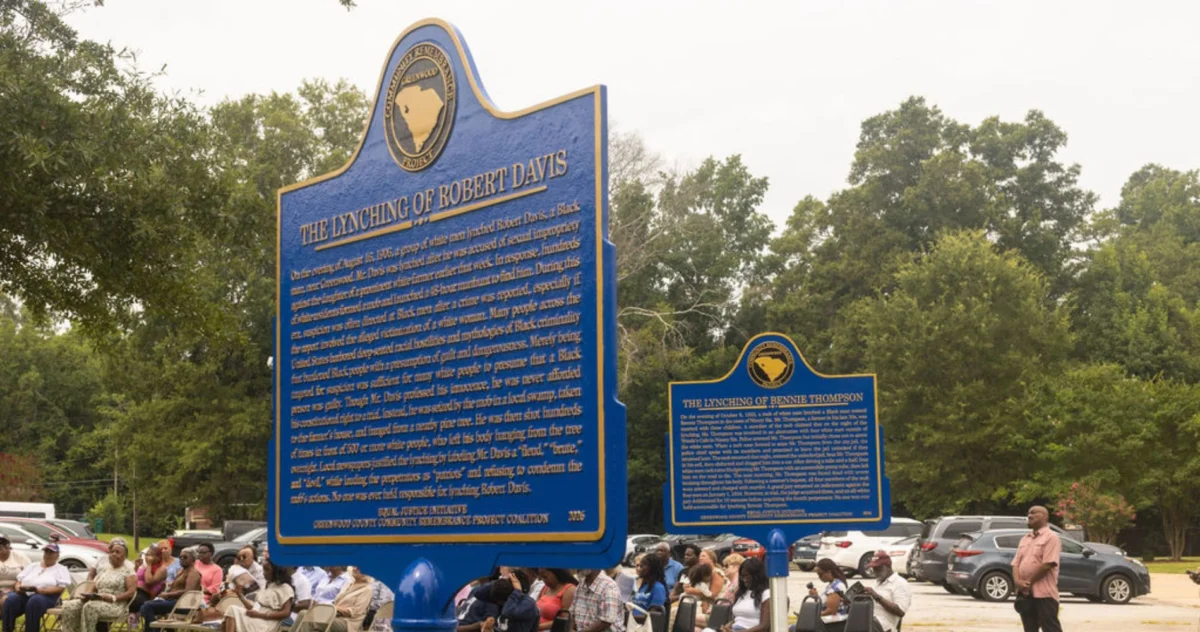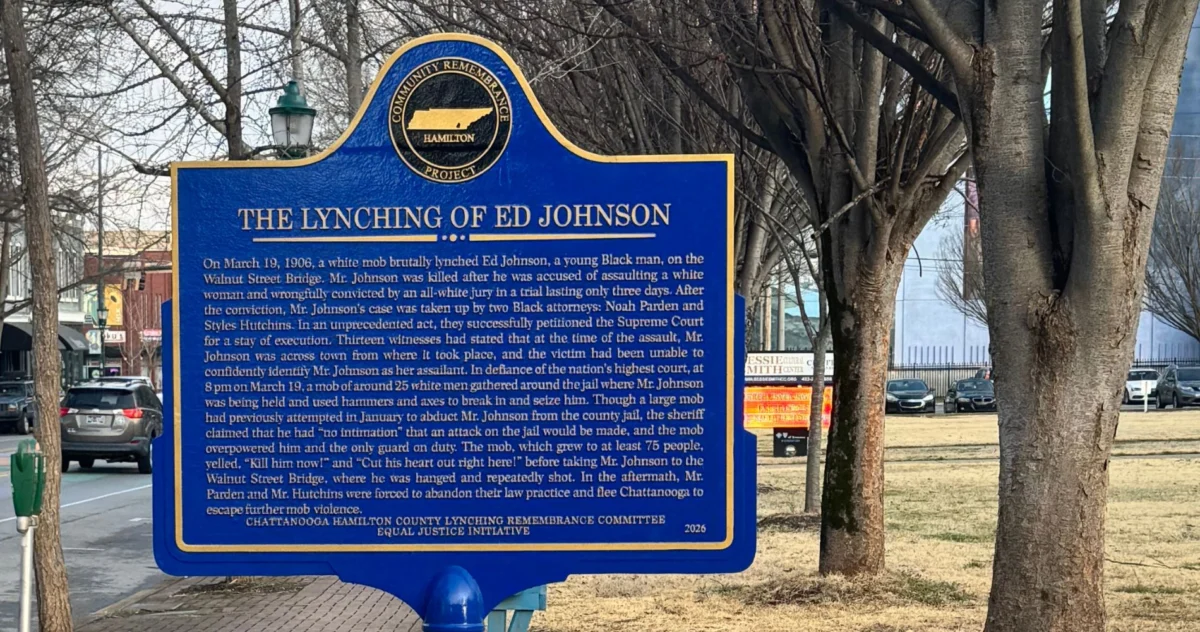
A century of silence was pierced last week in Hamilton County, Tennessee, as community members, in collaboration with the Equal Justice Initiative (EJI), dedicated a historical marker to memorialize Ed Johnson, a young Black man brutally lynched by a white mob in 1906. The poignant ceremony, held on February 26, served as a powerful act of remembrance and a commitment to confronting the deeply painful legacy of racial terror.
The marker dedication ceremony, a culmination of years of tireless advocacy and historical research, unfolded in downtown Chattanooga, Tennessee. The Bessie Smith Cultural Center, a cornerstone institution in the Chattanooga community dedicated to preserving and celebrating African American history and culture, graciously hosted the event. Paula Wilkes, president of the center, an organization founded in 1983, underscored its vital role in fostering education, art, research, and entertainment as vehicles for cultural preservation. Alongside Ms. Wilkes, Eric Atkins from the Unity Group played a pivotal role in organizing the event, continuing his long-standing commitment to historical preservation and educational outreach, particularly within marginalized communities. Mr. Atkins’s dedication to this cause is well-documented, having previously collaborated with EJI in 2017 to conduct a soil collection ceremony honoring Ed Johnson and other lynching victims in Chattanooga, an event that laid foundational groundwork for last week’s dedication.
The atmosphere at the ceremony was one of solemn reflection mixed with determined hope. The Rev. Ernest Reid of the Second Missionary Baptist Church led attendees in a moving prayer, invoking remembrance for the past while earnestly calling for unity and healing in the future. His words resonated deeply, setting a tone of spiritual grounding for the gravity of the occasion.
Paula Wilkes, addressing the assembled community members, articulated the profound significance of the marker. "By naming what happened here, we honor Ed Johnson’s humanity and affirm that remembrance is a necessary step toward justice and healing," she stated, her voice clear and resolute. "May this marker remind us not only of the past we must confront, but of the responsibility we carry forward." Her remarks underscored the dual purpose of the memorial: acknowledging historical injustice and galvanizing present and future generations to strive for a more equitable society.
Brandon McRae, a Community Remembrance Project Team Member representing EJI, offered gratitude to the local community for their unwavering dedication and collaborative spirit in bringing the project to fruition. His words emphasized the collective effort required to unearth and confront such difficult histories. Further amplifying the community’s commitment, Alexa LeBoefu, Hamilton County’s economic and community development director, and Carmen Elliot, a representative for Chattanooga Mayor Tim Kelly, both spoke passionately about the transformative impact of historical truth-telling on community cohesion and development. They affirmed their desire to continue supporting educational initiatives that promote a deeper understanding of the region’s complex past.
Eric Atkins, a driving force behind the multi-year endeavor, shared reflections on the project’s evolution from its initial inception. "This has been five and a half years in the making," he remarked, a testament to the perseverance of all involved. He concluded with a powerful call for collective action: "We have to love together, we have to pray together, we have to stand together. Together is the only way we are at our best as a community." His words encapsulated the spirit of unity and shared purpose that defined the dedication ceremony and the broader movement it represents.
The Unjust Lynching of Ed Johnson: A Detailed Chronology
The historical marker serves as a stark reminder of the tragic events of March 19, 1906, when Ed Johnson, a young Black man, became another victim of racial terror in America. The narrative of his lynching is a harrowing account of injustice, mob rule, and the systemic subversion of legal processes in the Jim Crow South.
The chain of events began on January 23, 1906, when a white woman in Chattanooga reported being assaulted. Within days, Ed Johnson was arrested and accused of the crime, despite a lack of credible evidence and conflicting witness accounts. His trial, swift and deeply flawed, commenced on February 23, 1906. Lasting only three days, it was presided over by an all-white jury in a climate of intense racial prejudice and public hysteria. Predictably, Johnson was wrongfully convicted and sentenced to death.
In an extraordinary and unprecedented act of legal courage, two Black attorneys, Noah Parden and Styles Hutchins, took on Johnson’s case. Defying immense personal risk and societal pressure, they mounted an appeal that reached the highest court in the land – the U.S. Supreme Court. Their petition highlighted glaring inconsistencies in the evidence: thirteen witnesses had testified that Johnson was across town at the time of the alleged assault, and the victim herself had expressed uncertainty in identifying Johnson as her assailant. Demonstrating an astonishing commitment to due process, Parden and Hutchins successfully petitioned the Supreme Court for a stay of execution, securing a temporary reprieve for Johnson and challenging the deeply entrenched racial bias of the Southern legal system. This intervention by the Supreme Court was a rare occurrence in lynching cases and represented a momentary, albeit ultimately tragic, triumph for legal justice against overwhelming odds.
However, the legal victory was short-lived. In a shocking act of defiance against the nation’s highest judicial authority, a mob of white men, estimated at around 25 initially, gathered outside the Hamilton County jail where Johnson was being held on the evening of March 19, 1906, the very day the Supreme Court’s stay was issued. Armed with hammers and axes, they systematically broke into the jail. Despite a previous attempt by a large mob in January to abduct Johnson, the sheriff later claimed to have had "no intimation" that such an attack would occur, a statement widely seen as a blatant dereliction of duty or even complicity. The mob quickly overpowered the lone guard on duty and the sheriff, seizing Johnson from his cell.
As Johnson was dragged from the jail, the mob swelled in size, growing to at least 75 people, fueled by bloodlust and racial hatred. Chants of "Kill him now!" and "Cut his heart out right here!" filled the air, illustrating the raw, unbridled violence that characterized racial terror lynchings. They marched Johnson to the nearby Walnut Street Bridge, a prominent landmark in downtown Chattanooga. There, in a public spectacle designed to instill terror and enforce white supremacy, Ed Johnson was hanged and then repeatedly shot, his life brutally extinguished by extrajudicial violence.
The aftermath of Johnson’s lynching was equally tragic for his courageous legal defenders. Noah Parden and Styles Hutchins, having dared to challenge the racial hierarchy, were forced to abandon their law practice and flee Chattanooga to escape further mob violence, their careers and lives irrevocably altered by their pursuit of justice.
Legal Precedent and Its Tragic Subversion
The Ed Johnson case stands as a pivotal, albeit deeply painful, moment in American legal history. The Supreme Court’s intervention, specifically in United States v. Shipp (1906), which arose from the defiance of its stay of execution, marked the only time in history that the U.S. Supreme Court initiated criminal proceedings against individuals for contempt of court. Sheriff Joseph F. Shipp and several deputies were ultimately found guilty of contempt for their role in allowing the mob to access Johnson. While this was a landmark decision affirming the Court’s authority, it came too late for Ed Johnson, highlighting the tragic limitations of the legal system when confronted with entrenched racial violence and local complicity. The case exposed the fragile nature of justice for Black Americans in an era where mob rule often superseded the rule of law, even at the highest levels.
The Broader Scourge of Racial Terror Lynching in America
Ed Johnson’s story is not an isolated incident but a chilling illustration of a widespread campaign of racial terror that plagued the United States for decades. Between 1865 and 1950, a staggering 6,500 Black people were victims of mob violence and lynching across the nation. These acts were not merely random violence; they were systemic tools of racial control, designed to enforce white supremacy, suppress Black economic and political advancement, and instill fear within African American communities.
A significant proportion of these lynchings, almost 25%, involved allegations of inappropriate behavior between a Black man and a white woman, often ambiguously characterized as "assault." This accusation, regardless of its veracity, served as a potent catalyst for mob violence. White society’s preoccupation and irrational fear of sexual contact between Black men and white women were deeply rooted in the pervasive presumption that Black men were inherently violent and sexually aggressive, a racist stereotype used to justify brutal reprisals.
The definition of "assault" in this era was alarmingly broad and subjective, extending to any action that could be interpreted, however tenuously, as a Black man seeking contact with a white woman. Accusations could be based on something as innocuous as merely looking at or accidentally bumping into a white woman, smiling, winking, or even being perceived as "disagreeable." These flimsy pretexts were sufficient to incite mobs, often leading to gruesome public executions witnessed by thousands, including women and children, further normalizing and embedding racial hatred.
One of the most disturbing aspects of this era was the widespread complicity of law enforcement and legal institutions. It was common practice for lynch mobs to seize their victims directly from jails, prisons, courtrooms, or out of police custody. Police forces almost never used force to resist white lynch mobs intent on killing Black people; in many documented cases, police officials were found to be complicit, actively participating, or at the very least, passively allowing lynchings to occur. This institutional failure underscored the systemic nature of racial terror and the profound lack of legal protection for Black citizens.
Hamilton County, Tennessee, tragically contributed to this national statistic. Ed Johnson was one of at least five documented victims of racial terror lynching killed in Hamilton County between 1865 and 1950. Across the state of Tennessee, the number of recorded victims exceeds 375, each representing a life unjustly taken and a community traumatized.
The Community Remembrance Project: A Path to Healing and Reconciliation
The dedication of the Ed Johnson marker is a direct outcome of the Equal Justice Initiative’s (EJI) Community Remembrance Project. This ambitious and deeply necessary initiative is a multi-faceted campaign designed to acknowledge and honor the victims of lynching throughout American history. The project operates on several key principles: collecting soil from lynching sites as a tangible connection to the victims, erecting historical markers like the one dedicated to Ed Johnson, and developing "Legacy Sites" in Montgomery, Alabama, to serve as enduring memorials and educational centers.
EJI’s philosophy is rooted in the belief that genuine healing and reconciliation within communities cannot begin without a forthright and honest reckoning with the truth of racial violence. By creating these physical spaces of remembrance and engaging communities in the process, EJI aims to foster difficult but essential conversations about America’s past, its present implications, and the path forward. These markers are not just memorials; they are educational tools, forcing passersby to confront a history that has often been ignored, suppressed, or sanitized. They serve as permanent public reminders that such atrocities occurred and that their legacy continues to shape contemporary society.
Local Leadership and Sustained Effort
The success of the Ed Johnson marker project underscores the power of local leadership and sustained community engagement. The Bessie Smith Cultural Center, under Paula Wilkes’s guidance, exemplifies institutions that bridge historical preservation with contemporary social relevance. Their commitment to African American history and culture provides a vital platform for such remembrance projects, ensuring that the narratives of figures like Ed Johnson are not lost to time.
Eric Atkins and the Unity Group represent the grassroots efforts essential for translating historical awareness into tangible action. His foresight in initiating the soil collection ceremony years ago demonstrates a long-term vision for community education and historical recognition. Such multi-year efforts require immense dedication, overcoming bureaucratic hurdles, securing funding, and maintaining community interest – a testament to the commitment of all involved in Chattanooga. The collaborative spirit, bringing together local cultural institutions, community activists, and national organizations like EJI, is a model for addressing historical injustices effectively.
Implications for Justice and Reconciliation
The dedication of the Ed Johnson marker carries profound implications for justice and reconciliation in America. Firstly, it offers a measure of dignity and recognition to victims whose lives were violently erased and whose stories were deliberately forgotten. By publicly naming and commemorating Ed Johnson, the community reclaims his humanity and acknowledges the injustice he suffered.
Secondly, these markers serve a critical educational function. They challenge sanitized historical narratives and compel communities to confront uncomfortable truths about racial violence and systemic oppression. For many, particularly younger generations, these physical markers are their first encounter with the brutal realities of racial terror, fostering a deeper understanding of the roots of racial inequality that persist today.
Thirdly, the act of collective remembrance, as witnessed in Chattanooga, strengthens community bonds and fosters a shared commitment to social justice. It transforms a dark historical event from a source of shame into a catalyst for dialogue, empathy, and collective action. By publicly acknowledging past wrongs, communities can begin to build a foundation for a more equitable and just future, learning from history to prevent its recurrence. The ongoing educational efforts championed by local officials like Alexa LeBoefu and Mayor Kelly’s office representative Carmen Elliot highlight a recognition that historical understanding is not merely academic, but crucial for civic health and economic development.
In conclusion, the dedication of the Ed Johnson historical marker in Hamilton County is more than just the unveiling of a plaque; it is a profound declaration of remembrance, a courageous act of truth-telling, and a steadfast commitment to justice. It stands as a testament to the enduring power of community to confront its past, honor its lost, and strive for a future where the lessons of history are never forgotten.