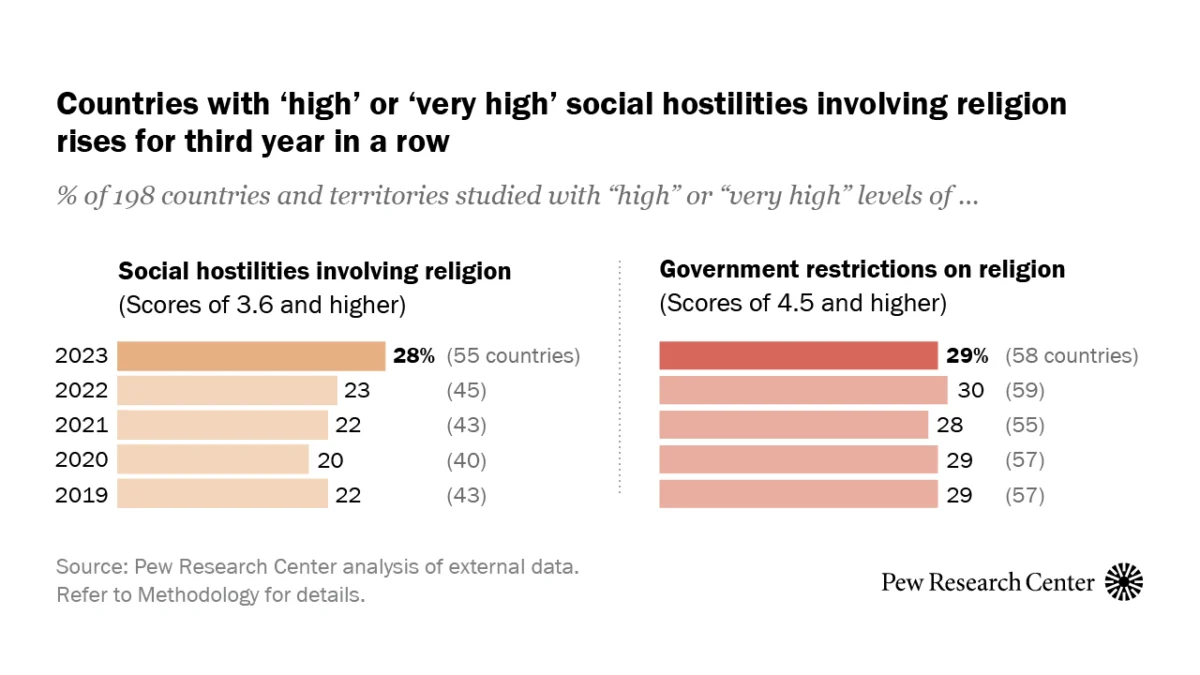
In 2023, a concerning trend emerged globally as the number of countries experiencing high or very high levels of social hostilities involving religion escalated. According to the 16th annual report from the Pew Research Center, 55 out of 198 countries and territories surveyed recorded significant religious-based harassment, assault, or mob violence by non-state actors. This marks a notable increase from 45 countries in the previous year, indicating a worsening climate for religious freedom in several regions.
The study, which meticulously analyzes data from a wide array of reputable sources including U.S. State Department reports, United Nations findings, and human rights organizations like Amnesty International and Human Rights Watch, employs two key indexes: the Social Hostilities Index (SHI) and the Government Restrictions Index (GRI). Both indexes are scored on a scale of 0 to 10, with higher scores indicating greater levels of religious restriction or hostility.
Global Hotspots of Religious Hostility
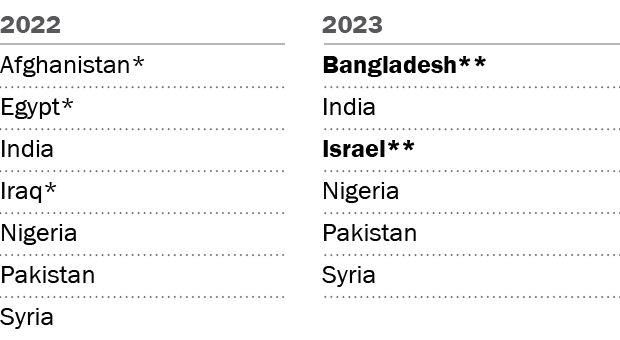
Six nations stood out in 2023 for experiencing "very high" levels of social hostilities involving religion: Nigeria, India, Israel, Syria, Bangladesh, and Pakistan. The inclusion of Israel and Bangladesh in this top tier was significantly influenced by large-scale violent events that occurred within their borders. In Israel, the Hamas attacks on October 7th, a coordinated assault that resulted in widespread civilian casualties and further escalated regional tensions, contributed to its elevated SHI score. Similarly, Bangladesh saw a surge in religious hostilities, partly due to rioting targeting the Ahmadi Muslim community on March 3rd and 4th, which resulted in fatalities and destruction of property.
These findings underscore a complex global landscape where religious freedom is increasingly challenged. While the majority of countries maintained low or moderate levels of social hostilities, the concentration of severe issues in specific nations highlights areas requiring urgent international attention and intervention.
Government Restrictions Remain Pervasive

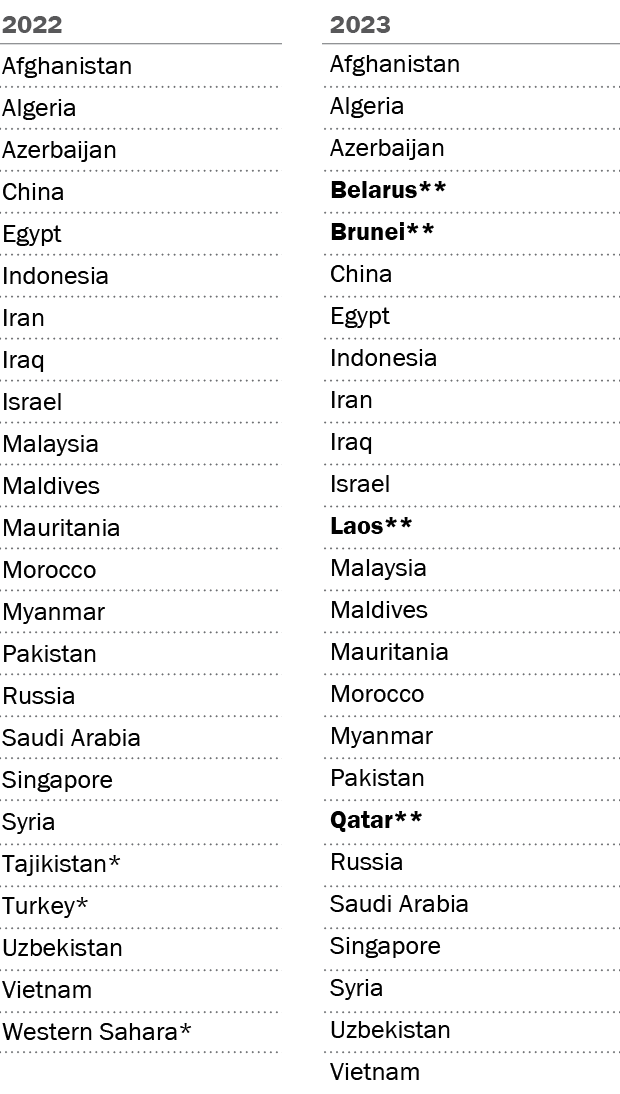
Parallel to the rise in social hostilities, government restrictions on religion also remained a significant concern in 2023. The Pew Research Center’s report indicates that 58 countries and territories faced high or very high levels of government restrictions, a figure nearly identical to the previous year’s 59. Twenty-five nations were categorized as having "very high" levels of these restrictions, a category that includes prominent countries such as China, Iran, Afghanistan, Indonesia, Syria, and Uzbekistan. These restrictions can manifest in various forms, including discriminatory laws, state surveillance, limitations on religious practice, and the persecution of religious minorities.
The simultaneous presence of high social hostilities and government restrictions creates a dual burden for religious communities, often leaving them vulnerable to both state-sponsored oppression and societal violence.
Understanding the Indexes: A Deeper Dive
The Pew Research Center’s methodology is robust, drawing on extensive research to quantify religious freedom conditions. The Social Hostilities Index (SHI) is comprised of 13 indicators that capture instances of religiously motivated violence, harassment, and discrimination perpetrated by individuals, groups, and non-state actors, including terrorist organizations. The Government Restrictions Index (GRI) similarly includes 20 indicators that assess the extent to which government officials, laws, and policies impede or suppress religious freedom.
The classification of scores into "very high," "high," "moderate," and "low" is based on percentiles relative to a baseline year of mid-2007. Scores in the top 5% on each index at that time were classified as "very high," with the subsequent 15% considered "high," the next 20% "moderate," and the bottom 60% "low."
Year-over-Year Shifts: A Mixed Picture
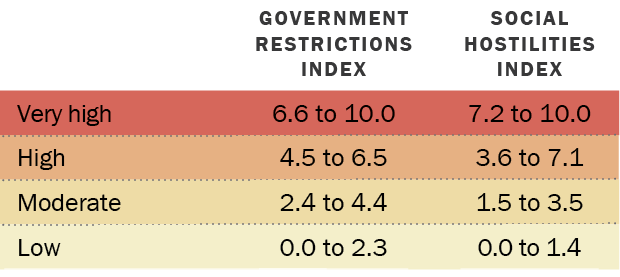
The 2023 report highlights significant year-to-year shifts in religious freedom conditions across the globe. While the number of countries with "very high" social hostilities saw a slight decrease from seven in 2022 to six in 2023, the number of countries with "high" social hostilities increased substantially, from 38 to 49. This shift indicates a broadening of concerning trends beyond the most extreme cases.
On the SHI, Israel’s score jumped from 7.1 in 2022 to 8.4 in 2023. This increase is directly linked to the October 7th Hamas attacks. The charter of Hamas explicitly cites religious principles and objectives, and terrorism motivated by religion or targeting religious groups is factored into the SHI. The attacks, which involved the targeting of civilians at a music festival and kibbutzim, were classified as a social hostility involving religion in Israel.
Bangladesh’s SHI score also rose significantly, from 6.1 to 7.8. This was largely attributed to mob violence against the Ahmadi Muslim community during an annual gathering, which resulted in deaths, injuries, and destruction of property. Reports from the U.S. State Department detail these incidents, including attacks on Ahmadi homes and a mosque. Earlier in the year, a separate incident involved an attack on a Hindu man’s home following an alleged Facebook post deemed blasphemous.
Conversely, Afghanistan, Egypt, and Iraq experienced a decline in their SHI levels, moving from "very high" to "high" categories. However, these transitions were often accompanied by only marginal numerical score reductions, suggesting that while the intensity may have slightly lessened, significant levels of religious hostility persisted. Afghanistan’s score decreased from 7.3 to 7.0, and Egypt’s from 7.4 to 7.1. Iraq saw a more substantial drop from 7.8 to 6.8.
Widespread Fluctuations in Social Hostilities
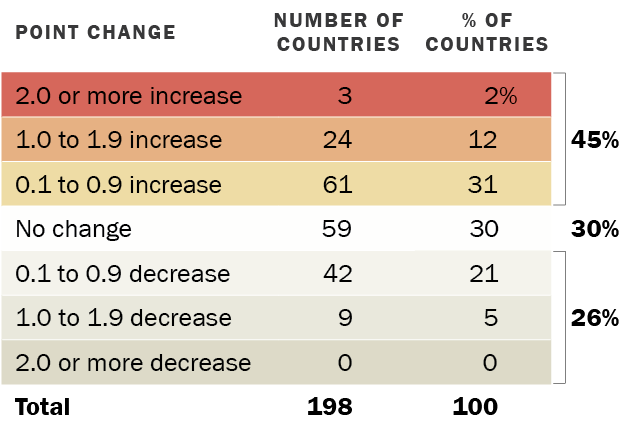
Across the 198 countries and territories studied, 139 countries exhibited changes of at least 0.1 point on the SHI in 2023. Of these, 88 countries saw an increase, while 51 experienced a decrease. Notably, the number of countries with a year-over-year decrease on the SHI (51) reached its lowest point in the 16-year history of the study, indicating a general upward trend in religious hostilities.
Fifty-nine countries maintained stable SHI scores. Of the countries experiencing changes, 103 saw relatively minor fluctuations (0.1 to 0.9 points), with 61 experiencing increases and 42 decreases. A further 33 countries had more moderate changes (1.0 to 1.9 points), comprising 24 increases and nine decreases.
Emerging Concerns: Argentina, Sudan, and Sweden
The report also highlights significant increases in social hostilities in specific countries. Argentina moved from the "low" to "moderate" category, with its SHI score rising from 0.2 to 2.4. This surge was partly linked to the discovery of Nazi memorabilia and Holocaust-denying materials in a private museum, as well as a bookstore that promoted such content. These findings point to the persistent presence of antisemitic ideologies.
Sudan and Sweden both transitioned from the "moderate" to "high" category of social hostilities. Sudan’s SHI score increased from 3.5 to 5.7, largely due to the ongoing conflict between the Sudanese military and the Rapid Support Forces (RSF). Reports from Amnesty International and the U.S. State Department indicate that the RSF targeted Coptic Christians, including an attack on a church where clergy were shot and religious artifacts stolen. The RSF also reportedly pressured Christians to convert to Islam and seized religious buildings for military use.
Sweden’s SHI score rose from 2.6 to 4.5, primarily due to anti-Muslim demonstrations that involved the desecration of the Quran. These acts, which included burning, tearing, and defacing the Quran, occurred in public spaces and outside diplomatic missions. The Swedish government condemned these acts as Islamophobic, but legal rulings upheld the right to assembly, highlighting the complex balance between freedom of expression and the protection of religious sensitivities.
Government Restrictions: A Persistent Challenge
The Government Restrictions Index (GRI) also revealed a stable, though concerning, picture. In 2023, 25 countries experienced "very high" levels of government restrictions, a slight increase from 24 in the previous year. An additional 33 countries scored "high," a decrease from 35 in 2022, resulting in a total of 58 countries with high or very high government restrictions.
The countries with the most extensive government restrictions in 2023 included China, Iran, Afghanistan, Indonesia, Syria, and Uzbekistan. These nations consistently demonstrate stringent state control over religious practices, often involving widespread surveillance, censorship, and the suppression of dissenting religious groups.
New Entrants and Departures in ‘Very High’ GRI Category
Belarus, Brunei, Laos, and Qatar moved into the "very high" GRI category in 2023, up from the "high" category in 2022. These transitions, while significant, were generally marked by increases of less than one point on the GRI. In Laos, reports indicated that local authorities displaced and detained Christians who refused to renounce their faith, and damaged their property. In Qatar, the Baha’i community reported government limitations on economic opportunities and intimidation tactics, leading some members to leave the country.
Conversely, Tajikistan, Turkey, and Western Sahara dropped from the "very high" to the "high" GRI category. These movements also involved relatively small numerical decreases on the index.
Shifting Scores on the Government Restrictions Index
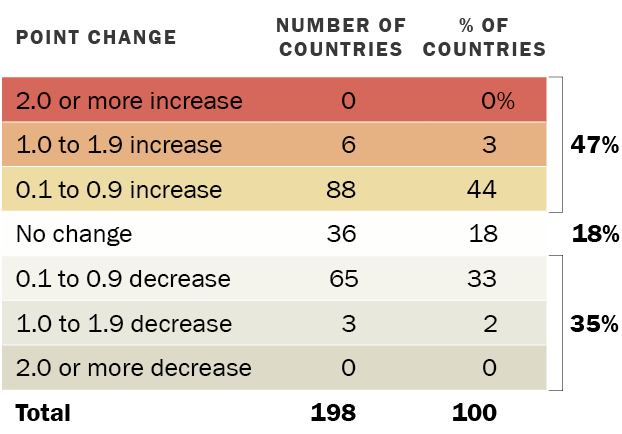
The GRI scores saw more widespread change than the SHI. From 2022 to 2023, 162 countries and territories experienced changes of at least 0.1 point on the GRI, with 94 showing increases and 68 showing decreases. Thirty-six countries recorded no change in their overall GRI scores.
The majority of these changes were minor, with 153 out of 198 countries experiencing only small shifts (0.1 to 0.9 points). Modest changes (1.0 to 1.9 points) were observed in nine countries, comprising six increases and three decreases. No country experienced a significant change of 2.0 points or more on the GRI.
Combined Impact: A Complex Global Picture
When the scores on both the Government Restrictions Index and the Social Hostilities Index are combined, a more comprehensive picture of the global religious freedom landscape emerges. In 2023, 114 countries and territories showed an overall increase in their combined scores. This includes 92 countries with small increases (0.1 to 0.9 points) and 20 countries with modest increases (1.0 to 1.9 points).
Two countries, Argentina and Sweden, experienced significant increases of 2.0 points or more in their combined scores. In Sweden, the repeated desecration of the Quran was categorized as both a social hostility and a government restriction, as authorities granted permits for such demonstrations. This dual classification highlights the intricate nature of assessing religious freedom challenges.
Argentina’s substantial increase was partly attributed to incidents of harassment against Muslims, including a case where a Muslim woman was detained for wearing a hijab at an airport. The U.S. State Department reported that the airport security office issued an apology for this incident.
Conversely, 66 countries saw decreases in their combined scores. Fifty-six of these experienced small decreases (0.1 to 0.9 points), and 10 had modest decreases (1.0 to 1.9 points). No country registered a large decrease of 2.0 points or more in its combined score. A total of 18 countries reported no change in their combined scores.
This detailed analysis by the Pew Research Center underscores the dynamic and often challenging global environment for religious freedom. The increase in social hostilities, coupled with persistent government restrictions, signals a continuing need for international dialogue, advocacy, and action to protect the rights and freedoms of religious communities worldwide.
Methodology and Funding
This analysis is part of the Pew-Templeton Global Religious Futures project, which examines changes in religion and their societal impacts globally. Funding for this project is provided by The Pew Charitable Trusts and the John Templeton Foundation. The research methodology, detailed in a dedicated section of the Pew Research Center’s website, involves the rigorous review of publicly available, widely cited sources to ensure accuracy and comprehensiveness in assessing religious restrictions and hostilities across 198 countries and territories.