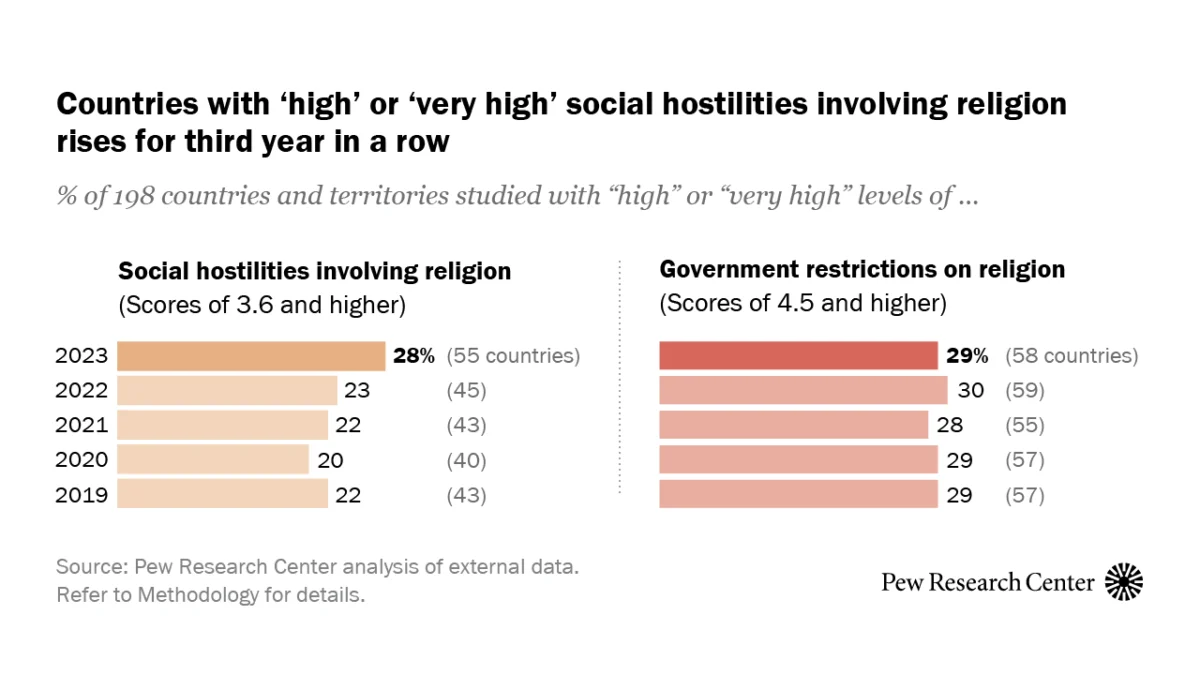
The global landscape of religious freedom experienced a significant deterioration in 2023, with a notable increase in the number of countries experiencing high or very high levels of social hostilities involving religion. This marks the third consecutive year of such an upward trend, according to the Pew Research Center’s 16th annual report on religious restrictions worldwide. The study, which meticulously analyzes data from 198 countries and territories, points to a complex interplay of factors, including heightened harassment of religious minorities and the far-reaching consequences of geopolitical events, most notably the Hamas attack on southern Israel on October 7, 2023, and Israel’s subsequent military operations in Gaza.
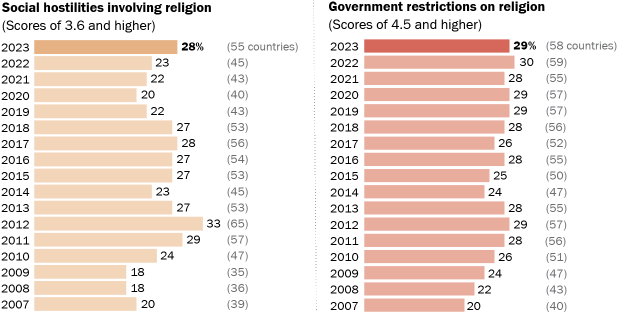
In 2023, 55 countries recorded elevated levels of social hostilities involving religion, a substantial rise from the 45 countries observed in the preceding year. While this figure remains below the peak of 65 countries recorded in 2012, following the Arab Spring uprisings, the persistent upward trajectory signals a growing global concern for religious tolerance and interfaith harmony. The report categorizes countries based on two distinct indexes: the Government Restrictions Index (GRI) and the Social Hostilities Index (SHI). Researchers meticulously comb through publicly available data from reputable sources, including reports from the U.S. State Department, the U.S. Commission on International Religious Freedom, the United Nations, and leading non-governmental organizations such as Freedom House, Amnesty International, and Human Rights Watch, to compile these comprehensive assessments.
Understanding the Indexes: Government Restrictions and Social Hostilities
The Pew Research Center’s analysis employs two key indexes to measure the global climate for religious freedom:
- The Government Restrictions Index (GRI): This index quantifies the ways in which governmental bodies, legislation, and policies can impede religious freedom. It encompasses actions such as the imposition of laws that restrict religious practice, governmental surveillance of religious groups, and policies that favor or disfavor particular religions.
- The Social Hostilities Index (SHI): This index measures the extent of religiously motivated violence and harassment perpetrated by private individuals, non-governmental organizations, and even terrorist entities. It includes acts of intimidation, discrimination, physical assault, and sectarian violence targeting religious communities.
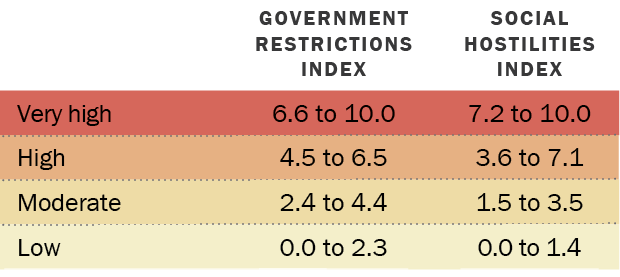
The classification of scores within these indexes is based on percentiles derived from the study’s baseline year, 2007. Scores falling within the top 5% of the distribution are classified as "very high," the next 15% as "high," the subsequent 20% as "moderate," and the bottom 60% as "low." This methodology allows for a nuanced understanding of the varying degrees of religious restriction and hostility experienced globally.

Trends in Government Restrictions and Social Hostilities
In 2023, the GRI indicated that 58 countries experienced high or very high levels of government restrictions on religion. This number is marginally lower than the record high of 59 countries in 2022, but still represents a significant portion of the global landscape. Countries consistently identified with very high GRI scores in 2023 include China, Iran, Afghanistan, Indonesia, Syria, and Uzbekistan. These nations often feature stringent state control over religious expression, including limitations on religious education, public worship, and the dissemination of religious materials.
On the Social Hostilities Index (SHI), the situation is equally concerning. The 55 countries identified with high or very high SHI scores in 2023 encompass nations where private actors, ranging from extremist groups to ordinary citizens, engage in religiously motivated violence and harassment. Prominent examples from 2023 with very high SHI scores include Nigeria, India, Israel, Syria, Bangladesh, and Pakistan. These countries often grapple with sectarian tensions, communal violence, and discrimination against religious minorities.
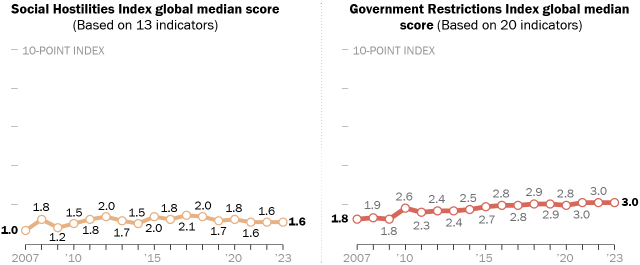
Despite the rise in the number of countries with elevated SHI scores, the global median score for social hostilities remained stable at 1.6 out of 10 in 2023, a level consistent with the previous two years. This indicates that while a growing number of nations are experiencing severe social hostilities, the average level of these hostilities across all 198 countries has not dramatically increased. The peak median SHI score recorded in the study’s history was 2.1 in 2017.
Conversely, the median score for the Government Restrictions Index has shown a more consistent upward trend since the study’s inception in 2007. In 2023, the global median GRI score stood at 3.0, matching the levels of the preceding two years and representing the highest median GRI score observed to date. This sustained increase suggests a growing tendency for governments worldwide to impose restrictions on religious beliefs and practices. Since the study’s commencement, the median GRI score has consistently been higher than the median SHI score, underscoring the pervasive nature of government-imposed limitations on religious freedom.
Factors Contributing to Increased Social Hostilities
The report highlights that a majority of the 55 countries with high or very high SHI scores in 2023 were already in that category in the previous year. However, 12 nations transitioned from moderate to high SHI levels in 2023, indicating a worsening of the situation within their borders. Conversely, Ethiopia and the Philippines saw their SHI scores decrease, moving from high to moderate levels.
The transition of Spain into the high SHI category, with its score rising from 2.8 to 3.7, is attributed to several incidents. Reports of verbal and physical assaults against Jehovah’s Witnesses in Valencia, where an information booth encounter escalated into violence requiring surgery, were noted. Additionally, a machete attack on churches in Algeciras, though potentially influenced by psychological factors, contributed to the heightened concern. The rise in "hate speech" and discrimination against Muslims following the October 7th attack, as reported by Muslim leaders, alongside an increase in antisemitic incidents, including vandalism, further impacted Spain’s SHI score.
Norway also moved into the high SHI category, its score increasing from 3.2 to 4.2. This rise was linked to physical harassment of Jehovah’s Witnesses, as well as increased hate speech directed at Jewish and Muslim communities. Incidents included the tearing down of a mezuzah from a Jewish home and rallies by groups like "Stop the Islamization of Norway" (SIAN) that involved Quran burnings. These actions, often amplified online, fueled anti-Muslim sentiments and harassment, particularly following major international news events.
Similarly, Sweden and Russia saw their SHI scores rise, with both countries experiencing incidents of Quran burnings. Russia’s score increased from 3.5 to 3.8, partly due to reports of mob violence. A notable event occurred at an airport in Dagestan, a predominantly Muslim region, where a mob protested an Israeli El Al flight, shouting antisemitic slogans in response to the Gaza conflict. Furthermore, Russia witnessed instances of hostility towards women wearing religious attire, including an assault on a hijab-wearing Muslim woman and her children in a playground near Moscow. Reports also indicated a continuation of requirements for women to adhere to Islamic dress codes in the North Caucasus region.
Tanzania’s SHI score rose from 3.1 to 4.4, significantly influenced by attacks against individuals accused of witchcraft, a practice often categorized as a folk religion in this study. Mobs in the Kigoma region reportedly assaulted and shaved the heads of accused witches, forcing them from their homes. Such accusations, often linked to traditional healing practices in rural areas, remain a persistent issue.
In the Asia-Pacific region, Thailand’s index score increased from 3.5 to 4.4, largely due to heightened violence in its southern provinces where the government is engaged in a conflict with Muslim separatists. Bombings and an increase in killings, predominantly of Muslims, were reported in 2023.
Sudan’s score escalated from 3.5 to 5.7, a surge driven by damage to places of worship and religious sites amidst the ongoing conflict between the Rapid Support Forces and the Sudanese army. This highlights how widespread conflict can have devastating collateral effects on religious communities and their infrastructure.
In the Americas, Guatemala’s social hostilities score increased from 2.8 to 3.8, partly attributed to reported "conversion therapies" for LGBTQ+ individuals, which were reportedly aided or funded by churches. This points to the complex intersection of religious beliefs and social policies impacting vulnerable groups.
Population Impact: Where Restrictions and Hostilities Affect the Most People
While the number of countries experiencing elevated levels of religious restrictions and hostilities is significant, the report also analyzes the impact on populations. Out of the 198 countries and territories studied, 86 countries exhibited elevated levels of either government restrictions or social hostilities, or both. Of particular note, 27 countries faced elevated levels on both indexes simultaneously.
Crucially, approximately three-quarters (78%) of the global population resides in countries where there are high or very high levels of government restrictions and/or social hostilities involving religion. This disproportionate impact is largely due to the sheer population size of countries like China, India, and Pakistan, which consistently rank high on these indexes. While most countries may have low or moderate levels of restrictions and hostilities, the concentration of these issues in highly populated nations means a substantial portion of humanity lives under such challenging conditions. It is important to note that within these countries, religious minorities often bear the brunt of these restrictions and hostilities.
Government Harassment and Interference in Worship: Pervasive Trends
Delving deeper into the Government Restrictions Index, the report highlights two particularly prevalent forms of state-imposed limitations: government harassment of religious groups and interference in worship.
In 2023, government harassment, encompassing both verbal and physical intimidation of religious adherents, was reported in an overwhelming 185 countries, or 93% of those studied. This figure remained largely consistent with the 186 countries recorded in 2022, underscoring its widespread nature.
Interference in worship, defined as governmental actions that disrupt religious activities such as denying permits for religious gatherings, obstructing religious education, or hindering burial rituals and conscientious objections, also remained a significant concern. In 2023, this type of interference was observed in 175 countries and territories, an increase from 170 countries in the previous year. This new peak suggests a growing trend of governments actively intervening in the religious practices of their citizens.
The detailed methodology, available through the Pew Research Center’s website, provides further insights into how these indexes are constructed and the sources researchers utilize. This ongoing work, supported by The Pew Charitable Trusts and the John Templeton Foundation, aims to provide a comprehensive and evolving picture of the global religious landscape.