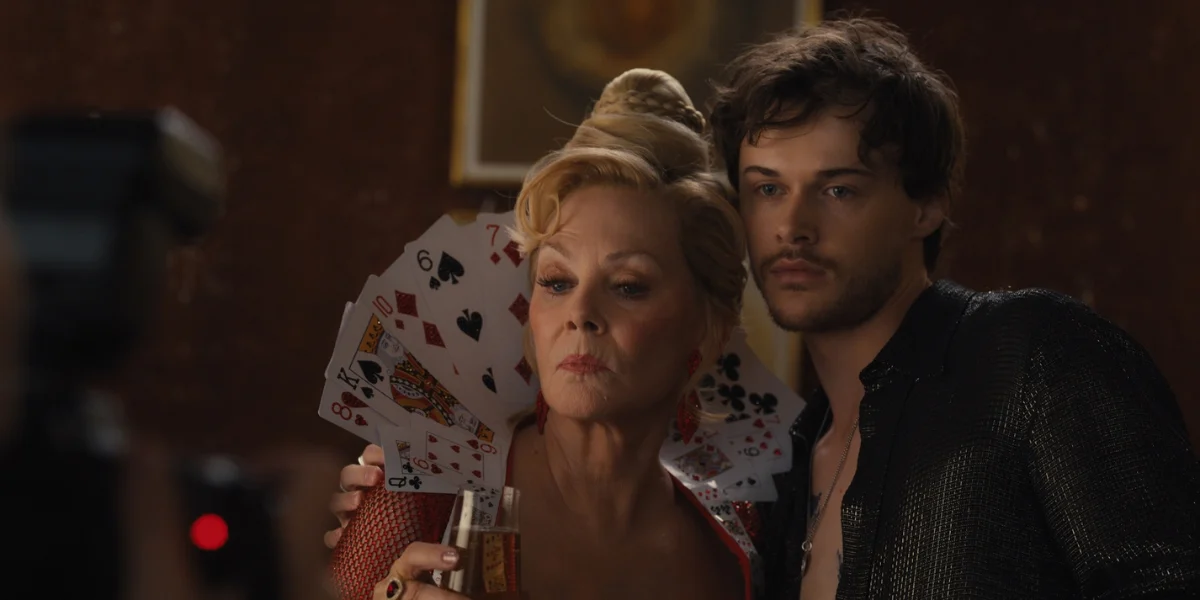
The critically acclaimed Max original series Hacks has consistently garnered praise for its nuanced portrayal of the intergenerational relationship between legendary comedienne Deborah Vance and her millennial writer, Ava Daniels. However, in its most recent season, the series has pivoted toward a more profound exploration of aging, sexual agency, and the emotional complexities of later-life romance. By centering an episode on a romantic entanglement between Deborah Vance, portrayed by Jean Smart, and a significantly younger international star, the show challenges long-standing television tropes regarding women of a certain age. Rather than utilizing the age gap for comedic relief or as a narrative gimmick, Hacks treats the protagonist’s romantic and sexual desires with a level of gravity and authenticity rarely seen in mainstream media.
The Thematic Framework of Aging and Agency
In the latest narrative arc, Deborah Vance finds herself pursued by Nico, a young, high-profile international celebrity who is beginning a residency at the Palmetto in Las Vegas. The initial setup of the plotline mirrors a familiar Hollywood trope: the cynical PR-driven relationship. Deborah, ever the pragmatist and media strategist, initially assumes the invitation is a publicity stunt designed to boost Nico’s profile and her own relevance in the Vegas circuit. This assumption highlights Deborah’s internal perception of her own marketability and her skepticism regarding genuine romantic interest from a younger demographic.
The narrative shift occurs when it is revealed that Nico’s intentions are entirely authentic. Emancipated from his parents after a betrayal of privacy involving his personal photographs, Nico represents a generation that values authenticity over orchestrated media narratives. This directly clashes with Deborah’s lifelong commitment to image management. The subsequent development of their relationship serves as a vehicle to explore Deborah’s vulnerability. For a character defined by her professional armor and caustic wit, the experience of a "dizzying crush" in her seventies provides a poignant look at the persistence of human emotion across the lifespan.
Chronology of Events and Narrative Development
The episode’s timeline begins with the professional collision of two Vegas residencies. As Deborah continues her pursuit of a late-night hosting position—a central conflict of the third season—the arrival of Nico at the Palmetto introduces a personal variable into her calculated professional life.
- The Initial Proposal: Nico invites Deborah on a date. Ava, representing the audience’s hopeful perspective, suggests the interest is genuine. Deborah dismisses this, citing her own preference for being "the pretty one" in a relationship and assuming the date is a "paparazzi walk."
- The Realization of Authenticity: During their encounter, Nico clarifies his disdain for press stunts. His background as a child star who sought legal emancipation provides a factual basis for his desire for a private, sincere connection.
- The Emotional Escalation: The relationship progresses rapidly, leading to Deborah experiencing the physiological and psychological symptoms of a new romance. This "crashing out" over a crush is portrayed not as a symptom of senility, but as a universal human experience.
- The Professional Conflict: The relationship reaches a breaking point when Deborah’s instinct for publicity overrides Nico’s need for privacy. By calling a photographer to document their date, Deborah prioritizes her career-long habit of media manipulation over a genuine emotional connection, leading to a swift termination of the fling.
- The Resolution: The episode concludes with a moment of reflection. Deborah acknowledges the pain of the breakup, ultimately viewing the ability to feel "lovesick" in her seventies as a testament to her continued vitality.
Supporting Data: Representation of Women Over 50 in Media
The portrayal of Deborah Vance’s romantic life aligns with shifting industry trends, though it remains an outlier in terms of depth. According to a 2021 study by the Geena Davis Institute on Gender in Media, women over 50 are significantly underrepresented in leading roles. When they do appear, their storylines often revolve around health issues, grandparenthood, or being the "butt of the joke" regarding their fading attractiveness.
Hacks deliberately subverts these statistics. Jean Smart’s portrayal of Deborah Vance as a "sex icon diva baddie" reflects a growing "Silver Tsunami" in the entertainment industry, where actresses like Jennifer Coolidge, Michelle Yeoh, and Smart are reclaiming narratives of power and desire. The show’s refusal to make the age gap the central joke is a departure from traditional sitcom structures. In most broadcast television formats, a 30-to-40-year age gap is typically framed as "predatory" or "absurd." Hacks, conversely, frames it as a natural byproduct of two high-achieving individuals finding common ground in the unique environment of Las Vegas entertainment.
Broader Implications and Industry Reactions
The industry reaction to Hacks’ treatment of aging has been overwhelmingly positive. Critics have noted that the series provides a blueprint for how to write older female characters without relying on tropes of "graceful aging" or "desperate clinging to youth." Instead, Deborah Vance is allowed to be messy, horny, ambitious, and heartbroken.
Jean Smart has frequently commented in interviews on the importance of this representation. While Smart herself has won multiple Emmy Awards for the role, she has emphasized that the writing allows her to explore the "full spectrum" of a woman’s life. The show suggests that "sexual agency" is not something that expires at a certain age but is a persistent part of a person’s identity.
Furthermore, the relationship between Deborah and her long-time rival/friend Marty (played by Christopher McDonald) serves as a secondary exploration of aging. Their "pact" to marry if they are still single at age 100 serves as a comedic beat, but it also underscores a deeper truth about the series: these characters do not view themselves as being in the "twilight" of their lives. They are in a state of constant evolution, characterized by the same competitive drive and emotional volatility they possessed in their youth.
Comparative Analysis: The Generational Equalizer
A significant element of the episode is the "equalizing" effect of dating. While the show often highlights the vast cultural divide between Deborah (a Baby Boomer/Silent Generation hybrid) and Ava (a Millennial/Gen Z cusp), their parallel dating struggles in this episode bridge that gap. The narrative suggests that the "messiness" of romance is a universal constant.
This thematic choice serves to humanize Deborah. By showing her "crashing out" over a crush—a term usually reserved for younger demographics—the writers effectively dismantle the pedestal of the "stoic elder." This choice has significant implications for how audiences perceive aging. It moves the conversation away from "preservation" and toward "participation." Deborah is not merely surviving; she is actively engaging with the risks of the modern world.
Fact-Based Analysis of Narrative Impact
The narrative decision to have the relationship end because of Deborah’s obsession with fame rather than the age gap is a crucial piece of character analysis. It reinforces the idea that Deborah’s primary obstacle is not her age, but her personality and her lifelong devotion to her career. This adds a layer of tragic irony to the character; the very traits that made her a legend—her ruthlessness, her media savvy, and her need for validation—are the traits that prevent her from sustaining a private, healthy relationship.
From a journalistic perspective, the episode functions as a commentary on the "attention economy." Deborah Vance is a product of an era where any press was good press. Nico represents a modern shift toward curated privacy. The conflict is not one of years, but of values. This distinction elevates the show from a standard comedy to a sophisticated character study.
Conclusion: The Lasting Legacy of Deborah Vance
As Hacks continues its run, the character of Deborah Vance remains a cultural touchstone for the reimagining of the "older woman" on screen. The show’s insistence on her sexual agency, her professional ambition, and her emotional capacity ensures that she remains a dynamic protagonist rather than a static archetype.
The episode centering on her romance with Nico serves as a definitive statement on the series’ philosophy: to be alive is to be vulnerable. By showing a woman in her seventies experiencing the highs and lows of a new crush, Hacks provides a vital counter-narrative to the "invisibility" often faced by older women in society. The message is clear: the pursuit of passion, whether professional or romantic, does not have an expiration date. As Deborah herself realizes, being heartbroken in your seventies is not a sign of failure, but a sign that you are still "truly living." This shift in perspective is perhaps the show’s most significant contribution to the modern television landscape, proving that the complexities of the human heart remain constant, regardless of the decade.