

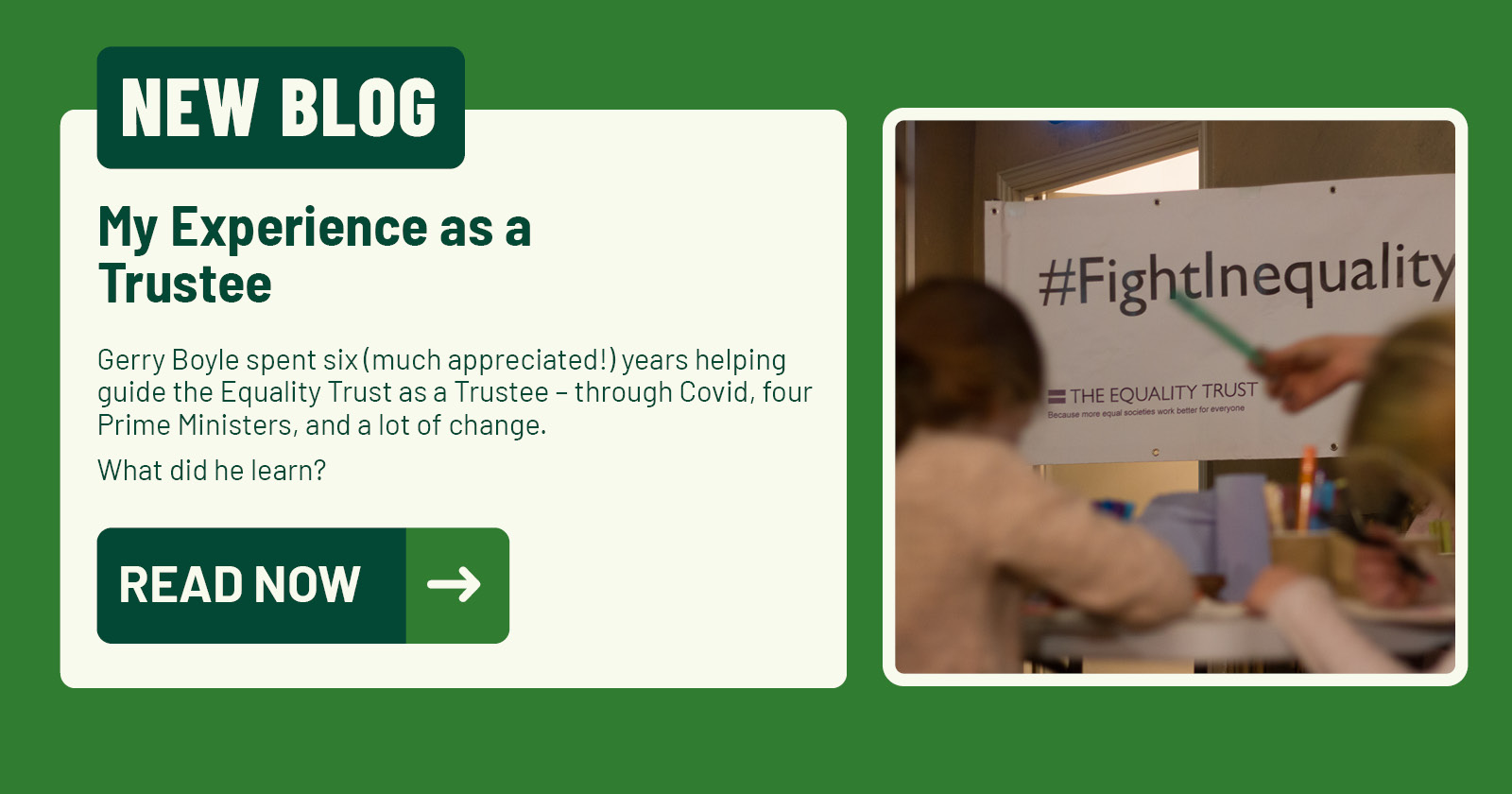
The landscape of British socioeconomic policy has long been defined by persistent disparities in wealth, health, and opportunity. At the center of the ongoing debate surrounding economic fairness sits the Equality Trust, a prominent UK-based campaigning organization dedicated to highlighting the societal damage wrought by extreme inequality. As the organization navigates an increasingly complex financial and political climate, it marks the departure of one of its most dedicated governance figures. Gerry Boyle, a long-serving member of the board of trustees, has officially stepped down after completing the maximum allowable tenure of six years, structured across two distinct three-year terms.
Boyle’s departure marks the conclusion of a turbulent and transformative period for the Equality Trust. His tenure spanned significant shifts in the United Kingdom’s political leadership, prolonged economic austerity, and a rapidly tightening funding environment for the third sector. In a reflective statement detailing his departure, Boyle highlighted the deep-seated motivations that initially drew him to the organization, the structural challenges faced by modern non-profits, and the vital importance of grassroots financial sustainability in preserving independent advocacy.
The Genesis of Commitment: Inspired by Empirical Evidence
Boyle’s journey with the Equality Trust began long before he assumed a formal governance role. Like many supporters and advocates of economic egalitarianism, his engagement was catalyzed by the landmark findings presented in The Spirit Level: Why Equality is Better for Everyone, authored by Richard Wilkinson and Kate Pickett. Published initially in 2009, the seminal text utilized extensive international data to demonstrate a robust correlation between income inequality and a vast array of social ills, including lower life expectancy, higher rates of mental illness, lower educational performance, and elevated rates of incarceration.
For Boyle, the empirical rigor of The Spirit Level provided an intellectual framework that aligned with his longstanding personal commitment to social justice. Prior to joining the board, his experience in the charity sector was relatively modest, restricted to a part-time voluntary role chairing a small organization that raised funds for international campaigners. However, his professional background in business management and international development equipped him with a strategic perspective that would prove invaluable to the Equality Trust.
When formally invited to join the board of trustees, Boyle brought a distinct operational lens to an organization primarily driven by academic research, public campaigning, and grassroots activism. Over the course of his six-year tenure, he worked alongside a rotating roster of trustees, executive directors, and staff members, noting that the diversity of lived experiences, academic backgrounds, and professional skills within the leadership team was one of the organization’s primary operational strengths.
A Chronology of Turbulence: Navigating the 2020–2026 Landscape
Boyle’s tenure, spanning from March 2020 to March 2026, coincided with one of the most volatile economic and political periods in modern British history. The timeline of his service captures a cascading series of national and international crises that directly impacted the operational capacity of civil society organizations.
In early 2020, as Boyle began his first term, the United Kingdom—and the global community—was plunged into the unprecedented health and economic crisis of the COVID-19 pandemic. While the immediate public health emergency highlighted deep health inequalities across different socioeconomic demographics, the subsequent economic recovery failed to deliver egalitarian outcomes. Instead, society experienced prolonged fragmentation, compounded by the sustained impacts of a decade of public sector austerity.
By 2022 and 2023, the UK economy entered a severe cost-of-living crisis, driven by soaring inflation, escalating energy costs, and stagnant real wages. This macroeconomic pressure squeezed household budgets while simultaneously increasing the demand for charitable and support services. Organizations operating within the third sector found themselves confronting a dual crisis: a surge in community need coupled with a sharp contraction in traditional funding streams.
Furthermore, the geopolitical and domestic funding landscape experienced severe contractions. Changes in government priorities, alongside international policy shifts—particularly concerning the reduction and restructuring of international aid budgets by major global powers, including the United States and the United Kingdom—created a ripple effect across the non-profit sector. Grant-making bodies faced diminished endowments and altered priorities, leaving a larger pool of advocacy and social justice organizations competing for a shrinking volume of financial resources.
Financial Vulnerabilities and the Shift Toward Grassroots Funding
As a long-standing member of the board’s finance committee, Boyle maintained a firsthand view of the structural financial pressures facing the Equality Trust. Historically, many independent advocacy organizations in the UK have relied heavily on a concentrated funding model, depending on a small number of substantial grants from philanthropic foundations or major donors.
While this funding architecture can provide stability during economic booms, it introduces profound institutional vulnerability. As Boyle observed, a reliance on "lumpy" funding means that an organization’s financial footing can shift rapidly from comfortable to precarious if even a single major grant fails to materialize. The loss or non-renewal of a primary institutional grant forces rapid budgetary recalibrations, often necessitating difficult choices regarding staffing, campaign scope, and operational reach.
In response to these systemic headwinds, the Equality Trust accelerated its strategic pivot toward a diversified funding model. Building a sustainable financial base anchored by smaller, recurring contributions from individual supporters and grassroots donors has become an existential priority. However, replacing concentrated institutional grants with a broad coalition of micro-donations is a labor-intensive process that requires sustained engagement, transparent communication, and long-term trust-building—particularly during periods when household disposable incomes are severely constrained by inflationary pressures.
Sector analysts note that independent advocacy organizations face a delicate balancing act. Financial reliance on state funding or corporate sponsorship can compromise an organization’s independence and willingness to critique established power structures. Consequently, grassroots fundraising remains the gold standard for maintaining uncompromised critical voices. Boyle’s reflections underscored this reality, issuing a direct appeal to the public to maintain and expand financial contributions to ensure the Equality Trust retains the absolute freedom required to challenge systemic inequality without fear or favor.
Milestones of Impact: Policy Wins and Public Engagement
Despite the unforgiving fiscal and political environment, the Equality Trust achieved several notable milestones during Boyle’s six-year tenure. These achievements reflect the organization’s dual focus on structural legislative reform and the amplification of marginalized voices at the grassroots level.
One of the standout achievements highlighted by departing trustees and executive staff is the persistent advocacy surrounding the Socio-Economic Duty—often referred to as Section 1 of the Equality Act 2010. While enacted as part of broader equality legislation, successive governments delayed its implementation in England for over a decade. Through sustained lobbying, public awareness campaigns, and policy research, the Equality Trust, alongside allied civil society groups, kept the duty on the political agenda, witnessing its progressive adoption by local authorities and devolved administrations as a tool to mandate poverty-proofed decision-making in public policy.
Equally significant has been the Trust’s commitment to centering the lived experiences of young people. Recognizing that future generations bear the brunt of housing affordability crises, educational disparities, and precarious labor markets, the organization actively cultivated platforms for youth-led advocacy. By integrating young voices directly into national conversations on wealth distribution and social mobility, the Trust injected fresh urgency and authenticity into its public campaigns.
Furthermore, the organization consistently utilized empirical research to expose the widening wealth gap within the United Kingdom. By publishing regular analyses on executive pay disparities, regional inequality, and the concentration of wealth among top earners, the Equality Trust maintained pressure on policymakers to address the structural drivers of poverty rather than merely treating its symptoms.
Governance in the Third Sector: Perspectives from the Boardroom
Serving as a trustee in the contemporary non-profit landscape demands a complex navigation of legal responsibilities, strategic oversight, and fiduciary stewardship. For Boyle, transitioning from a hands-on project management background to the strategic, governance-focused realm of a charity trustee presented both unique challenges and rewarding opportunities.
In modern UK charity governance, trustees operate on a voluntary, part-time basis, legally bound by the Charities Act to act in the best interests of the organization, safeguard its assets, and ensure compliance with regulatory standards set by the Charity Commission. Unlike executive staff members who manage day-to-day operations, trustees maintain a deliberately "hands-off" posture, focusing on high-level strategy, financial oversight, risk management, and executive appointments.
Boyle noted that while adjusting to this governance-oriented distance required an initial mental shift, the experience offered a profound sense of shared purpose. Working alongside individuals from diverse professional backgrounds—spanning academic research, frontline activism, corporate governance, and direct lived experience of inequality—fostered a dynamic and resilient leadership culture. His tenure illustrates the value of bringing multidisciplinary perspectives into non-profit boardrooms, where business acumen must be carefully balanced with a deep understanding of social justice and community advocacy.
Broader Implications: The Future of Economic Inequality Advocacy
As Boyle steps down upon reaching his constitutional term limit, the broader implications of his departure extend far beyond internal board administration. The challenges he articulated—shrinking philanthropic capital, rising societal fragmentation, and an increasingly hostile economic environment for lower-income households—are emblematic of the broader hurdles facing the entire social justice sector in the mid-2020s.
Economic analyses from major research institutions indicate that wealth concentration within the UK remains near historic highs. The post-pandemic economic recovery has disproportionately benefited asset owners and high-income earners, while median households continue to struggle against the lingering structural effects of inflation and elevated borrowing costs. In this climate, the analytical and campaigning work performed by organizations like the Equality Trust is widely regarded by sociologists and economists as more critical than ever.
However, the financial fragility described by departing governance members serves as a cautionary indicator for the health of British civil society as a whole. When independent watchdogs and advocacy groups are forced to divert significant organizational energy toward basic survival and fundraising in an arid funding market, their capacity to hold power to account, scrutinize legislative agendas, and educate the public is inevitably constrained.
The transition of leadership at the Equality Trust thus arrives at a critical juncture. As the board initiates processes to recruit new trustees to fill vacancies left by departing members like Boyle, the organization must continue to adapt its operational models, deepen its engagement with individual supporters, and articulate a compelling vision for an egalitarian society.
Reflecting on his six years of service, Boyle offered a glowing endorsement of the trustee experience, characterizing it as a profoundly positive contribution to a vital societal struggle. For an organization dedicated to proving that more equal societies almost always perform better across every measurable indicator of human well-being, the dedication of its volunteer leadership remains a foundational pillar. As the Equality Trust looks toward its next chapter, the institutional memory and strategic foundations laid during Boyle’s tenure will continue to inform its ongoing mission to build a fairer, more equitable United Kingdom.




