

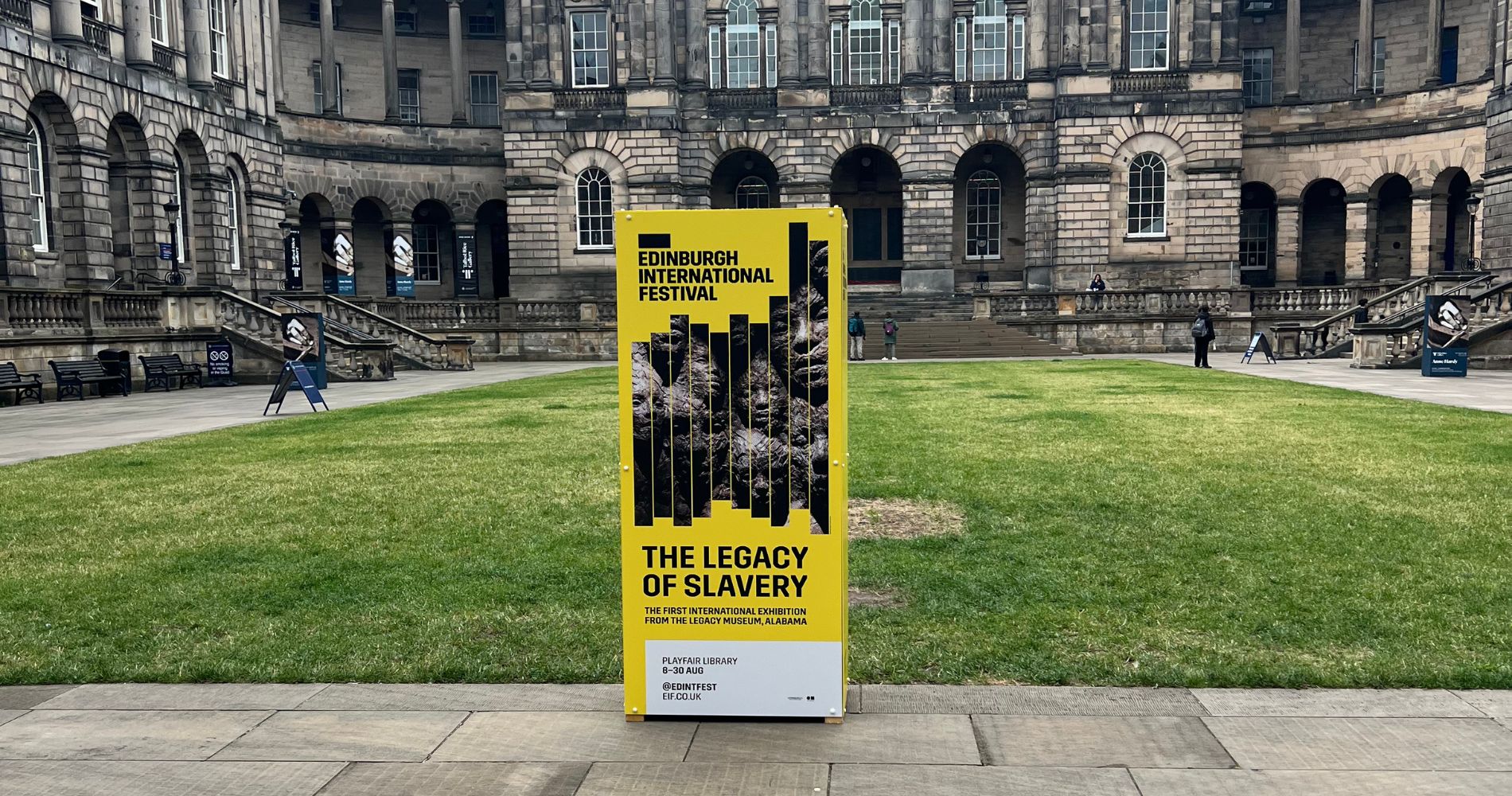
The Equal Justice Initiative (EJI) has marked a historic milestone in its mission to confront the legacy of systemic racial injustice, bringing an abridged, narrative-focused version of its renowned Legacy Museum to the international stage for the first time. Housed within the historic Playfair Library at the University of Edinburgh, the exhibition, titled The Legacy of Slavery in America, opened this past weekend as a marquee component of the 2026 Edinburgh International Festival. This arrival in Scotland represents a strategic expansion of EJI’s public education efforts, moving the discourse on American racial history beyond domestic borders and into the global cultural consciousness.
A Historical Context: From Montgomery to Edinburgh
Since its inception, the Equal Justice Initiative, led by executive director and public interest attorney Bryan Stevenson, has sought to address the historical silence surrounding the era of enslavement, racial terror, and contemporary mass incarceration in the United States. EJI’s work is anchored by its four “Legacy Sites” in Montgomery, Alabama: the Legacy Museum, the National Memorial for Peace and Justice, the Freedom Monument Sculpture Park, and the recently established Montgomery Square.
The exhibition in Edinburgh serves as an immersive, pedagogical bridge between these American sites and an international audience. By utilizing deeply researched written content, archival documentation, first-person testimonies, and cinematic installations, the exhibit maps the evolution of racial hierarchy from the trans-Atlantic slave trade through the Jim Crow era and into the modern American criminal justice system.
The Evolution of Racial Injustice: A Chronological Framework
To understand the exhibition’s narrative arc, one must examine the timeline of racial policy in the United States that the display meticulously reconstructs:
- The Era of Enslavement (1619–1865): The exhibition begins by contextualizing the economic and social structures that necessitated the kidnapping of Africans. It emphasizes that the “false narrative of racial difference” was not merely a social prejudice but a legal and economic construct designed to sustain the trans-Atlantic and domestic slave trades.
- Reconstruction and the Rise of Racial Terror (1865–1900s): Following the abolition of slavery via the 13th Amendment, the exhibit illustrates how white supremacy adapted to the new legal landscape. This period saw the rise of lynching as a tool of domestic terror, designed to maintain control over formerly enslaved populations and suppress political agency.
- The Era of Codified Segregation (1890s–1960s): The exhibit transitions into the Jim Crow era, highlighting how federal and state laws systematically disenfranchised Black Americans, limited their mobility, and codified economic inequality.
- The Contemporary Era (1970s–Present): The narrative concludes by examining the modern era of mass incarceration. EJI data suggests that the mechanisms of control have shifted, with contemporary policing and sentencing policies perpetuating historical disparities.
The Festival Connection: Aligning with “All Rise”
The Edinburgh International Festival, established in 1947 in the shadow of World War II, was originally conceived as a platform for cultural reconciliation and international dialogue. In 2026, the festival aligns its programming with the 250th anniversary of the United States. Under the thematic banner of “All Rise,” the festival aims to use artistic endeavor as a medium for truth-telling and tolerance.
The inclusion of the EJI exhibition is a departure for the festival, marking the first time the event has featured a museum-style narrative experience as a centerpiece of its program. This decision was underscored during the festival’s opening concert on August 8, which featured the Jazz at Lincoln Center Orchestra and Wynton Marsalis performing his 12-movement symphony, All Rise. The synchronization between Marsalis’s composition—which explores the complexities of American identity—and the EJI exhibit creates a cohesive, if somber, cultural commentary on the nation’s past.
Data-Driven Narrative and Human Impact
The exhibit relies on a substantial body of data to support its claims regarding the enduring nature of racial inequality. EJI’s research, which informs the exhibition, has previously identified the documentation of over 4,000 racial terror lynchings in the American South between 1877 and 1950. By bringing these figures and the individual stories behind them to a Scottish audience, the exhibition challenges the notion that these events are isolated incidents of the past.
Bryan Stevenson, in recent discussions, has emphasized that art is not merely an aesthetic choice but a necessary tool for historical reckoning. “The relationship between art, music, and justice is deep, profound, and ancient,” Stevenson stated. He suggests that the most enduring creative works are often those that emerge from the furnace of inequality. By presenting this history in the Playfair Library, the exhibition invites visitors to reconsider the American experience through a lens of global accountability.
The Logistics of Engagement
The exhibition is open to the public daily from 10:00 am to 5:00 pm through August 30. While admission is free, the high demand for festival programming necessitates advance ticket booking, though walk-ins are considered based on daily capacity. The choice of the Playfair Library, a location synonymous with intellectual inquiry and academic rigor, reinforces the exhibition’s commitment to evidence-based historical analysis.
Broader Implications and Global Resonance
The decision to exhibit in Scotland is strategically significant. As Europe and the United States continue to navigate the complexities of their respective histories regarding colonialism and the trade of enslaved people, the EJI exhibit serves as a catalyst for broader transnational conversations.
Political analysts and historians observing the festival have noted that the exhibition serves as a “backbone” for the broader festival program. Many of the featured works at this year’s festival are presented by artists grappling with the global footprint of American hegemony and the lingering impacts of 18th-century economic policies. By grounding these artistic expressions in the historical reality of the U.S. racial hierarchy, the exhibition provides a necessary intellectual framework for audiences.
Furthermore, the collaboration between EJI and the Edinburgh International Festival highlights a shift in how cultural institutions view their responsibility toward social justice. It is no longer sufficient to present art in a vacuum; there is an increasing demand for curation that provides context, historical depth, and a call to action.
Looking Forward
As the exhibition continues its month-long residency, the impact of its presence in Edinburgh will likely be measured by the depth of the discourse it inspires among international attendees. For many European visitors, the exhibition offers a sobering look at the mechanisms that allowed racial hierarchy to persist long after the abolition of slavery. For American visitors, it provides an opportunity to view their nation’s history from a distance, perhaps gaining a clearer perspective on the structural shifts that characterize the modern era.
The partnership between EJI and the festival underscores a growing recognition that the fight for racial justice is not restricted by geography. The “All Rise” theme of the 2026 festival, coupled with the EJI exhibition, acts as a reminder that the pursuit of truth is an ongoing project—one that requires the synthesis of historical records, artistic expression, and sustained public engagement.
By the time the exhibition concludes on August 30, it will have served thousands of international visitors, cementing the role of the Equal Justice Initiative as a leader in the global movement for racial recognition and historical accuracy. The success of this inaugural international effort may well pave the way for future global engagements, ensuring that the history of the American experience continues to inform and challenge the world’s understanding of human rights and justice.




