The Federal Communications Commission (FCC) has initiated a comprehensive review of ABC’s broadcast licenses, centering on its flagship daytime talk show, "The View." This unprecedented examination, launched earlier this year, probes whether the popular program has adhered to the long-standing equal time rule, a cornerstone of broadcast regulation designed to ensure fairness in political coverage. The FCC’s scrutiny stems from allegations that "The View" may have provided disproportionate airtime to certain political figures, potentially violating the mandate that broadcast programs offer equal opportunities to opposing candidates for public office.
The Equal Time Rule Under Scrutiny
The equal time rule, formally Section 315 of the Communications Act of 1934, stipulates that if a broadcast station permits any one candidate for public office to use its facilities, it must afford equal opportunities to all other candidates for the same office. This rule is critical for maintaining a level playing field in political discourse, particularly for lesser-known candidates who may lack the resources of their more established opponents.
However, the rule includes several exemptions, one of the most significant being for "bona fide news programs." This classification allows news broadcasts, interviews with political figures as part of a news event, and documentaries to operate outside the strict equal time provisions. ABC has consistently argued that "The View" falls under this exemption, asserting its status as a bona fide news program.
A Shift in Programming Following FCC Inquiry
The FCC’s investigation appears to have prompted a noticeable shift in "The View’s" programming. An analysis by Semafor, published on July 5, 2026, revealed that since the announcement of the FCC inquiry, the show has ceased featuring guests who are actively campaigning in competitive midterm races. This change suggests an effort by the network to mitigate potential violations of the equal time rule while the investigation is ongoing.
The timing of this programming adjustment is significant, occurring in the months following the FCC’s announcement of its early review. This observation by Semafor raises questions about the show’s editorial decisions and their potential alignment with regulatory pressures.
Defining "News" in the Digital Age
The FCC’s inquiry into "The View" highlights a broader and more complex challenge: the evolving definition of "news" in contemporary America. A 2025 Pew Research Center study titled "What is News?" underscores the multifaceted nature of this perception. The study found that individuals’ definitions of news are not monolithic and are influenced by a variety of factors, including the topic of the information, its source, and crucially, the audience’s own identities and attitudes.
This subjective interpretation of "news" complicates the application of regulatory frameworks like the equal time rule, which were established in an era of broadcast television dominance. What one viewer considers a legitimate news discussion, another might perceive as partisan commentary. The FCC’s challenge lies in applying a decades-old rule to a media landscape that is increasingly fragmented and where the lines between news, opinion, and entertainment are often blurred.
Background of the FCC’s Review
The FCC’s decision to conduct an early review of ABC’s broadcast licenses, specifically concerning "The View," was announced in April 2026. This move signaled a heightened level of regulatory attention towards the program’s political coverage. While the exact impetus for the FCC’s decision remains a subject of internal deliberation, it is understood to be a response to complaints or concerns raised by various parties regarding the show’s treatment of political candidates.
"The View" has long been a prominent platform for discussions on current events and politics, often featuring politicians, commentators, and public figures. Its format, which blends panel discussion with interviews, has garnered significant viewership but has also occasionally drawn criticism for its perceived political leanings or interview tactics.
ABC’s Stance: A Bona Fide News Program
In response to the FCC’s inquiry and the subsequent reporting, ABC has maintained its position that "The View" qualifies as a "bona fide news program." This classification is crucial for the show’s exemption from the equal time rule. Network representatives have emphasized that the program’s content, format, and editorial standards align with those expected of news programming.

"The View has always strived to provide viewers with insightful and engaging discussions on the issues of the day," an ABC spokesperson stated in a press release earlier this year. "We believe our program consistently meets the FCC’s criteria for a bona fide news program, offering a platform for diverse perspectives and in-depth conversations with prominent figures, including those in politics."
The network’s defense hinges on the established precedent and the argument that the show’s journalistic integrity and informative nature should exempt it from the strict equal time requirements. However, the FCC’s ongoing review suggests a need for a thorough examination of these claims in the current media environment.
Shifts in Local News Trust
In related developments concerning public trust in media, a new analysis published in Nieman Lab this week, based on data from the Pew-Knight Initiative, reveals a concerning trend in how Americans perceive local news. Historically, local news organizations have enjoyed broad trust across the political spectrum. However, this report indicates a recent decline in this trust.
The analysis highlights a decrease in the percentage of Americans who express confidence in local news outlets. Concurrently, there has been a drop in the proportion of individuals who view local news as highly important for the well-being of their communities. This erosion of trust at the local level could have significant implications for civic engagement and informed decision-making. The Pew-Knight Initiative’s extensive data collection on local news consumption and trust provides a critical baseline for understanding these evolving public attitudes.
The Growing Influence of AI in Political Decision-Making
Looking ahead, the role of artificial intelligence in shaping voter decisions is emerging as a significant concern. A recent New York Times article explored the increasing reliance of some voters on AI chatbots for assistance in making their voting choices. While many major AI platforms are programmed to avoid direct political endorsements or partisan advice, users are reportedly finding ways to circumvent these restrictions and elicit political guidance.
The convenience and efficiency of AI chatbots could prove attractive to voters, particularly in an environment where, as noted by Pew Research Center data from 2024, a substantial number of Americans find it challenging to access the necessary information to make informed voting decisions. However, this trend is accompanied by considerable apprehension regarding the accuracy and potential biases of information provided by AI.
A 2024 Pew Research Center survey revealed widespread wariness about AI’s influence on elections. Over half of U.S. adults (51%) predicted a negative impact of AI on American elections over the next two decades, with only 9% anticipating a positive effect. A further 17% foresaw an equal mix of positive and negative impacts, while 23% remained unsure. This public sentiment underscores the need for careful consideration of AI’s integration into the political process.
Public Opinion on Social Media Restrictions for Minors
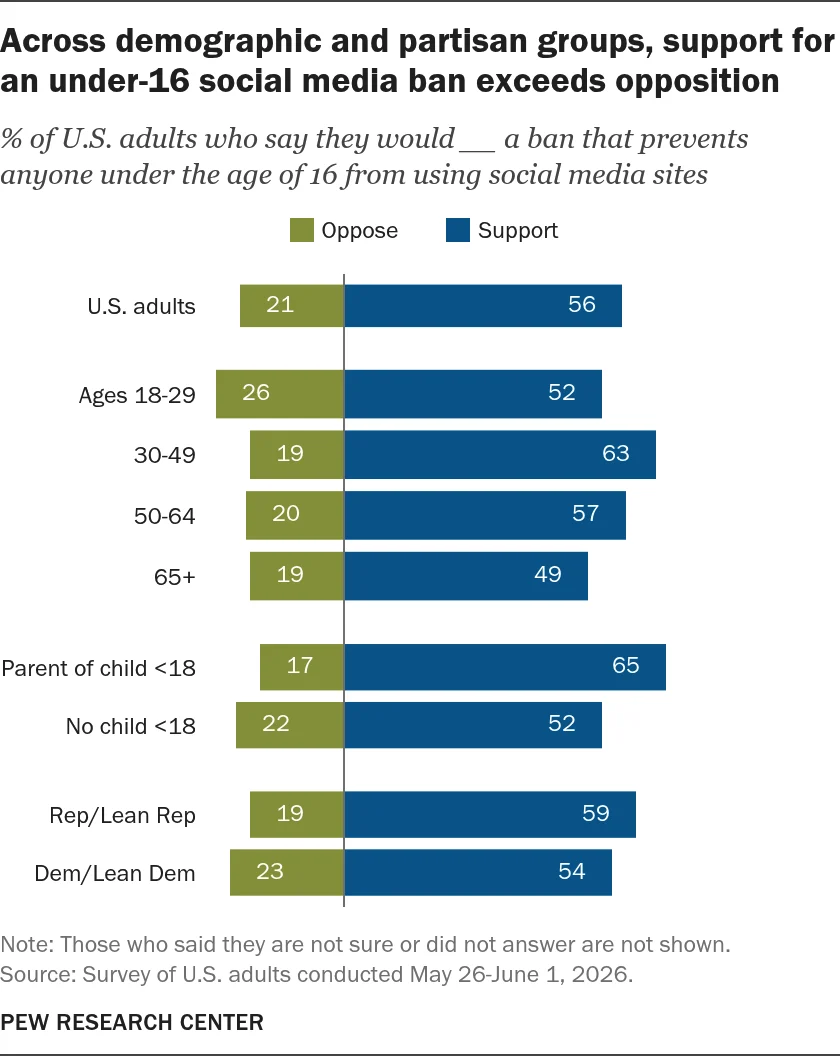
A compelling chart of the week, derived from a recent Pew Research Center analysis, sheds light on American attitudes toward restricting social media access for children under 16. This issue has gained prominence globally, with countries like the U.K. and Australia considering or enacting such bans.
The Pew data indicates that a majority of U.S. adults (56%) support the idea of prohibiting social media use for individuals under 16. Conversely, 21% oppose such measures. Support for these restrictions is substantial across most age demographics, with those aged 30 to 49 and parents of minor children expressing the highest levels of favorability. Notably, the proposal garners bipartisan backing, with both Republicans and Democrats showing a greater propensity to support than oppose such a ban. This widespread consensus suggests a growing public concern about the impact of social media on young people.
The Pew Research Center staff involved in compiling "The Briefing" include Naomi Forman-Katz, Christopher St. Aubin, Emily Tomasik, Joanne Haner, and Sawyer Reed. The publication is edited by Michael Lipka and copy edited by Anna Jackson. Readers interested in providing feedback are encouraged to email [email protected] or complete a brief survey.