A comprehensive new study from the Pew Research Center, conducted in collaboration with the Pew-Knight Initiative, offers an in-depth examination of the religious radio landscape across the United States, with a particular focus on the unique characteristics and programming of Catholic radio stations. The research reveals that approximately a quarter of all FCC-licensed AM and FM radio stations nationwide primarily broadcast religious or faith-based content, the vast majority of which identify as Christian. Within this significant segment of the American media, Catholic stations, though a smaller portion, exhibit distinct programming trends and audience engagement patterns compared to their Protestant and general Christian counterparts.
The Pew-Knight Initiative, a joint endeavor by The Pew Charitable Trusts and the John S. and James L. Knight Foundation, is dedicated to fostering a deeper understanding of how Americans consume civic information, shape their beliefs and identities, and participate in their communities. This latest report, "Religious Radio Across America," aligns with the Pew Research Center’s long-standing commitment to illuminating news habits and media consumption, recognizing that religious radio stations represent a considerable, yet often overlooked, component of the nation’s media ecosystem.
Understanding the Scope: The Pervasiveness of Religious Radio
The study’s findings underscore the widespread presence of religious broadcasting. Out of all FCC-licensed AM and FM radio stations in the U.S., a substantial 25% are dedicated to religious programming. Of these, the overwhelming majority are Christian in their affiliation. The research categorizes these stations based on their self-identification and content analysis. A significant 63% simply identify as "Christian" without further denominational specifics. Another 10% are affiliated with specific Protestant traditions, while a notable 8% of the religious radio stations analyzed identify specifically as Catholic radio.
This statistical breakdown highlights the diverse religious broadcasting landscape, with Christian programming dominating the airwaves. However, it is the distinct characteristics of Catholic radio that draw particular attention in this report, suggesting a unique approach to faith-based media engagement.
Geographic Distribution: A Midwestern and Northeastern Concentration
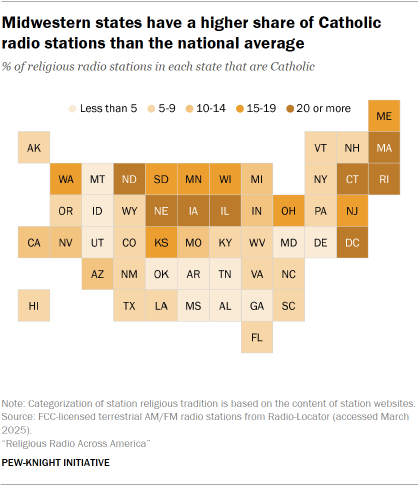
While religious radio stations, including Catholic ones, can be found throughout the United States, the study identifies a notable concentration of Catholic radio stations in the Midwest and Northeast regions. Conversely, these stations appear to be less prevalent in the Southern United States when compared to stations identifying with Protestant traditions or simply as "Christian." This geographical distribution may be influenced by historical demographic patterns of Catholic populations within the U.S.
Programming Differentiators: The Distinctive Voice of Catholic Radio
A key revelation of the Pew Research Center’s analysis is the significant divergence in programming content between Catholic radio and other Christian radio formats. While many religious stations share popular syndicated talk shows, Catholic stations largely eschew these common programs. For instance, popular syndicated shows like "Unshackled," "Turning Point," and "Focus on the Family," which are carried by a substantial portion of non-Catholic religious stations, are virtually absent from Catholic station schedules.

This indicates a deliberate curation of content on Catholic radio, aiming to provide a distinct offering to its listeners. The research further reveals that the typical schedule for a Catholic station has "essentially no overlap" with non-Catholic religious stations, underscoring a commitment to a unique broadcast identity.
Format Preferences: A Predominance of Talk Over Music
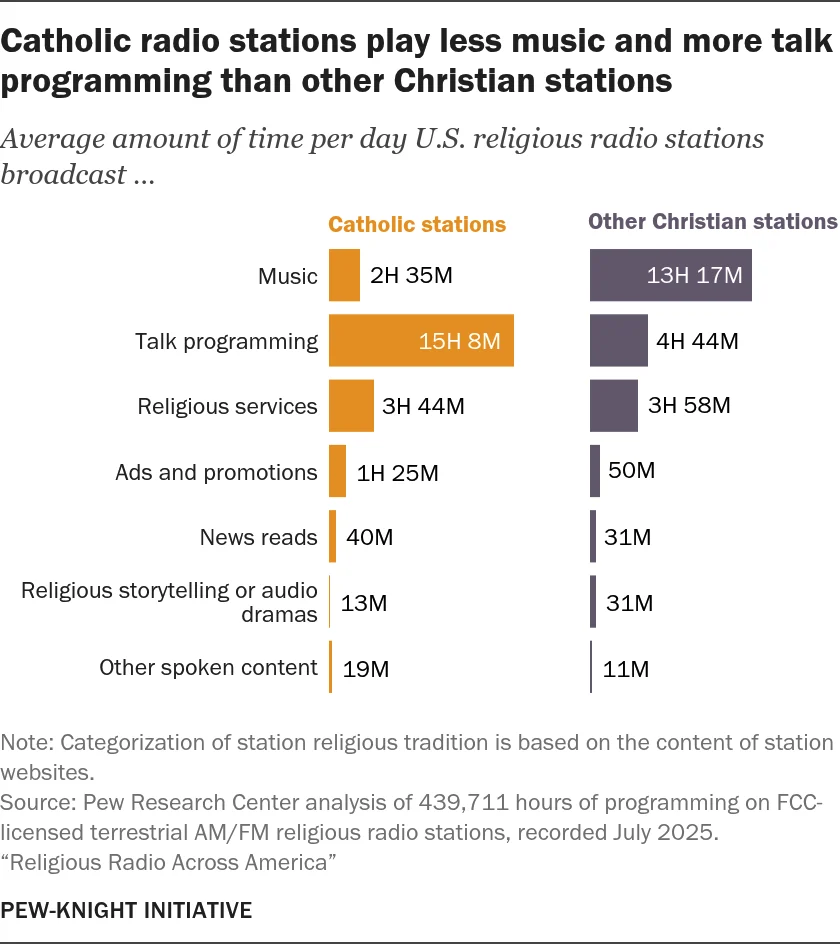
The study’s detailed analysis of broadcast content reveals a striking difference in format preferences. Overall, religious radio stations dedicate approximately half of their airtime to music. However, Catholic stations present a stark contrast, with music accounting for only 11% of their programming. This figure encompasses all forms of musical content, from jingles in advertisements and program intros to music played during religious services.
The music that does appear on Catholic radio also exhibits unique characteristics. A significant portion of this music is difficult to categorize using automated music recognition systems, suggesting it may not be derived from widely available commercial recordings. This could imply a focus on more traditional, liturgical, or locally produced music within the Catholic broadcasting sphere.
In stark contrast to the limited music programming, Catholic radio stations overwhelmingly favor talk programming. On average, Catholic stations broadcast an impressive 15 hours of talk content per day. This figure dwarfs the under five hours of talk programming typically found on other Christian stations. This emphasis on spoken word content allows for a more in-depth exploration of theological, pastoral, and community-focused topics relevant to the Catholic faith.
Content Analysis: Talk, Services, and Biblical References
The extensive talk programming on Catholic radio encompasses a variety of formats, including host-led discussions, interviews with guests, monologues, and listener call-in segments. These formats provide a platform for engaging with listeners on a wide range of issues.
Beyond talk and music, both Catholic and non-Catholic religious stations allocate a similar amount of time to content categorized as religious services or sermons. However, the nature of these broadcasts reflects the distinct liturgical practices of their respective traditions. Catholic Mass, with its specific structure and prayers, naturally differs from services in other Christian denominations.
An examination of biblical references also provides insight into programming differences. While there is significant overlap in the most frequently mentioned books of the Bible – including the Gospels of Matthew, Luke, and John, and Old Testament books like Psalms, Genesis, Exodus, and Isaiah – a notable distinction emerges regarding the Book of Revelation. At the time of the study, listeners were significantly more likely to hear references to the Book of Revelation on non-Catholic radio stations than on Catholic ones. This could indicate different theological emphases or interpretative approaches to eschatological themes.
Methodology and Sponsorship: Ensuring Rigor and Independence
The Pew Research Center’s rigorous methodology is crucial to the credibility of these findings. For this study, researchers employed three primary data sources to provide a comprehensive understanding of religious radio. This approach allowed for a broad overview of station locations, programming styles, and listener motivations.
The Pew-Knight Initiative’s funding is critical to supporting this type of in-depth research. The Pew Charitable Trusts and the John S. and James L. Knight Foundation, both nonpartisan and non-advocacy organizations, are committed to informing the public and supporting informed and engaged communities. The Pew Research Center itself operates as a fact tank, dedicated to providing unbiased data and analysis on a wide array of societal issues.
The report provides transparent access to its research methods, including the survey questions utilized, detailed responses, and a comprehensive methodology document. This commitment to transparency allows for scrutiny and verification of the study’s findings.
Implications for the Media Landscape and Faith Communities
The findings of this study have several important implications. Firstly, they highlight the significant role that religious radio plays in the American media landscape, offering a distinct source of information and community for millions of listeners. The specialization within religious broadcasting, particularly the distinct programming of Catholic radio, suggests a sophisticated approach to audience engagement and content delivery tailored to specific faith traditions.
Secondly, the research provides valuable insights for media scholars, religious organizations, and policymakers interested in understanding media consumption patterns within faith communities. The differences observed in programming and format preferences can inform strategies for content creation, outreach, and community building.
For Catholic dioceses, parishes, and lay organizations, understanding these trends can help in supporting and promoting Catholic media initiatives. The emphasis on talk programming on Catholic radio suggests an opportunity for deeper engagement with theological discourse, social justice issues, and the practical application of faith in daily life. The relative scarcity of music could also point to opportunities for increased support for Catholic musicians and the incorporation of more faith-inspired music within broadcasts.
The study’s focus on the "why" behind listening habits, though not detailed in this excerpt, will likely provide further avenues for understanding the motivations of religious radio listeners, whether seeking spiritual guidance, community connection, or news and commentary from a faith-informed perspective.
In conclusion, the Pew Research Center’s study, supported by the Pew-Knight Initiative, offers a granular and illuminating look into the diverse world of American religious radio. The detailed analysis of Catholic radio’s unique programming, geographic distribution, and content preferences provides a valuable contribution to our understanding of how faith is communicated and consumed through the medium of radio in the 21st century. As the media landscape continues to evolve, such research remains essential for comprehending the multifaceted ways in which Americans engage with information and community.