Unconscious bias awareness training, once heralded as the cornerstone in the fight against discrimination and a rapid solution for fostering equity and inclusion, has become a pervasive global trend and a lucrative multi-billion dollar industry. However, growing evidence suggests that this widely adopted approach is, at best, ineffective, and at worst, actively detrimental, often backfiring in its stated objectives. This article delves into the systemic shortcomings of current bias awareness training models and argues for a paradigm shift towards designing environments and processes that inherently promote a more just and inclusive world for the benefit of all.
The proliferation of unconscious bias training (UBT) within organizations reflects a common, yet flawed, pattern of response to urgent calls for social change. Following watershed moments like the #MeToo movement, which exposed pervasive sexual harassment and gender inequality, and the #BlackLivesMatter protests, which shone a harsh light on systemic racial injustice, companies and institutions worldwide rushed to implement UBT programs. The pattern became predictable: an employee grievance citing discriminatory treatment, or a general desire to signal commitment to diversity, equity, and inclusion (DE&I), would invariably lead to the rollout of bias training for all personnel. This reactive approach often positions UBT as a defensive shield, a visible token of action intended to quell criticism and demonstrate a commitment to change, with the underlying assumption that awareness alone will "fix" deep-seated issues. However, the anticipated transformation rarely materializes, prompting a critical examination of why this seemingly intuitive solution consistently falls short.
The Rise and Commercialization of Unconscious Bias Training
The concept of unconscious bias gained significant traction in the early 2000s, moving from academic discourse into corporate boardrooms. Psychological research, particularly from social cognition, highlighted how implicit associations and stereotypes could influence judgments and behaviors outside conscious awareness. This scientific insight offered a compelling explanation for persistent inequalities despite overt commitments to fairness. Consultants quickly recognized the market potential, packaging these academic findings into corporate training programs.
The industry truly exploded in the past decade, driven by increased public scrutiny on diversity and inclusion issues. Organizations, eager to demonstrate social responsibility and avoid legal repercussions, invested heavily. The promise was simple: by making individuals aware of their biases, they would learn to mitigate them, leading to fairer decisions and a more inclusive culture. This narrative fueled a lucrative market for trainers, workshops, and online modules, creating a vast ecosystem of providers. According to various market analyses, the global diversity and inclusion training market size was valued at several billion dollars in the mid-2200s and is projected to grow significantly, underscoring the enormous financial investment in these solutions.
Why Awareness Alone is Insufficient: A Cognitive Mismatch
The fundamental flaw in the over-reliance on UBT lies in a misapprehension of human cognition and behavior. Our minds operate on two primary systems, as popularized by Nobel laureate Daniel Kahneman: System 1, the unconscious, fast, intuitive, and emotional system responsible for the vast majority of our cognitive functions, including biases and heuristics; and System 2, the conscious, slow, rational, and effortful system used for deliberate thought and decision-making.
Unconscious bias awareness training predominantly appeals to System 2. It aims to educate, inform, and persuade individuals on a rational level about the existence and impact of biases. While this can provide valuable knowledge, it often fails to penetrate or alter the deeply ingrained, automatic processes of System 1. Knowing about bias in a conscious, rational sense does not automatically reduce its powerful, unconscious influence on our perceptions, judgments, and behaviors. This cognitive mismatch means that while participants might intellectually grasp the concepts, their actual behavior in real-world scenarios, where System 1 often takes over, remains largely unchanged. It’s akin to knowing the theory of swimming without ever getting in the water; the knowledge doesn’t translate into ability.
The Counterproductive Outcomes of Traditional UBT
Beyond mere ineffectiveness, a growing body of research and real-world experience indicates that UBT can often backfire, exacerbating the very problems it seeks to solve:
-
Mental Overload and Reinforcement of Bias: The conscious effort required to continuously monitor and counteract unconscious biases can lead to cognitive overload. When individuals are mentally fatigued or under pressure, System 1 defaults become even more dominant. Paradoxically, the attempt to be constantly aware of the unconscious can deplete mental resources, making individuals more susceptible to relying on biased heuristics, thus strengthening their impact rather than diminishing it. This creates a vicious cycle where the effort to mitigate bias inadvertently entrenches it.
-
Enhancement of Biases and Stereotypes: Studies have shown that simply making people aware of stereotypes can, in certain contexts, inadvertently reinforce them. By bringing these cognitive shortcuts to the forefront, UBT can sometimes legitimize or activate them in individuals’ minds, particularly if not coupled with actionable strategies for mitigation. For instance, research published in the Journal of Applied Psychology and other peer-reviewed journals has explored how certain types of diversity training can unintentionally make participants more aware of group differences, potentially leading to increased stereotyping or intergroup anxiety rather than cohesion.
-
Strengthening Misconceptions of Inequality: A significant finding from 2020 research published in Personality and Social Psychology Bulletin revealed a particularly concerning backfiring effect. For individuals in privileged positions, being made aware of racial prejudice and societal inequality did not necessarily shift their perception towards acknowledging systemic unfairness. Instead, it sometimes strengthened their belief that society is largely fair to all, and even led to a more optimistic (and inaccurate) perception of past inequalities. This "awareness backfire" indicates that merely presenting facts about inequality can, for some, trigger defensive mechanisms that entrench existing worldviews rather than challenging them.
-
Moral Licensing: Perhaps one of the most insidious unintended consequences is "moral licensing." Attending UBT can create a self-perception of being "one of the good people" who are aware of and committed to overcoming bias. This self-image, a form of moral credentialing, can unconsciously liberate individuals to act less inclusively or even in discriminatory ways later on. Studies, such as those by Monin and Miller (2001) on "moral credentials and the expression of prejudice," have demonstrated this phenomenon. For example, participants who initially expressed strong disagreement with sexist statements were later more likely to make sexist comments or hire a man for a job typically associated with women, feeling their prior "non-sexist" stance provided a license for subsequent biased behavior. Similarly, expressing anti-racist sentiments can lead individuals to unconsciously discriminate against racial minorities, believing their initial moral act has ‘offset’ any potential future wrongdoing.
-
Activating Shame, Fear, and Resistance: The very terminology of "Unconscious Bias Awareness Training" or "Inclusion & Diversity Training" can trigger counterproductive emotional responses. For many, these terms unconsciously activate feelings of anxiety ("I am going to be fixed"), loss aversion ("I’ll lose privilege, status, and power"), or even resentment and a desire for "revenge" ("Now, I’ll show them how wrong they are"). Others may develop an inflated sense of control ("Now, I know my bias and control it," leading to over-optimism). These emotions create psychological barriers to genuine engagement and change, transforming a potentially collaborative learning experience into a defensive or confrontational one. When individuals feel attacked or implicitly labeled as biased, their natural response is to shut down, resist, or rationalize, rather than to open up to self-reflection and behavioral adjustment.
While some UBT sessions may yield fleeting positive effects—such as creating a shared language for discussing inclusion, prompting brief self-reflection, or generating "aha moments" about previously unseen patterns of discrimination—these benefits are typically short-lived, often lasting only a few days. They are insufficient to drive the sustained behavioral and systemic changes necessary for true organizational transformation.
Designing for Inclusion: The Power of Inclusion Nudges
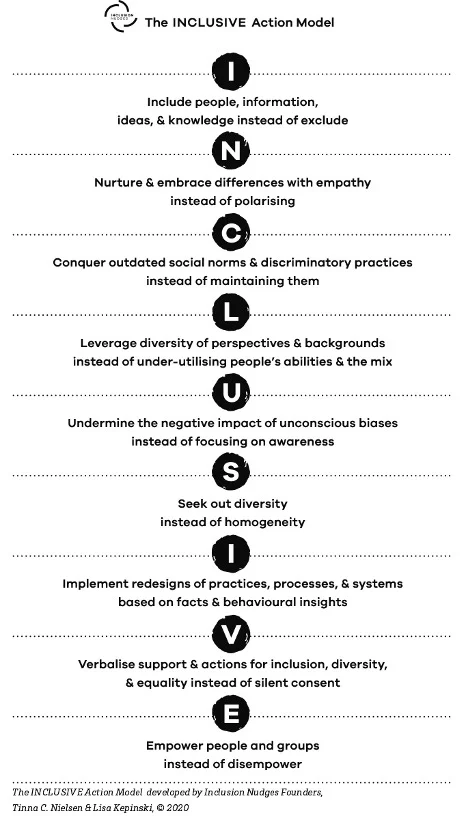
Given the limitations and potential pitfalls of traditional UBT, a more effective path to de-bias and foster inclusion lies not in attempting to rewire the human mind through awareness, but in redesigning the environments, processes, and choices we navigate daily. The focus must shift from fixing individuals to fixing systems. This is where the concept of "Inclusion Nudges" becomes paramount.
An Inclusion Nudge is an action deliberately designed to influence the unconscious mind, making inclusive behavior easy, automatic, and the default choice in daily interactions and decision-making. These nudges are practical applications of insights drawn from behavioral and social sciences, nudge theory, and a deep understanding of the hidden barriers to achieving genuine inclusion. They work by steering the unconscious mind—both our own and others’—towards inclusive actions without requiring constant conscious effort, rational persuasion, threats, or coercion. Crucially, they respect freedom of choice while subtly guiding individuals towards desired outcomes. This approach leverages the power of System 1, rather than futilely fighting against it.
Inclusion Nudges operate by minimizing the impact of cognitive shortcuts (biases) and reducing reliance on the conscious mind to drive change. They make the desired behavior automatic, aligning actions with stated values and intentions. This often comes at a remarkably low cost, making it an efficient and impactful strategy.
A Powerful Example: The Symphony Orchestra Blind Auditions
One of the most compelling and long-standing examples of an Inclusion Nudge is the implementation of blind auditions in symphony orchestras, a practice that gained traction in the 1970s. Prior to this, many major orchestras were predominantly composed of white males. When internal discussions began to question this homogeneity, a radical experiment was undertaken: musicians auditioned behind a screen, making their identity, gender, and ethnicity unknown to the selection committee.
The results of these pilot programs were profound and, for many, shocking. The number of women selected for orchestras increased dramatically, in some cases by as much as 50%. The ethnic diversity of selected candidates also saw a significant shift. The success of this simple design intervention led to its widespread adoption, and today, most major symphony orchestras globally utilize anonymous auditions to ensure that evaluations are based solely on merit—the quality of the musical performance—rather than being biased by gender, race, or appearance. Some orchestras have even gone a step further, placing carpets behind the screen to muffle the sound of footsteps, which could unconsciously prime committee members to infer gender (e.g., high heels vs. dress shoes) and thus subtly skew their listening experience.
This example starkly illustrates the power of systemic design over individual awareness. The committee members were not asked to become more aware of their biases; instead, the system was redesigned to prevent their biases from influencing the outcome. Despite this compelling evidence having been available for over 40 years, the widespread implementation of similar anonymizing designs in other sectors, such as job applications, has been remarkably slow. This inertia highlights a persistent challenge in shifting from individual-focused solutions to systemic, design-based interventions.
Broader Implications and the Path Forward
The implications of UBT’s ineffectiveness are far-reaching. Organizations are spending billions on solutions that do not work, diverting resources from truly impactful initiatives. More critically, they are failing in their ethical and societal responsibility to create genuinely equitable and inclusive environments. The persistent belief in UBT as a primary solution often masks deeper, structural issues that require robust, design-led interventions.
Moving forward, organizations must:
- Prioritize Systemic Design: Shift focus from changing individual minds to redesigning processes, policies, and environments to make inclusion the default. This includes anonymized hiring, structured interviews, clear evaluation rubrics, diverse hiring panels, and equitable promotion criteria.
- Leverage Behavioral Science: Invest in solutions informed by behavioral economics and social psychology, understanding how human cognition actually works and designing interventions that work with it.
- Measure Impact Rigorously: Implement robust evaluation frameworks to assess the actual behavioral and systemic changes resulting from DE&I initiatives, rather than relying on participation rates or anecdotal feedback.
- Cultivate a Culture of Accountability: Establish clear metrics and accountability mechanisms for diversity and inclusion outcomes at all levels of the organization.
- Educate Leaders: Help leaders understand the limitations of awareness training and the power of design, empowering them to champion systemic changes.
Awareness, while a starting point, is not the solution. True progress in combating discrimination and fostering equity demands a fundamental reorientation towards mitigating the influence of unconscious bias by nudging the unconscious mind to be inclusive by default and as the established norm. The evidence is clear: we cannot simply think our way out of bias; we must design our way out. By embracing Inclusion Nudges and systemic changes, we can accelerate the journey towards truly inclusive organizations and a more just world for everyone.