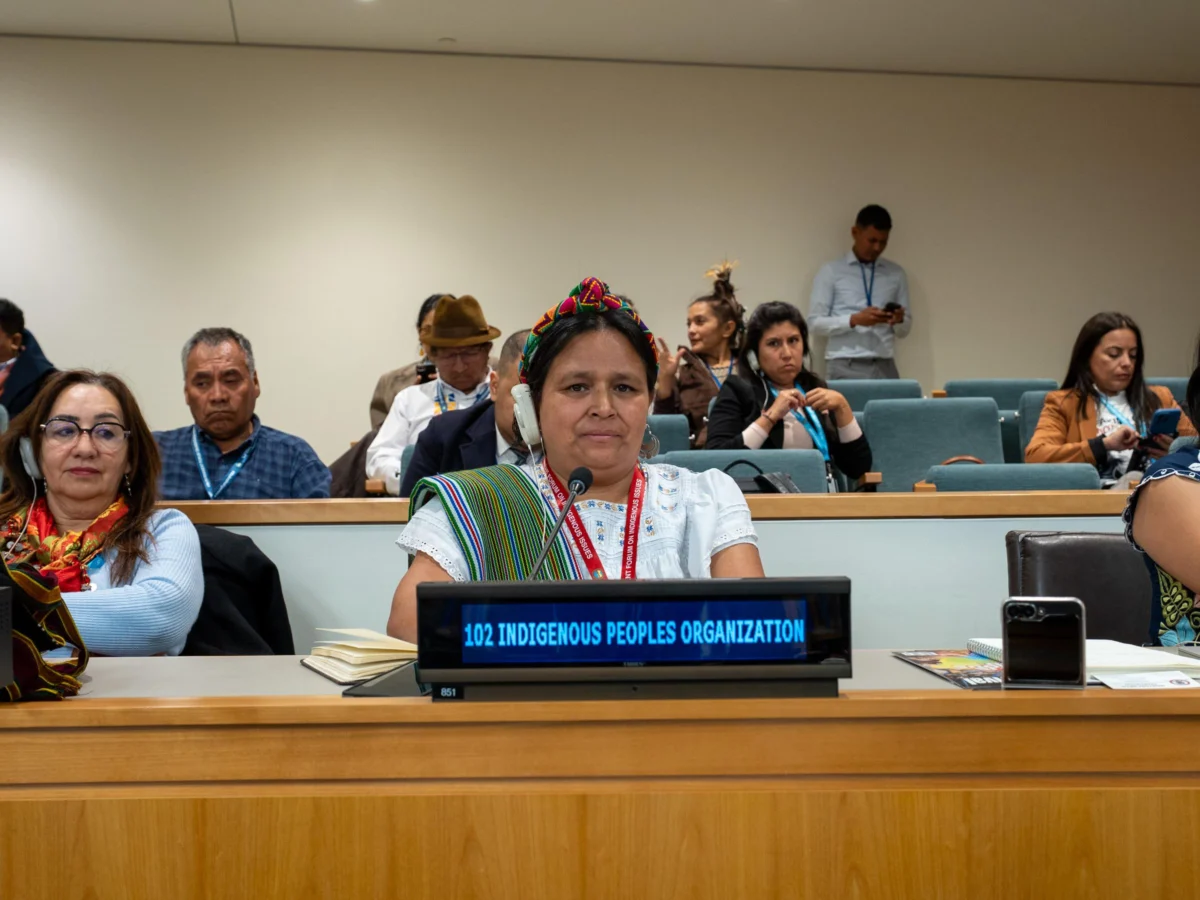
New York – April 21, 2026 – Addressing the 25th session of the United Nations Permanent Forum on Indigenous Issues, Margarita Diaz, a Maya Poptí woman from Guatemala representing the Wuxhtaj Council and the Council of the Maya Peoples (CPO), delivered a powerful statement highlighting the persistent consequences of colonization and the devastating health impacts of the contemporary capitalist system on Indigenous communities. Diaz’s address underscored a critical juncture for Indigenous rights, particularly in the face of rampant resource extraction and systemic discrimination.
The statement, delivered in the formal setting of the UN, served as a stark reminder that the struggles of Indigenous peoples are not confined to historical narratives but are actively unfolding in the 21st century, with profound implications for health and well-being. Diaz’s testimony provided a ground-level perspective on how broader socio-economic and political forces translate into tangible suffering for communities whose connection to their ancestral lands is intrinsically linked to their health and survival.
Historical Roots of Contemporary Crises
Diaz’s address began by acknowledging the deep-seated historical injustices that continue to plague Guatemala. The legacy of colonization, she articulated, has not merely reshaped political boundaries but has fundamentally altered the social, economic, and ecological landscapes upon which Indigenous peoples depend. This historical context is crucial for understanding the current state of affairs, where centuries of subjugation have created vulnerabilities that are being further exploited by modern economic paradigms.
The prevailing capitalist system, as described by Diaz, has exacerbated these vulnerabilities, leading to what she termed "genocide, destruction, dispossession, and the subjugation of our peoples." This strong language reflects the lived experience of communities that have witnessed the systematic erosion of their cultures, languages, lands, and self-governance. The framing of these issues not as isolated incidents but as systemic outcomes of historical and ongoing processes is central to the CPO’s advocacy.
The Stark Reality of Child Malnutrition
A key piece of evidence presented by Diaz to illustrate the severity of the health crisis was the alarming rate of chronic malnutrition among young children in Guatemala. She cited a statistic indicating that "49% of children under the age of five suffer from chronic malnutrition," a figure that places Guatemala sixth globally in this devastating metric. This statistic is not merely a number; it represents a generation of children whose physical and cognitive development is being stunted from their earliest years, with long-term consequences for individuals and the nation as a whole.
The high prevalence of chronic malnutrition is a direct indicator of systemic failures in food security, access to healthcare, and equitable distribution of resources. For Indigenous communities, these failures are often compounded by geographical isolation, lack of culturally appropriate health services, and economic marginalization. The CPO’s emphasis on this statistic underscores the urgent need for interventions that address the root causes of poverty and inequality, rather than just the symptoms.
Health as a Structural Crisis Rooted in Discrimination
Diaz explicitly linked the health of Indigenous peoples to broader structural issues, stating that "to speak of health in Guatemala is to speak of a structural crisis rooted in racism, historical exclusion, and the systematic violation of human rights." This statement reframes health not as an individual issue or a matter of personal choice, but as a direct consequence of societal structures and policies that perpetuate discrimination.
Racism, in this context, translates into differential access to quality education, employment opportunities, and essential services, including healthcare. Historical exclusion has meant that Indigenous voices and needs have been systematically ignored or marginalized in policy-making processes, leading to the development of systems that do not adequately serve them. The ongoing violation of human rights, particularly the rights to land, culture, and self-determination, further erodes the foundations of community health and well-being.
Territorial Invasion and the Criminalization of Defenders
A significant portion of Diaz’s statement focused on the direct impact of extractive projects on the health of Indigenous communities and their territories. She explained how "the health of our peoples is compromised when our territories are invaded by extractive projects that pollute and destroy them; when our ancestral authorities are criminalized; and when the act of defending Mother Earth is punished as a crime."
The invasion of ancestral lands by mining, logging, and agricultural corporations often leads to severe environmental degradation. Pollution of water sources, contamination of soil, and deforestation disrupt traditional livelihoods, threaten food security, and expose communities to hazardous substances. This ecological damage has direct repercussions on physical health, leading to increased rates of illness and disease.
Furthermore, the criminalization of Indigenous leaders and communities who oppose these projects is a critical concern. When defending their lands and natural resources – which are inextricably linked to their cultural identity and spiritual practices – is met with legal persecution, arbitrary arrests, and violence, it creates an environment of fear and insecurity. This not only undermines their ability to protect their environment but also inflicts significant mental and spiritual distress. The CPO views the defense of Mother Earth not as an act of defiance but as a fundamental human right and a responsibility, and its criminalization represents a profound injustice.
The Violation of Free, Prior, and Informed Consent
Diaz highlighted the imposition of extractive projects without the necessary safeguards, specifically noting the absence of "consultation or free, prior, and informed consent." This principle, enshrined in international law, particularly the UN Declaration on the Rights of Indigenous Peoples (UNDRIP), mandates that Indigenous peoples have the right to give or withhold their consent to projects affecting their lands, territories, and resources.
The violation of this principle has led to "conflict-ridden scenarios within our territories." When projects are imposed, communities often find themselves divided, with internal conflicts arising between those who may benefit from employment or compensation and those who prioritize the long-term preservation of their environment and way of life. This social fracturing is a direct consequence of external pressures that disregard the collective will and autonomy of Indigenous peoples.
The impact extends beyond physical and social well-being. Diaz stated that these violations "undermine our physical, mental, and spiritual health. Fear, violence, the fracturing of the social fabric, and the destruction of our natural commons are, in themselves, forms of illness." This holistic understanding of health recognizes that well-being is not solely about the absence of disease but also encompasses a state of balance, harmony, and security within oneself, one’s community, and one’s environment. The destruction of natural resources, which are often sacred and integral to Indigenous spirituality, is thus a direct assault on their spiritual health.
Demands from the Council of the Maya Peoples (CPO)
In response to this dire reality, the Council of the Maya Peoples (CPO) presented a series of clear demands to the international community and Guatemalan authorities. While the original provided text leaves the specific demands as a blank list, the context of Diaz’s speech allows for the inference of key areas of concern that would be included in such a list. These likely encompass:
- Respect for Self-Determination and Territorial Rights: A demand for the recognition and protection of Indigenous peoples’ right to govern their own affairs and control their ancestral lands, territories, and resources. This includes an end to the forced displacement and dispossession caused by extractive projects.
- Upholding Free, Prior, and Informed Consent (FPIC): A strong call for the strict implementation of FPIC for any development projects affecting Indigenous territories, ensuring that decisions are made with the full participation and consent of the affected communities.
- End to Criminalization and Violence: A demand for an immediate cessation of the criminalization of Indigenous leaders and communities who defend their rights and territories, and for justice and accountability for past and present acts of violence.
- Equitable Access to Culturally Appropriate Healthcare: A call for the development and implementation of health policies and services that are accessible, affordable, and culturally sensitive to the needs of Indigenous peoples, addressing the specific health disparities they face.
- Environmental Protection and Remediation: A demand for the protection of Indigenous territories from further environmental degradation and for comprehensive remediation efforts for areas already damaged by extractive industries.
- Investment in Indigenous Communities: A call for direct investment in Indigenous communities, supporting their own development initiatives and strengthening their capacity to manage their resources and improve their well-being.
An Urgent Call to the International Community
Diaz issued an urgent appeal to the international community, urging them to "take action to guarantee the full enjoyment of human rights—including equitable, timely, and culturally appropriate access to physical and mental healthcare—and to address the profound inequalities affecting the peoples." This plea underscores the shared responsibility of the global community in upholding human rights and addressing systemic injustices.
The call for "equitable, timely, and culturally appropriate access to physical and mental healthcare" is particularly significant. It acknowledges that existing healthcare systems often fail to meet the specific needs of Indigenous populations due to geographical barriers, lack of trained personnel who understand Indigenous cultures and languages, and the historical mistrust that has developed due to past mistreatment. Culturally appropriate care involves respecting traditional healing practices, incorporating Indigenous knowledge into health services, and ensuring that healthcare providers are trained in cultural competency.
Furthermore, the emphasis on addressing "profound inequalities" recognizes that health outcomes are inextricably linked to socio-economic factors. Tackling these inequalities requires a multi-faceted approach that includes poverty reduction, education reform, and land rights advocacy.
The Interconnectedness of Self-Determination and Environmental Health
The statement concluded with a powerful affirmation of the inalienable right of Indigenous Peoples to self-determination, asserting that "defending and exercising it protects the health of Mother Earth and, with it, our own." This statement encapsulates a core tenet of Indigenous philosophy: the profound interconnectedness between human well-being and the health of the natural world.
For Indigenous peoples, Mother Earth is not merely a resource to be exploited but a living entity that sustains them physically, spiritually, and culturally. Their health and survival are therefore directly dependent on the health of their environment. By defending their right to self-determination, Indigenous peoples are not only asserting their political autonomy but also safeguarding the ecological integrity of their territories, which in turn ensures their own health and the health of future generations.
The CPO’s closing remarks, "Respect and unity in diversity constitute our present and serve as the foundation for our future," emphasized the importance of intercultural dialogue, mutual understanding, and collaboration in building a more just and sustainable world. This vision calls for a paradigm shift, moving away from extractive and exploitative models towards one that values the wisdom and resilience of Indigenous peoples and recognizes their vital role in protecting the planet.
The address by Margarita Diaz at the UN Permanent Forum on Indigenous Issues serves as a critical reminder of the ongoing struggles faced by Indigenous peoples globally and the urgent need for concerted action to address the systemic injustices that continue to undermine their health, rights, and well-being. Her words resonate as a call to uphold international commitments and to work collaboratively towards a future where Indigenous peoples can exercise their rights and live in dignity and harmony with their environment.