When a significant breaking news event unfolds, the way Americans seek to understand it reflects the increasingly fragmented landscape of information consumption. A comprehensive survey conducted by the Pew Research Center, as part of the Pew-Knight Initiative, reveals a complex and evolving pattern in how U.S. adults gather details about unfolding events. The findings highlight a significant shift from previous years, particularly in the reliance on traditional news organizations, with a concurrent rise in the use of digital platforms and search engines.
The study, which surveyed 3,560 U.S. adults from December 8-14, 2025, indicates that while preferred news organizations remain the top destination for information on breaking news for a substantial portion of the population, their dominance has somewhat waned. A significant 36% of U.S. adults reported turning to their preferred news organization first when seeking more information about a breaking news event. This figure, while still the largest single category, represents a notable decrease from 2018, when a slim majority (54%) of Americans indicated the same.
This shift underscores a broader trend in how individuals engage with news. The proliferation of digital media, the accessibility of search engines, and the pervasive influence of social media platforms have fundamentally altered information-gathering habits. The Pew Research Center’s ongoing work, supported by the Pew-Knight Initiative, aims to illuminate these changes, understanding how Americans absorb civic information, form their beliefs, and engage with their communities in this dynamic environment.
The Evolving Landscape of Breaking News Consumption
The fragmented nature of news consumption today means that no single source dominates the initial search for information. The 2025 survey reveals a diversified approach, with a considerable number of Americans now turning to digital intermediaries. Following their preferred news organizations, search engines like Google and Bing emerged as the second most popular starting point, with 28% of U.S. adults reporting they use them first. This represents a significant increase from 2018, when only 15% of Americans cited search engines as their primary source for breaking news information.
Social media platforms also play a crucial role, with 19% of U.S. adults indicating they turn to them first for breaking news updates. This is a substantial jump from the 9% who reported the same in 2018, highlighting the growing influence of these platforms as a conduit for real-time information, even as concerns about misinformation persist.

A smaller, but consistent, segment of the population continues to rely on interpersonal networks. Five percent of U.S. adults reported that they typically ask friends, family, or acquaintances for more information about breaking news events. This human-to-human element, while less prominent than digital sources, remains a part of the information ecosystem.
Emerging Technologies and Information Seeking
The 2025 survey also incorporated new categories reflecting technological advancements. AI chatbots, such as ChatGPT and Gemini, were included as a distinct source for the first time. Currently, their role in breaking news consumption is minimal, with only 1% of U.S. adults reporting they turn to them first. This reflects a broader finding from the Pew Research Center that a relatively small number of Americans are actively using AI chatbots for news consumption in general. However, the indirect influence of AI is also present, as those who rely on search engines may encounter AI-generated summaries within their search results.
Other categories in the 2025 survey included "Some other source," which accounted for 5% of respondents, and "Doesn’t look for more information," also cited by 5% of U.S. adults. These responses indicate that while most people seek to understand breaking news, a small portion either finds sufficient information through their initial exposure or chooses not to delve deeper.
Historical Context: A Shifting Paradigm
Comparing the 2025 data with findings from a similar Pew Research Center survey conducted in February-March 2018 provides crucial context for understanding the observed shifts. The 2018 survey, which had slightly different response options, indicated a stronger reliance on traditional news outlets. At that time, 54% of Americans turned to their preferred news organization for breaking news. The figures for search engines (15%) and social media (9%) were significantly lower than in 2025.
The differences in survey questions between the two years warrant careful consideration when making direct comparisons. For instance, the 2018 survey included "News aggregating websites or apps (such as Google News, Apple News or Flipboard)" as a distinct option, which was not present in the 2025 survey. Conversely, the 2025 survey introduced options for AI chatbots, "Some other source," and "Doesn’t look for more information." Despite these variations, the overall trend clearly indicates a move away from exclusive reliance on preferred news organizations towards a more distributed model of information acquisition.
Age as a Defining Factor in Information Sources
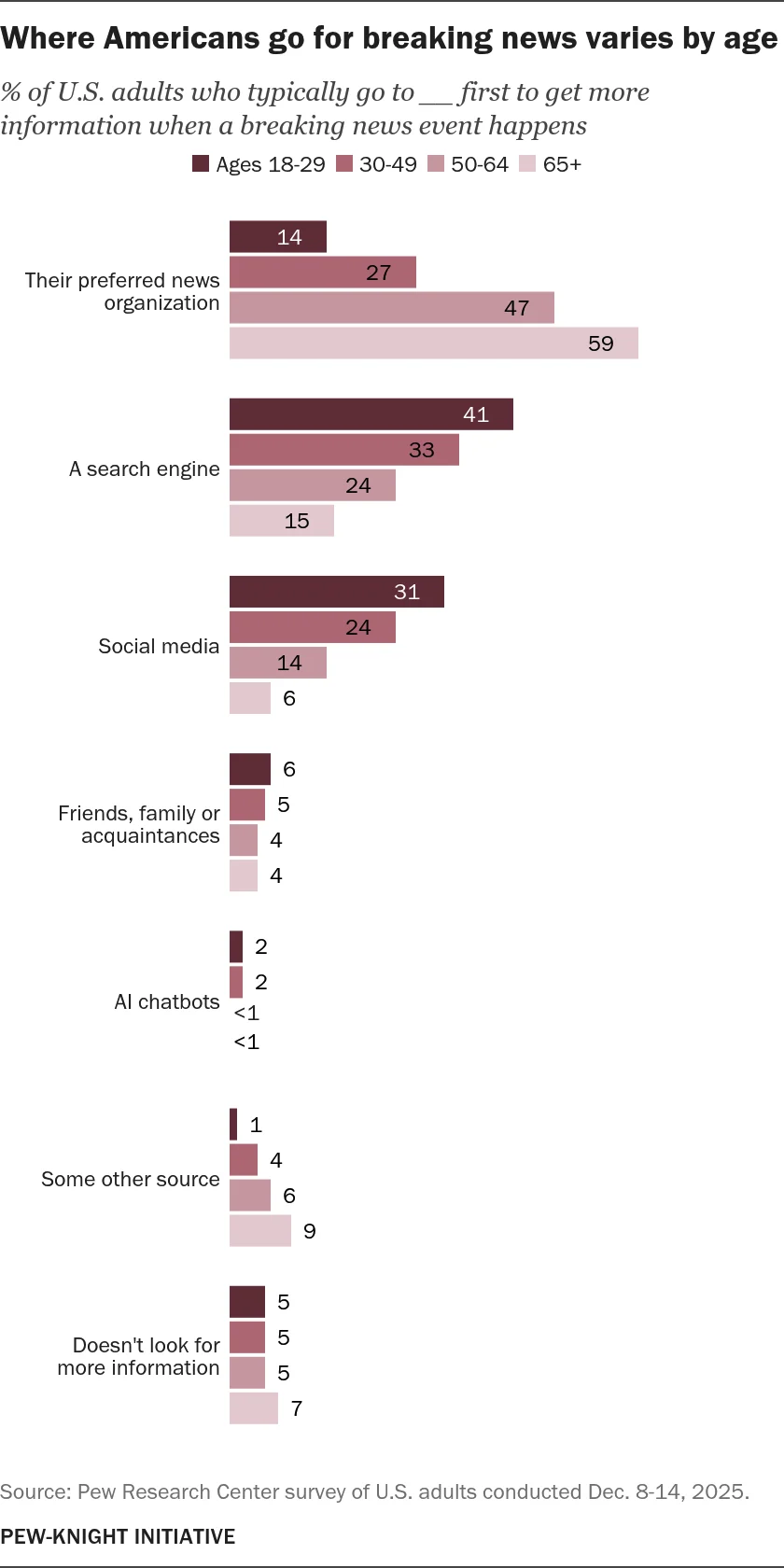
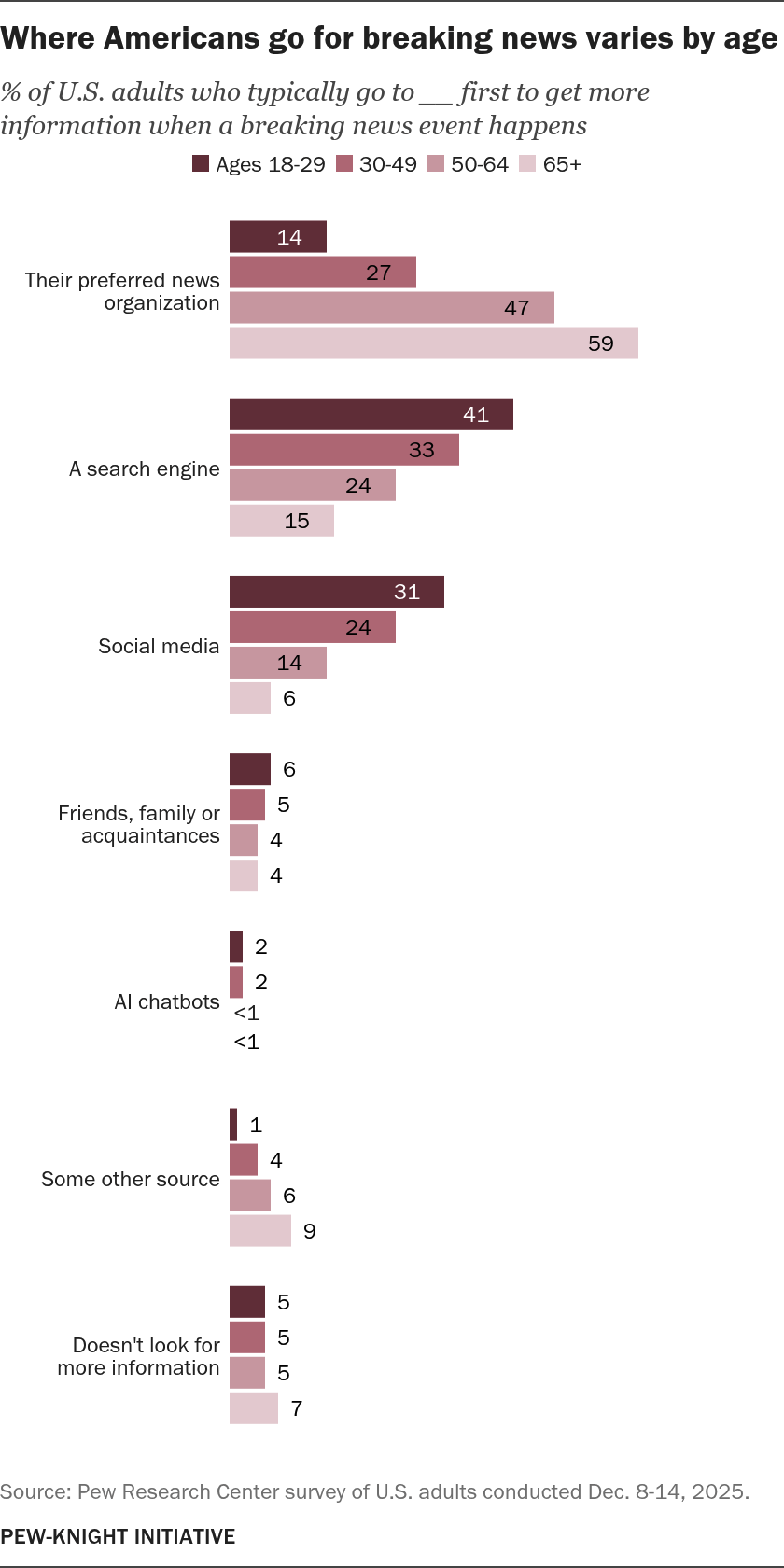
Perhaps the most striking demographic difference in breaking news consumption lies in age. The survey data reveals a clear generational divide in where Americans turn first for information.

For older Americans, particularly those aged 65 and older, their preferred news organization remains the dominant source. A substantial 59% of this age group turns to their trusted news outlets first. This is in stark contrast to younger adults. Among those aged 18 to 29, only 14% cite their preferred news organization as their primary source for breaking news.
Conversely, younger demographics demonstrate a stronger inclination towards search engines and social media. For adults aged 18 to 29, search engines are the most frequent first stop, with 41% utilizing them. Social media is also a significant pathway for this age group, with 31% turning to it first for breaking news. These figures are considerably higher than those reported by older adults. For instance, only 15% of those 65 and older use search engines first, and a mere 6% turn to social media.
These patterns align with previous Pew Research Center findings regarding general news consumption habits. A study published in December 2025 indicated that 76% of adults aged 18 to 29 get their news from social media at least sometimes, compared to only 28% of adults aged 65 and older. Furthermore, younger adults are more likely to trust information from social media platforms, with the 18-29 age group showing an equal likelihood of trusting information from social media and national news organizations. This growing trust in social media among younger generations, coupled with their higher usage rates, has direct implications for how they perceive and engage with breaking news.
Broader Implications and Future Trends
The diversification of breaking news sources has significant implications for the media landscape and public discourse. As individuals increasingly rely on a mix of traditional news, search engines, and social media, the challenge of ensuring consistent, accurate, and unbiased information becomes more complex.
The rise of search engines and social media as primary gateways means that algorithmic curation plays a larger role in what information individuals encounter. This can lead to filter bubbles and echo chambers, potentially limiting exposure to diverse perspectives and exacerbating societal polarization. The Pew-Knight Initiative’s research consistently explores these dynamics, seeking to understand how these platforms shape belief formation and civic engagement.
The nascent role of AI chatbots in breaking news consumption, while currently small, warrants continued observation. As AI technologies mature and become more integrated into everyday tools, their impact on how people access and process information is likely to grow. Understanding the public’s trust, concerns, and usage patterns related to AI-generated news summaries and information will be critical in the coming years.
The differing age-based consumption patterns also highlight a generational divide in news literacy and engagement. While older generations may be more accustomed to established news hierarchies, younger generations are navigating a more fluid and decentralized information environment. Educational initiatives aimed at fostering critical evaluation of information from all sources will be increasingly vital.
The Pew Research Center’s ongoing commitment, supported by the Pew-Knight Initiative, to monitor these trends is essential for providing policymakers, journalists, and the public with data-driven insights into the evolving information ecosystem. As breaking news events continue to shape our world, understanding where Americans turn first for information is key to fostering an informed and engaged citizenry.
About this research: This analysis from the Pew-Knight Initiative examines where Americans turn first to get more information about breaking news events. Pew Research Center regularly studies how Americans use different platforms to access news and information, and how they engage with the broader information environment. This research was conducted as part of a larger study exploring Americans’ perceptions of their role in the news ecosystem.
Methodology: The findings are based on a nationally representative survey of 3,560 U.S. adults conducted by the Pew Research Center’s American Trends Panel from December 8-14, 2025. The survey represents the views of the entire U.S. adult population. This analysis also draws on findings from a nationally representative survey conducted from February 22 to March 4, 2018. Comparisons between the 2018 and 2025 surveys are made with caution due to differences in response options. Specific details on survey questions, detailed responses, and methodology are available from Pew Research Center.
The Pew-Knight Initiative is a research program funded by The Pew Charitable Trusts and the John S. and James L. Knight Foundation, dedicated to supporting new research on how Americans absorb civic information, form beliefs and identities, and engage in their communities. Pew Research Center is a nonpartisan, non-advocacy fact tank that informs the public about the issues, attitudes, and trends shaping the world. Knight Foundation is a social investor committed to supporting informed and engaged communities.