
As digital platforms have firmly cemented their role as the primary architecture of the modern global information environment, a sobering consensus has begun to emerge among the public. A new, comprehensive 37-nation study from the Pew Research Center reveals that in the majority of countries where longitudinal data is available, public perception regarding the impact of social media on democracy has shifted toward the negative. This trend, which tracks changes from 2022 and 2023 through the spring of 2026, marks a significant turning point in how citizens of diverse political systems view the intersection of technology and civic engagement.
The study, which surveyed 42,151 individuals across 36 countries—supplemented by robust data from the United States—indicates that while social media was once heralded as a democratizing force, its reputation has increasingly soured. Across the nations polled, there is a clear, rising concern that the digital public square has become a conduit for misinformation, political polarization, and societal fragmentation.
The Growing Divide: Wealth and Perception
One of the most striking findings of the 2026 report is the strong correlation between a nation’s economic prosperity and its citizens’ skepticism toward social media. In many of the world’s wealthiest democracies, including the United States, France, Germany, and the Netherlands, a clear majority of adults now characterize social media as a "bad thing" for their democracy.
The United States stands at the forefront of this trend, with 64% of American adults expressing the view that social media is damaging to the democratic process. While this figure has remained relatively stable since 2022, other nations are showing a rapid acceleration of negative sentiment. For instance, in the Netherlands, 70% of respondents now view social media negatively, a significant jump from 54% in 2022. Similarly, France has seen a surge, with 65% now labeling the impact as negative, up from 51% four years prior.
Conversely, developing nations or those with lower gross domestic products (GDP) per capita often report more favorable views. In countries like Kenya, Nigeria, the Philippines, and Thailand, upwards of 75% of the population see social media as a net positive for their democracy. This divergence suggests that in regions where traditional media may be restricted or less accessible, social media platforms are still primarily viewed as vital tools for information and political expression rather than sources of polarization.

A Dual-Edged Sword: Empowerment vs. Manipulation
To understand why public opinion remains so conflicted, it is necessary to examine the paradoxical nature of these platforms. The survey data highlights a fundamental tension: users acknowledge that social media provides them with a voice, even while they simultaneously recognize that it serves as a vehicle for systemic harm.
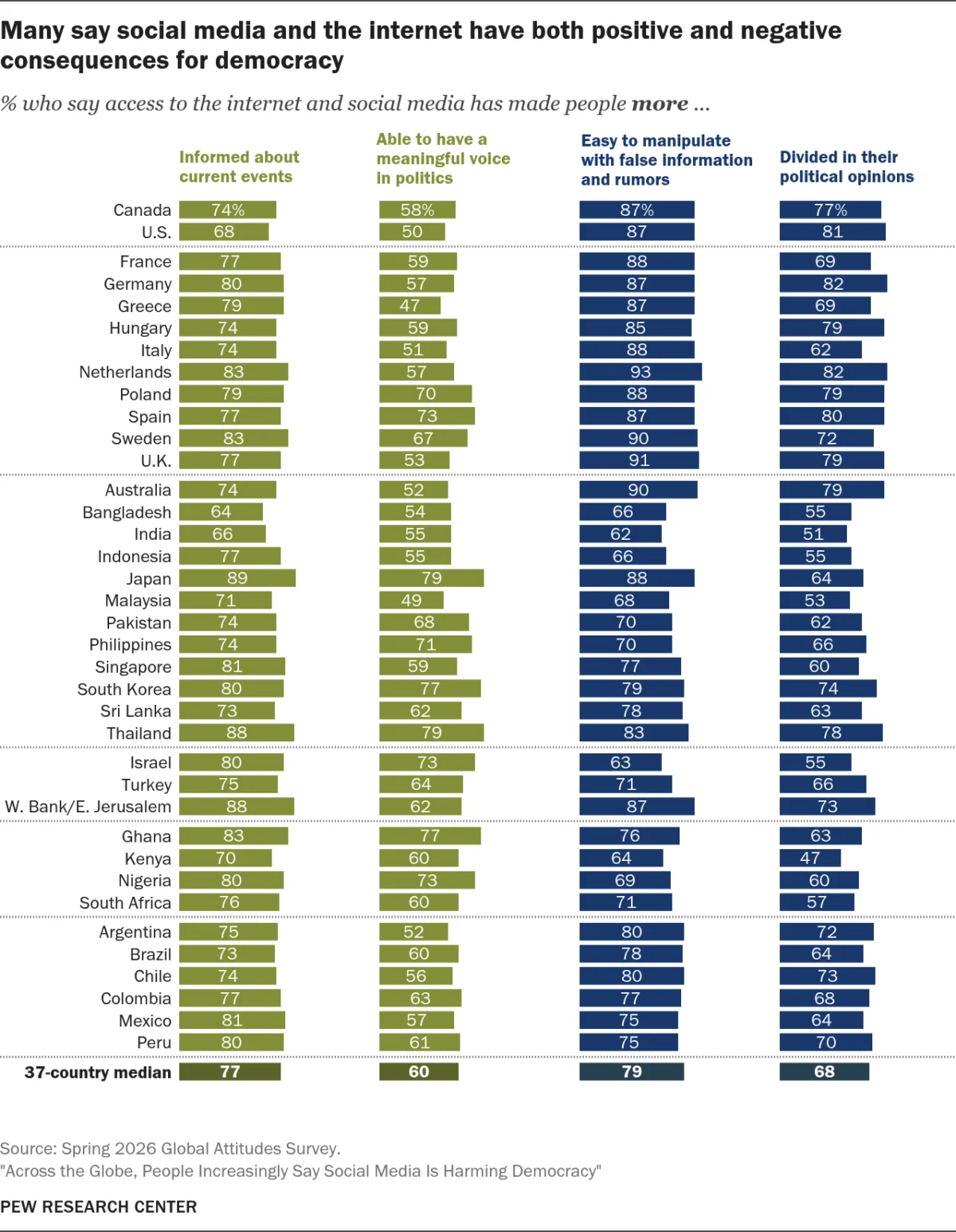
Across the 37 countries surveyed, a median of 77% of respondents agree that the internet and social media have made people more informed about current events. Furthermore, a median of 60% believe that these platforms have provided individuals with a more meaningful voice in the political process. For many, especially in environments where mainstream media is state-controlled or exclusionary, the ability to bypass traditional gatekeepers is a distinct democratic gain.
However, this utility is overshadowed by a widespread awareness of the dangers. A median of 79% of respondents across all surveyed countries argue that these technologies have made it easier to manipulate the public with false information and rumors. Furthermore, 68% believe these platforms have deepened political divisions. These figures are consistent across nearly all regions, suggesting that users are cognizant of the "algorithmic cost" of their connectivity: a more informed public is also a more polarized and easily misled one.

Chronology of Concern: 2022–2026
The shift in sentiment is not merely a snapshot of 2026 but part of a multi-year trajectory. Between 2022 and 2026, several nations experienced double-digit increases in the belief that social media is "bad" for democracy.
- 2022: Initial post-pandemic surveys suggested a lingering optimism about the digital age, though concerns about misinformation were already beginning to take root in North America and Western Europe.
- 2023: In countries like Indonesia, the first major tracking questions began to show that while usage was high, the perception of social media as a negative political influence was starting to climb, particularly as election cycles saw increased digital interference.
- 2024–2025: Throughout this period, global political events, including high-stakes elections and ongoing geopolitical conflicts, fueled a global conversation about platform regulation, AI-driven content, and deepfakes.
- 2026: The current data shows the culmination of these trends. The "wait-and-see" approach of the early 2020s has been replaced by a more hardened, critical public attitude, particularly in the Global North.
Demographic Disparities: The Generational Gap
The study reveals that age is a critical predictor of how an individual perceives the digital landscape. In almost every country surveyed, young adults—those between the ages of 18 and 34—are significantly more likely than their elders to view social media as a positive influence on democracy.
The gap is most pronounced in the United Kingdom, where 60% of young adults view social media as a positive force, compared to only 31% of those aged 50 and older. This age gap suggests that for digital natives, the online experience is an integral part of their civic identity, whereas older generations may view these platforms as foreign, disruptive, or inherently untrustworthy.

However, this does not mean younger people are blind to the dangers. In fact, the data suggests that younger, more educated users, and those who maintain active accounts across multiple platforms, are more nuanced in their views. They are more likely to report both the benefits—such as increased access to information—and the harms—such as heightened political polarization—simultaneously.
Political Implications and the Path Forward
The consistency of these findings across diverse political systems presents a significant challenge for policymakers and tech companies alike. In the United States, for example, the concern over social media-driven division is one of the few issues that bridges the partisan divide. Both Republicans (83%) and Democrats (82%) agree that social media has amplified political divisions, suggesting that the problem is perceived as a structural flaw of the platforms rather than a result of any one party’s behavior.
The implications for democratic governance are profound. As public trust in the information environment declines, the potential for political instability increases. Governments in Europe and beyond are already responding with legislative efforts, such as the EU’s Digital Services Act, aimed at forcing platforms to take greater responsibility for the content they host.

However, the survey also serves as a warning: if citizens feel that their primary method of political engagement—social media—is inherently flawed, they may become increasingly disillusioned with the democratic process as a whole. The challenge for the coming years will be to determine whether these platforms can be reformed to mitigate their divisive elements without sacrificing the genuine,, and highly valued, access to information and voice they provide to millions.
Methodology and Scope
The findings in this report are based on a massive international survey effort conducted by the Pew Research Center. The primary data comes from 42,151 respondents across 36 countries, with fieldwork spanning from February 8 to May 13, 2026. Data for the United States was compiled using two distinct methodologies: the American Trends Panel (3,507 respondents) and the National Public Opinion Reference Survey (5,511 respondents), both conducted in the first half of 2026.
By encompassing such a wide variety of nations—from high-income economies like Canada and Japan to developing nations like Ghana and Sri Lanka—the study provides a definitive, global look at the state of public opinion. As the world approaches the latter half of the decade, the message from the global public is clear: the digital experiment is no longer viewed through a lens of unbridled optimism. Instead, it is being scrutinized with a growing sense of urgency and, in many parts of the world, deep-seated concern.




