The United States Congress, an institution designed to serve as the primary engine of federal governance, is currently experiencing one of the least productive periods in modern history. While the legislative branch maintains broad responsibilities—ranging from constituent advocacy and the confirmation of executive and judicial nominees to the rigorous oversight of federal agencies—its core constitutional mandate remains the enactment of substantive law. Recent data from a comprehensive Pew Research Center analysis reveals a striking decline in this capacity, marking the 119th Congress as the second-least productive session in the last forty years.
Since convening in January 2025, the 119th Congress has enacted a total of 121 public laws. To put this figure into historical perspective, only the 118th Congress, which produced 106 laws at a comparable stage in its two-year term, recorded lower output. This downward trend is not merely a recent anomaly but rather the continuation of a multi-decade erosion in legislative volume.
Defining Productivity: Substantive versus Ceremonial Legislation
To accurately measure legislative health, analysts categorize public laws into two distinct buckets: "substantive" and "ceremonial." Substantive laws are defined as those that carry tangible real-world weight—such as authorizing federal spending, establishing or amending permanent statutes, directing government officials, or managing public land. Ceremonial laws, by contrast, serve symbolic functions, such as bestowing Congressional Gold Medals, authorizing commemorative coins, or renaming federal buildings.
Of the 121 laws passed by the current Congress as of mid-October 2026, only 109 were classified as substantive. While this count utilizes a broad, generous definition of "substantive," it remains the second-lowest total in four decades. The trend is stark when compared to the late 20th century. Between the 100th Congress (1987–1989) and the 110th Congress (2007–2009), the legislative body averaged 440 total laws per session, with roughly 306 falling under the substantive category. In the current era, the pre-election legislative output has effectively been halved.
Chronology of Legislative Decline
The decline in output has been progressive, punctuated by periods of intense gridlock. Throughout the 1990s, while ceremonial laws saw a significant reduction, the volume of substantive legislation remained relatively robust. However, as partisan polarization intensified in the 2010s, the ability of the House and Senate to reach consensus on broad policy initiatives began to falter.
The 112th Congress (2011–2013) serves as a notable inflection point, where the combination of divided government and heightened fiscal debates led to a sharp drop-off in enacted legislation. This pattern has persisted, with the 118th and 119th Congresses representing the nadir of this trend. While the current session did manage to pass the "One Big Beautiful Bill"—a major package of tax and spending adjustments finalized in July 2025—such singular accomplishments have become the exception rather than the rule.
The Rise of the Lame-Duck Session
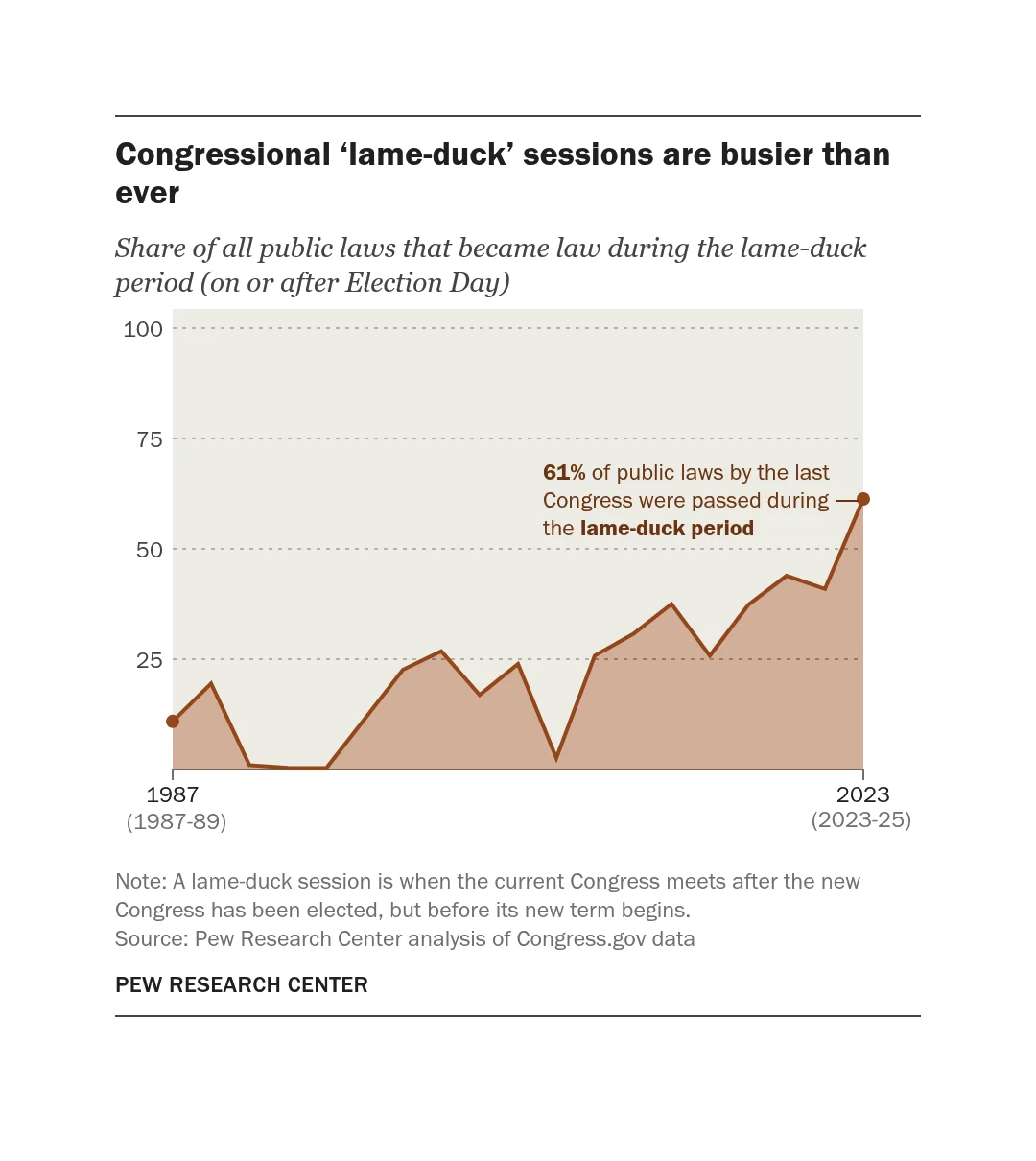
A significant factor contributing to the current legislative landscape is the increasing reliance on "lame-duck" sessions. A lame-duck session occurs when the sitting Congress convenes after the general election but before the new Congress is sworn in. Historically, these sessions were intended for clearing minor administrative hurdles; however, they have evolved into high-stakes environments for passing major, often controversial, legislation.
The reliance on these sessions has skyrocketed. In the 100th Congress, only about 11% of laws were enacted on or after Election Day. By the 118th Congress, that figure had ballooned to 61%. This shift suggests that the primary legislative work of the federal government is increasingly being deferred until after the political pressure of re-election has dissipated for members of the House and Senate.
Political analysts point to this trend as a double-edged sword. On one hand, it allows lawmakers to pursue politically unpopular or complex policy decisions without the immediate threat of electoral retribution. On the other hand, it often results in rushed legislative packages, reduced opportunities for public debate, and a governance model that relies on crisis-driven timelines rather than proactive policy planning.
Legislative Reversals and Regulatory Oversight
A notable feature of the 119th Congress has been its focus on regulatory oversight rather than the creation of new law. The current body has enacted 23 laws specifically aimed at overturning regulations promulgated during the Biden administration, in addition to legislation voiding a local law in Washington, D.C. These reversals account for approximately 20% of the total legislative output of the current Congress.
This emphasis on "de-legislating" or nullifying existing rules reflects the broader political strategy of the current majority, which has prioritized the dismantling of previous executive actions over the initiation of new statutory frameworks. While this strategy satisfies core base requirements, it contributes to the perception of a body that is focused on reactive maneuvering rather than long-term infrastructure, social, or economic policy.
Broader Implications for Governance
The implications of a slow-moving, low-output Congress are significant for both the public and the executive branch. When Congress fails to pass substantive, comprehensive legislation, the vacuum is frequently filled by executive orders and federal agency regulations. This transfer of authority from the legislative branch to the executive branch creates a system where the "rules of the road" are subject to constant fluctuation based on which party occupies the White House, rather than being settled by the deliberative process of the Capitol.
Furthermore, the persistent decline in legislative output complicates the long-term planning of federal agencies. Without consistent, modernized statutory authorizations, agencies often operate on temporary funding measures or outdated mandates, leading to inefficiency and unpredictability in the delivery of government services.
Prospects for the Final Months
As the 119th Congress enters its final months, eyes are turned toward the upcoming post-midterm session. Given the historical data, there is a strong possibility that the legislative output will see a late-session surge. With senators and representatives who have either retired or been voted out of office looking to secure final policy goals or legacy-building projects, the lame-duck period could see a flurry of activity.
However, experts caution that even a productive lame-duck session is unlikely to bring the 119th Congress out of the bottom tier of historical productivity. The structural issues—partisan division, the increasing use of procedural hurdles, and the reliance on last-minute, omnibus-style negotiations—appear deeply entrenched.
Ultimately, the record of the 119th Congress serves as a bellwether for the health of the American legislative process. While the institution continues to function, the diminished volume of enacted law suggests a profound change in how Washington manages its priorities. Whether this represents a temporary lull in activity or a permanent shift toward a less active, more reactive legislature remains a central question for political scientists and the American electorate alike. The data provided by the Pew Research Center confirms that the trend toward reduced output is not a fleeting occurrence but a consistent trajectory, one that continues to reshape the landscape of federal power in the United States.