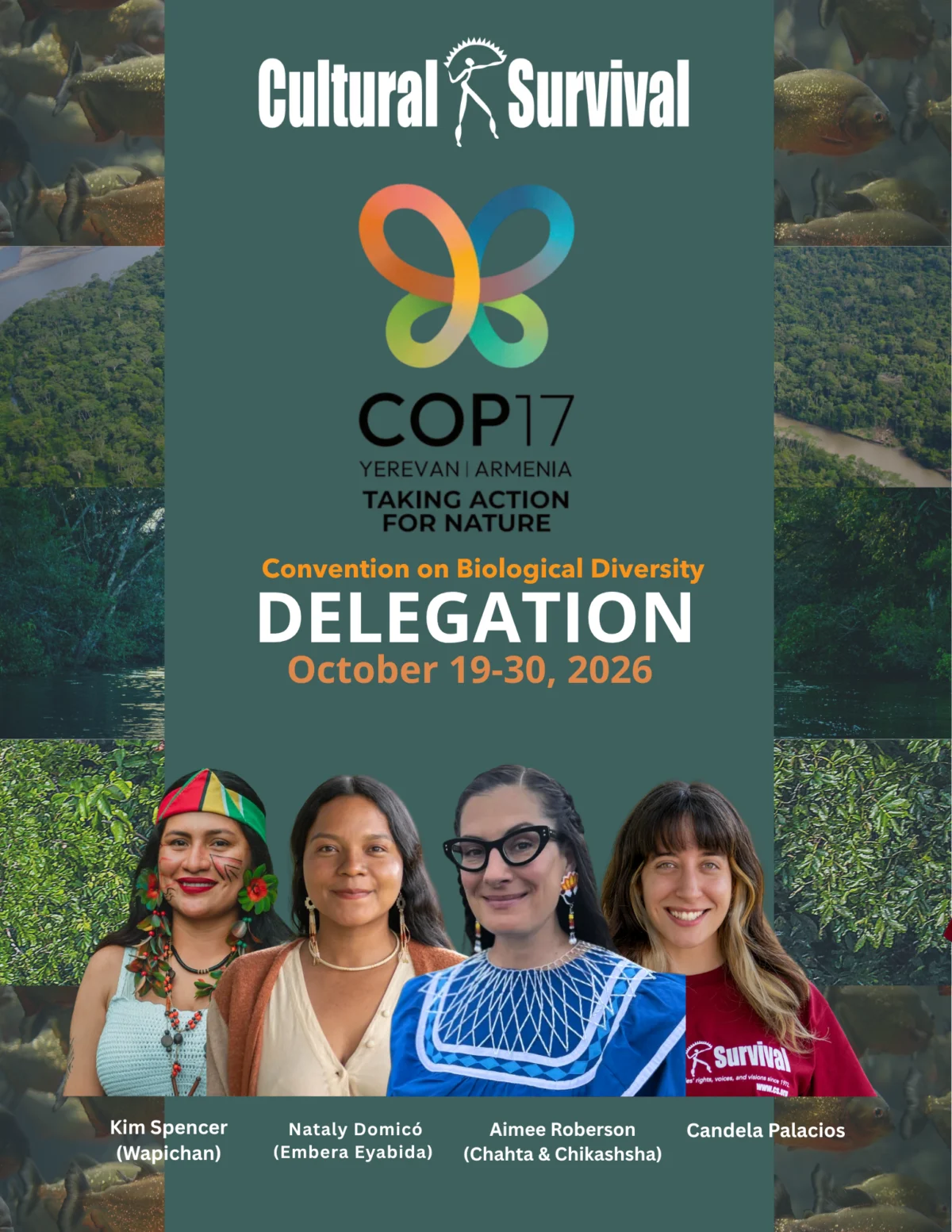
The global community stands at a critical juncture in environmental governance as policymakers, scientists, Indigenous leaders, and international delegates prepare for the upcoming United Nations Convention on Biological Diversity Conference of the Parties. Scheduled to take place from October 19 to October 30, 2026, in Yerevan, Armenia, the 17th meeting of the Conference of the Parties (COP17) represents a monumental milestone in international conservation efforts. This high-level summit will run concurrently with the 12th meeting of the Parties to the Cartagena Protocol on Biosafety (CP-MOP-12) and the 6th meeting of the Parties to the Nagoya Protocol on Access and Benefit-sharing (NP-MOP-6). As governments gather to evaluate the health of the planet’s ecosystems, the proceedings in Yerevan will mark the first comprehensive global review of collective progress toward the implementation of the ambitious Kunming-Montreal Global Biodiversity Framework (KMGBF).
The Stakes of COP17 and the Kunming-Montreal Global Biodiversity Framework
Adopted in December 2022 during COP15 in Montreal, Canada, the Kunming-Montreal Global Biodiversity Framework established a sweeping blueprint to halt and reverse nature loss by 2030. The framework outlines four overarching goals for 2050 and 23 target action items for 2030, most notably the objective to effectively conserve and manage at least 30 percent of the world’s terrestrial, inland water, and coastal and marine areas—commonly referred to as the "30×30" target.
However, as delegations from the 196 Parties to the Convention converge on Yerevan, mounting scientific evidence suggests that global progress remains uneven. Critics and environmental watchdogs emphasize that achieving the 2030 targets requires more than top-down governmental declarations; it demands the active, empowered participation of those who have historically protected the world’s remaining biodiversity. Indigenous Peoples safeguard an estimated 80 percent of the planet’s remaining biodiversity on lands that they have inhabited, managed, and defended for generations. Consequently, COP17 serves as an essential testing ground for whether global leaders will transition from rhetorical acknowledgments of Indigenous contributions to enforceable, rights-based funding and policy mechanisms.
The Cultural Survival Delegation and International Indigenous Advocacy
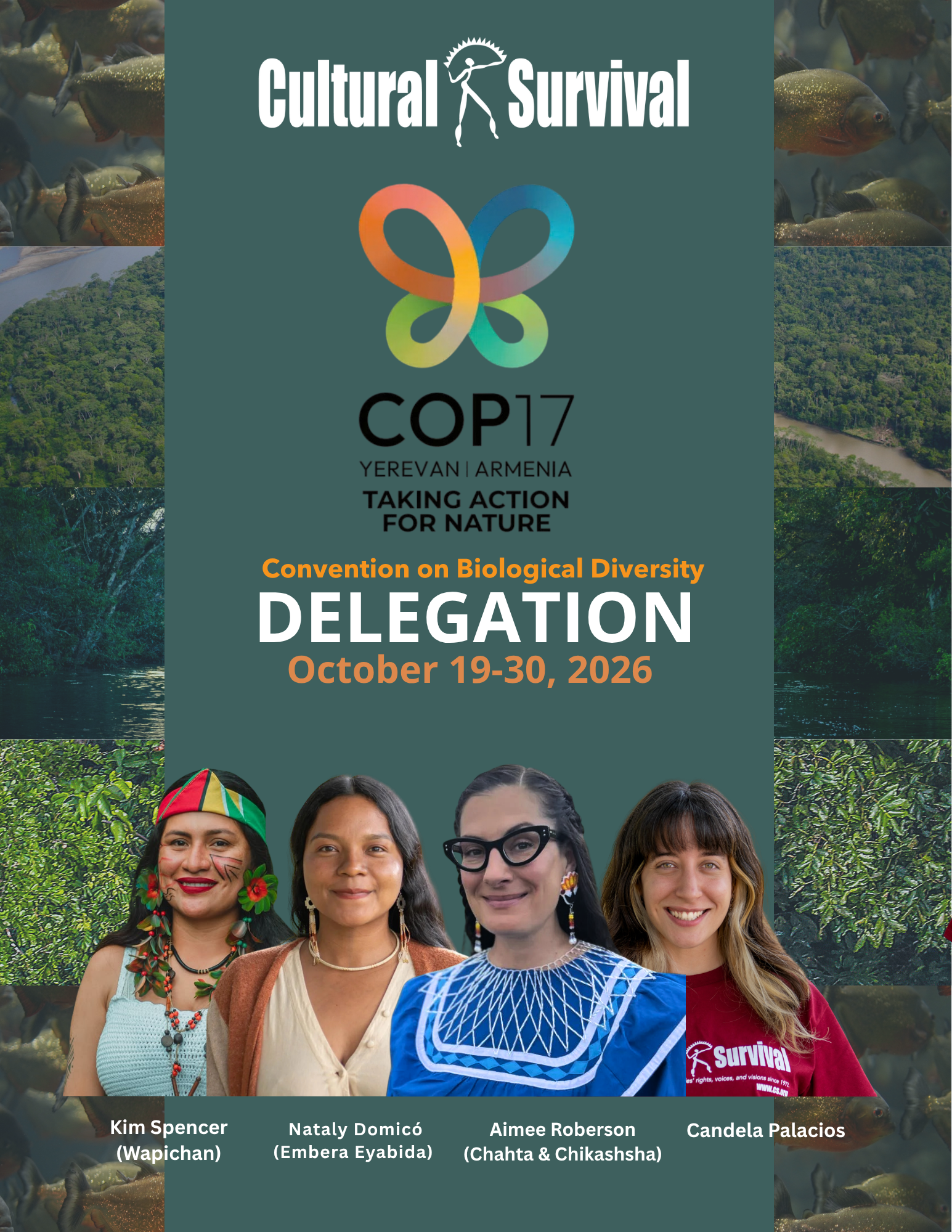
To ensure that Indigenous voices remain at the forefront of these pivotal negotiations, Cultural Survival has announced its official in-person delegation to COP17. The delegation features prominent advocates and conservationists who bring a wealth of lived experience and technical expertise to the global stage.
The delegation is led by Aimee Roberson (Chahta/Chikashsha), Executive Director of Cultural Survival. She is joined by Nataly Domício Murillo (Embera Eyabida), Keepers of the Earth Fund Program Assistant; Candela Palacios, Executive Assistant; and Kim Spencer (Wapichana), a conservationist, educator, and senior ranger from Guyana who previously served as a Cultural Survival Youth Fellow.
Throughout the two-week conference, the Cultural Survival team will actively participate in the International Indigenous Forum on Biodiversity (IIFB), functioning as part of the Indigenous Caucus. The IIFB serves as the primary collective voice for Indigenous Peoples within the CBD negotiations, coordinating strategy, reviewing draft decisions, and pressing state parties to integrate human rights protections into every facet of the framework.
Centering Indigenous Self-Determination in Global Conservation
The core message of the Cultural Survival delegation centers on the indivisibility of Indigenous rights, self-determination, and ecological health. Modern conservation science increasingly validates what Indigenous communities have known for millennia: that biological diversity thrives best under the stewardship of customary governance systems.
Aimee Roberson articulated the philosophical and practical foundation of the delegation’s advocacy ahead of the conference. "The cosmovisions, lifeways, and cultures of Indigenous Peoples emerge from our relationships to Mother Earth and include a deep sense of responsibility to care for the ecosystems we all depend on," Roberson stated. "However, our ability to steward ecosystems and biodiversity depends on maintaining our ancestral and self-determined lifeways, ceremonies, and economies, and relies on uninterrupted access to our lands, waters, and territories. Clearly, upholding the rights of Indigenous Peoples to self-determination and governance of our territories is critical to a future of mutual flourishing for the diversity of life on Mother Earth."
Despite occupying ancestral territories that harbor the vast majority of the world’s intact forests and wildlife corridors, Indigenous communities frequently face systemic marginalization, land dispossession, and violence from industrial extractivism, poorly planned infrastructure, and top-down conservation models that rely on fortress conservation. Cultural Survival’s recommendations to CBD Parties emphasize that global biodiversity targets cannot be met ethically or effectively if states continue to treat Indigenous Peoples as mere stakeholders rather than sovereign rights holders.
Key Events and Panels Hosted by Cultural Survival and Allies
In addition to engaging directly with state delegations behind closed doors in the Blue Zone, the Cultural Survival team, alongside global allies, has organized and will participate in several high-profile public panels and side events designed to highlight community-led solutions, traditional knowledge systems, and gender-just approaches to conservation.
From False Solutions to Transformative Change: Defending Territories, Protecting Forests, Advancing Justice
Scheduled for Monday, October 19, 2026, from 10:00 AM to 11:30 AM Yerevan time on the Main Stage of the Green Zone, this session is organized by the Global Forest Coalition. The panel addresses the tensions between genuine grassroots biodiversity initiatives and so-called "false solutions"—such as carbon offset schemes, biodiversity offsetting markets, and large-scale industrial bioenergy projects—that frequently result in greengrabbing and human rights violations. Drawing on preliminary findings from a Gender-Just Real Solutions Map developed with civil society organizations across Africa, Latin America, and the Caribbean, and Southeast Asia, the panel will showcase how women-led community practices protect ecosystems while advancing human rights.
Gobernanza Indígena en la Protección de la Biodiversidad / Indigenous Governance in Biodiversity Protection
Taking place on Thursday, October 22, from 10:00 AM to 11:30 AM Yerevan time in the Blue Zone within the IIFB/FIIB Action Zone, this panel is jointly organized by Cultural Survival, the Foro Indígena del Abya Yala (FIAY), the Red de Jóvenes Indígenas de Latinoamérica y El Caribe, and the ICCA Consortium. The discussion focuses on the administrative, protective, and conservation outcomes yielded by Indigenous governance structures. Panelists will examine how ancestral knowledge systems translate into tangible ecological preservation and why the formal recognition of community-based governance is indispensable for the success of international environmental treaties.
Cultivating Mutual Flourishing through Indigenous-led Conservation
Later on Thursday, October 22, from 3:00 PM to 4:30 PM Yerevan time at the NGO Hub within the Action Zone of the Blue Zone, this session dives deeper into the philosophical underpinnings of Indigenous stewardship. The panel will explore how traditional lifeways are built upon reciprocal relationships with non-human relatives in lands, territories, and waters. Speakers will present case studies of successful Indigenous-led conservation initiatives, illustrating that the most enduring ecological safeguards are those rooted in self-determination and inherent rights.
Broader Implications and Analytical Outlook
As COP17 unfolds in Yerevan, the decisions made by delegates will reverberate far beyond the negotiation halls. The midterm trajectory of the Kunming-Montreal Global Biodiversity Framework depends heavily on whether governments are willing to establish direct, flexible funding mechanisms for Indigenous-led conservation initiatives, such as the Keepers of the Earth Fund, bypassing cumbersome bureaucratic bottlenecks that often prevent financial aid from reaching grassroots communities.
Furthermore, human rights organizations and conservation scientists will be closely watching how state parties address the implementation of Target 3 (the 30×30 goal). Without explicit safeguards to prevent the forced displacement of Indigenous Peoples under the guise of protected area expansion, conservation efforts risk repeating the historical injustices of colonial conservation models.
Through rigorous advocacy, media reporting, and active coalition-building at COP17, Cultural Survival and its international partners aim to hold world leaders accountable to their commitments, ensuring that human rights and biological diversity are recognized as two sides of the same coin in the global quest to secure a sustainable future for the planet.