The survey, which captured the perspectives of 3,917 registered voters as part of a larger study of 5,062 U.S. adults, paints a complex portrait of a nation in a "sour mood." This widespread dissatisfaction, often linked to economic anxieties and general political fatigue, has fostered a climate where Democratic voters appear more energized and mobilized than their Republican counterparts. However, beneath this topline enthusiasm, deep-seated allegiances to party platforms continue to be anchored in religious communities, particularly among White evangelical Protestants.
The Partisan Divide Among Faith Groups
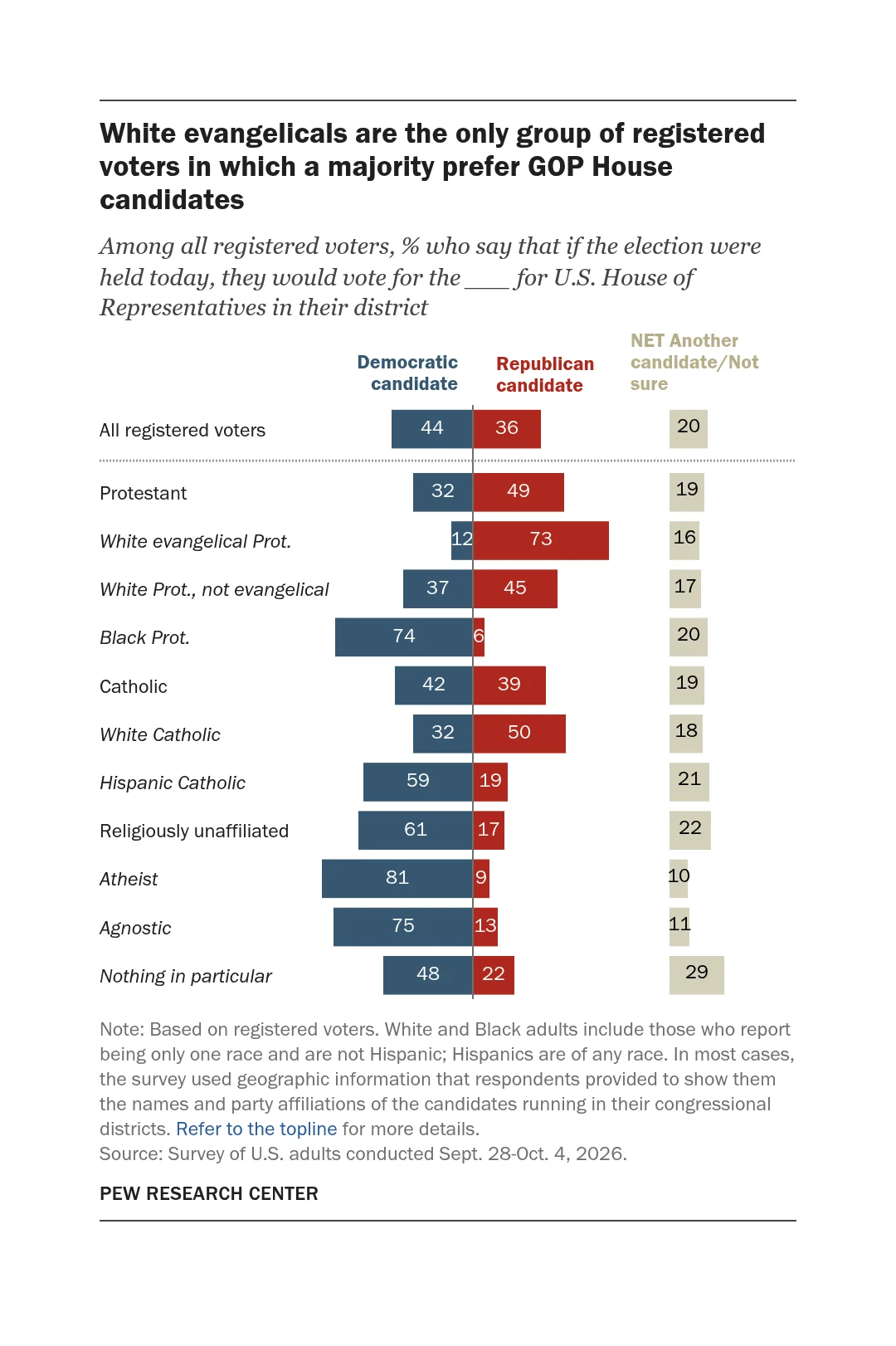
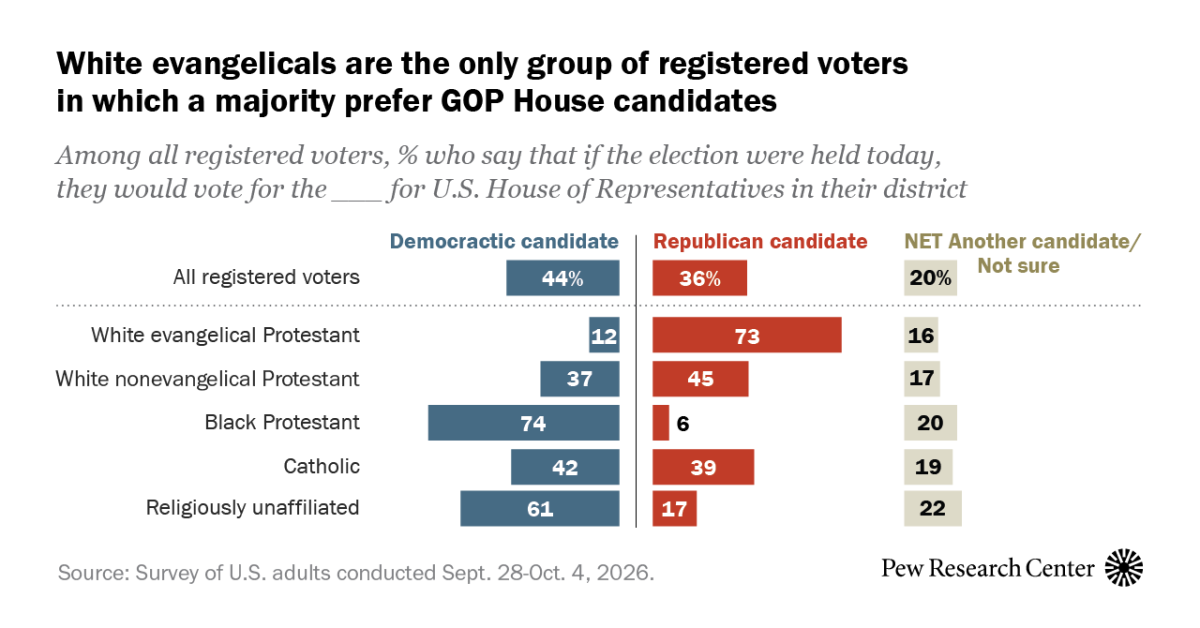
The data indicates that White evangelical Protestants stand as the most reliable voting bloc for the Republican Party. Roughly 73% of registered voters within this demographic expressed a preference for the GOP candidate in their district, with only 12% favoring the Democratic alternative. This massive 61-point margin highlights the enduring strength of the conservative-evangelical alliance that has defined much of American politics over the last several decades.
In contrast, other major religious groups show a markedly different trajectory. White Catholics, often considered a "swing" demographic in national elections, currently favor Republican candidates by a 50% to 32% margin. While this represents a clear preference for the GOP, it is significantly less lopsided than the support found among white evangelicals. Meanwhile, White Protestants who do not identify as evangelical are effectively split, with 45% favoring Republicans and 37% favoring Democrats—a difference that falls within the margin of error, suggesting a high degree of volatility within this group.
The Democratic Party, conversely, maintains overwhelming support among several other key demographics. Black Protestants show a massive preference for Democratic candidates, with 74% supporting them compared to just 6% for Republicans. Similar, though slightly less intense, levels of support are seen among the religiously unaffiliated (61%), agnostics (75%), and atheists (81%). Hispanic Catholics also lean heavily toward the Democratic ticket, with 59% backing the party against 19% for the GOP.
A Chronology of Declining Approval for President Trump
The political environment of 2026 has been defined by the challenges of the second half of President Donald Trump’s second term. Since the start of 2025, the President has faced a steady erosion of public confidence across virtually every religious demographic. The trend is not merely a reflection of a single bad month; it is a cumulative decline that has tracked through the entirety of his second term.
In January and February 2025, the President’s approval rating among all Protestants stood at 58%. By the September-October 2026 survey window, that number had plummeted to 39%. A similar trajectory is visible across all major groups. Among White Catholics, approval dropped from 59% at the beginning of his term to 39% by October 2026. Even among his strongest base, White evangelical Protestants, approval ratings have slipped from 78% in early 2025 to 58% in the most recent polling.
This decline is consistent with broader economic indicators and public sentiment regarding the President’s handling of national issues. The data suggests that the "sour mood" of the American public—as noted in the Pew report—is directly impacting the President’s standing, leaving him with a job approval rating that is under water in almost every religious category measured by the study.
Contextualizing Voter Engagement and Midterm Dynamics
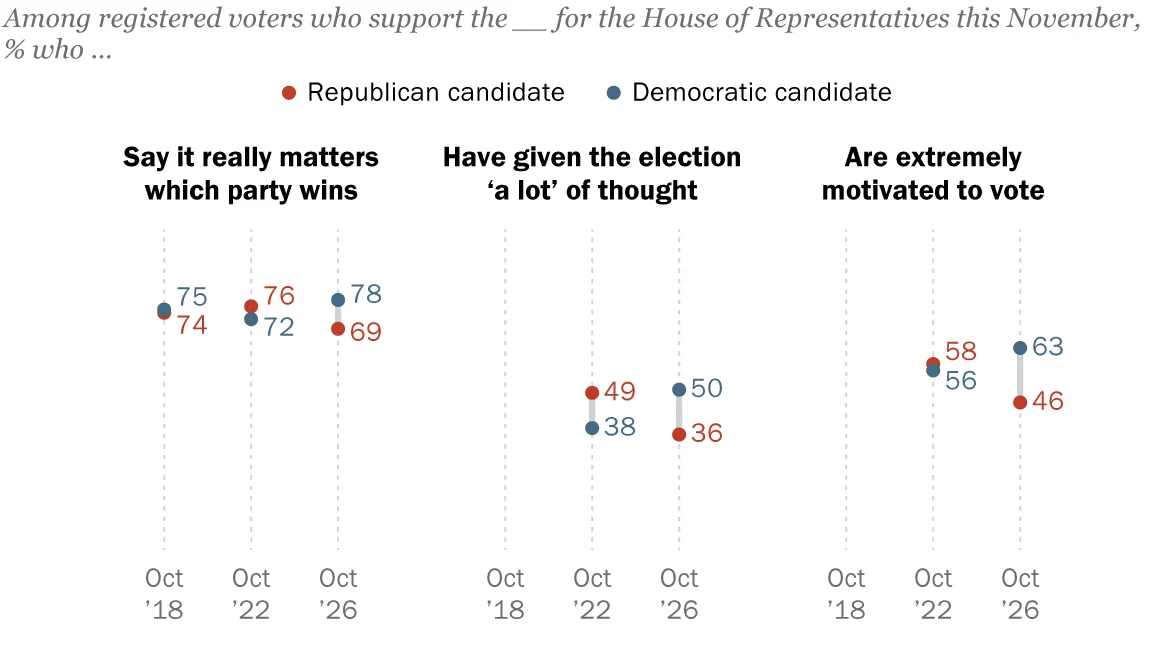
The significance of these preferences must be viewed through the lens of historical voter turnout. While 44% of all registered voters in the survey indicated support for Democratic candidates compared to 36% for Republicans, the actual outcome of the election will hinge on who shows up at the polls. Historically, midterm elections see significantly lower participation than presidential cycles. In the 2022 midterms, for example, only 46% of eligible voters cast a ballot.
The current survey reveals a crucial, if perhaps intangible, factor: motivation. Voters who support Democratic candidates report higher levels of engagement and a greater likelihood of voting than those who support the Republican platform. If this enthusiasm gap persists through Election Day, it could potentially offset the structural advantages that Republicans enjoy in certain districts, particularly in states with high concentrations of white evangelical and rural voters.

Political analysts note that midterms are often treated as a referendum on the sitting president. Given that President Trump’s approval rating has hit new lows across every religious group, the electoral pressure on Republican House candidates is significant. Candidates in swing districts are being forced to navigate a precarious landscape: they must maintain the support of the base, which remains largely loyal, while attempting to appeal to the growing number of voters who have grown disenchanted with the current administration.
The Broader Impact on the Legislative Agenda
The implications of these shifts are profound for the remainder of the 2026 legislative session and the balance of power in Washington. A shift in the House of Representatives would fundamentally alter the President’s ability to pass legislation, confirm appointments, and conduct oversight.
The fact that the religiously unaffiliated—a group that has grown substantially in size over the last two decades—are increasingly moving toward the Democratic Party provides a strategic tailwind for liberal candidates. As this demographic becomes a larger share of the electorate, the traditional Republican strategy of relying on high-turnout, conservative religious voters becomes increasingly difficult to sustain without broadening their appeal to secular or less religious voters.
Analysis of the Current Political Climate
The data suggests that we are witnessing a period of "political calcification" interrupted by moments of severe economic volatility. Religious identity, which has long been the primary prism through which Americans view their political choices, is currently undergoing a stress test. For the Republican Party, the challenge is clear: how to retain the loyalty of the white evangelical core while preventing the slide in approval ratings from turning into a broader electoral defeat among Catholics and mainline Protestants.
For the Democratic Party, the opportunity is equally clear: leverage the high levels of enthusiasm among the religiously unaffiliated and minority religious groups to build a coalition that can withstand the traditional midterm advantage held by the party out of power.

As the election approaches, the role of religion will continue to be a primary focus for campaign strategists. While faith serves as a foundation for many voters’ moral and political values, the 2026 cycle is proving that even the most reliable religious blocs are not immune to the pressures of a difficult economic environment and shifting national sentiment.
Methodology and Research Scope
The Pew Research Center’s findings are derived from the American Trends Panel, a nationally representative group of randomly selected U.S. adults. By utilizing geographic data, researchers were able to present respondents with specific information about the candidates running in their respective congressional districts, ensuring the findings reflect local realities rather than just abstract partisan preferences.
The survey’s rigorous methodology, including detailed topline responses and a clear accounting of margin of error, provides a baseline for understanding the current state of American politics. As the nation approaches the 2026 midterms, these insights will likely serve as a roadmap for understanding not just the final tally of votes, but the shifting allegiances that will define the American political landscape for years to come. The decline in presidential approval, combined with the partisan splits along religious lines, underscores a nation that is deeply divided, yet increasingly active in its pursuit of electoral change.