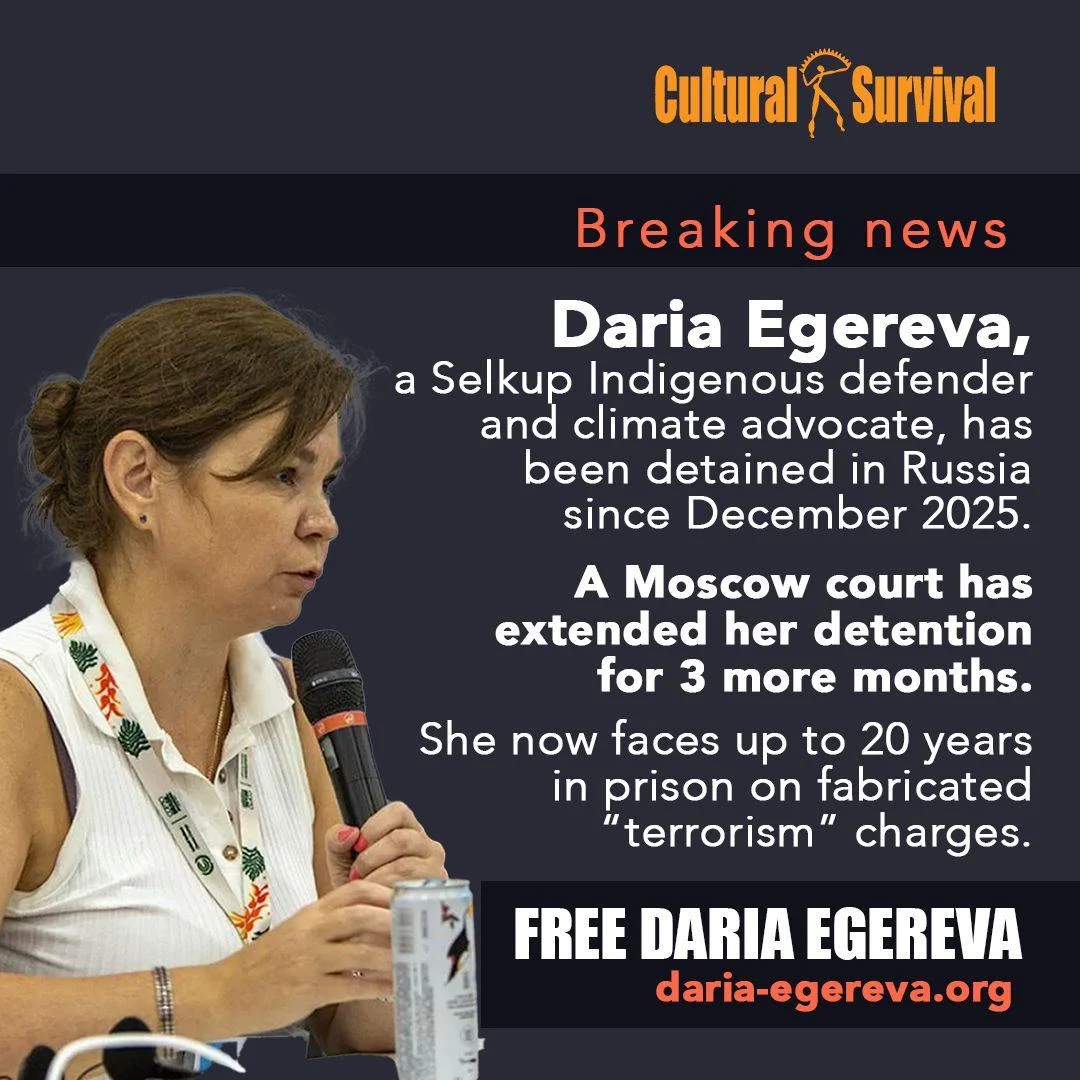
Moscow, Russia – March 12, 2026 – The Basmanny Court in Moscow today extended the pretrial detention of Daria Egereva, a prominent Indigenous rights defender and co-chair of the International Indigenous Peoples Forum on Climate Change (IIPFCC), for an additional three months. The court’s decision, which aligns with the request of government investigators, will keep Egereva, an ethnic Selkup, in custody pending further investigation into charges of terrorism. The hearing, conducted in public, was attended by diplomats from several embassies, alongside Egereva’s husband and children, highlighting the international attention surrounding her case. Egereva faces a potential sentence of up to 20 years in prison if convicted.
The extension of Egereva’s detention has drawn sharp criticism from Indigenous representatives and international human rights advocates who view her arrest and ongoing imprisonment as a politically motivated crackdown on environmental and Indigenous activism. The charges of terrorism against Egereva are seen by many as a disproportionate and unfounded application of law, intended to silence a vocal critic of government policies impacting Indigenous lands and the environment.
Background of the Case and Egereva’s Activism
Daria Egereva’s arrest on December 17, 2025, occurred amidst what has been described as a “large-scale, coordinated wave of repressive actions against Indigenous Peoples and their human rights defenders in Russia.” This date marked a significant escalation in pressure on individuals and organizations advocating for Indigenous rights and environmental protection within the Russian Federation. Egereva, a respected member of the Selkup community, has dedicated years to advocating for the rights of Indigenous peoples, particularly concerning the preservation of their traditional lands, cultures, and the protection of the Arctic environment from industrial development and climate change impacts.
As a co-chair of the IIPFCC, Egereva has been instrumental in raising international awareness about the challenges faced by Indigenous communities in Russia and globally. Her work has often involved advocating for greater Indigenous participation in decision-making processes related to resource extraction, conservation efforts, and climate policy. Colleagues and supporters within the international civil society community widely believe her detention is directly linked to her activism, particularly her outspoken stance on climate change and its disproportionate effects on Indigenous populations. The IIPFCC has been a key platform for Indigenous voices on the global stage, advocating for the implementation of international agreements and conventions that protect Indigenous rights and promote sustainable development. Egereva’s leadership within this organization has amplified these concerns, leading to increased scrutiny of Russian environmental and Indigenous policies.
Chronology of Events and Legal Proceedings
The legal process against Daria Egereva began with her arrest on December 17, 2025. Initially, her detention was subject to review by the courts, leading to periodic decisions regarding her pretrial status. The court’s decision today to extend her detention for a further three months signifies a prolonged period of pretrial confinement. This latest extension follows a previous one, which, according to Indigenous representatives, was for a month. The increasing duration of her pretrial detention suggests a deliberate strategy by investigators to keep her in custody while the case progresses, or potentially, to exert pressure.
The Basmanny Court, known for handling high-profile and politically sensitive cases in Moscow, has become the venue for these crucial hearings. The public nature of today’s hearing, while a positive sign for transparency, also underscores the international visibility of Egereva’s situation. The presence of diplomats from multiple embassies indicates that foreign governments are closely monitoring the proceedings and the treatment of a prominent Indigenous rights defender.
Statements from Indigenous Representatives and International Observers
The extension of Egereva’s detention has elicited strong condemnations from fellow Indigenous leaders and human rights advocates. Andrei Danilov, a Saami Indigenous representative, expressed profound concern over the prolonged incarceration, stating, “Being held in a Russian prison is a tremendous ordeal for anyone. I spent five days in this nightmare in 2021. For me, it’s like five years of my life. Daria has already been held for 86 days, and her sentence was extended by 92 days. This is terrible, unlawful, a violation of rights. Demand Daria Egereva’s release!” Danilov’s personal experience highlights the severe psychological and physical toll of imprisonment in Russia, and his comparison of Egereva’s extended detention to years of suffering underscores the gravity of the situation.
Aivana Enmynkau, a Nuvuqaghmiit Indigenous representative, echoed these sentiments, emphasizing the disregard for international solidarity. “Last time, Daria Egereva’s detention was extended by a month; now it’s been extended to three. Despite appeals from Indigenous representatives from various countries, Daria remains in custody. It’s heartbreaking to see how the solidarity of people around the world in this situation is simply ignored.” Enmynkau’s statement points to a pattern of ignoring international calls for Egereva’s release, suggesting a potential inflexibility or unwillingness on the part of Russian authorities to engage with external pressure.
Supporting Data and Context
The charges of terrorism leveled against Daria Egereva are particularly concerning given the context of increasing restrictions on civil society and environmental activism in Russia. Recent years have seen a tightening of laws regarding “foreign agents” and “undesirable organizations,” which have been used to stifle dissent and limit the operations of non-governmental organizations. While specific details of the evidence presented by investigators are not publicly disclosed, the broad nature of terrorism charges can often be applied to individuals engaged in political activism, particularly if their activities are perceived as challenging state interests.
The International Indigenous Peoples Forum on Climate Change (IIPFCC) has been active in documenting and advocating against the negative impacts of climate change and industrial development on Indigenous communities worldwide. Their work often involves presenting findings at international forums, such as the United Nations Permanent Forum on Indigenous Issues, and engaging with governments to promote policies that uphold Indigenous rights and environmental sustainability. Egereva’s role as co-chair has placed her at the forefront of these efforts, making her a visible and influential figure in the international Indigenous rights movement.
The website and petition launched as part of the #FreeDariaEgereva campaign serve as crucial platforms for disseminating information and mobilizing global support. These initiatives allow individuals to send messages of solidarity to Egereva, sign petitions, and learn about other ways to contribute to her defense. The campaign aims to highlight the alleged injustice of her detention and pressure Russian authorities for her release. The website, daria-egereva.org, provides a central hub for all campaign-related activities and information.
Broader Implications and Analysis
The prolonged detention of Daria Egereva carries significant implications for Indigenous rights and environmental activism within Russia and on the international stage. Her case highlights a growing trend of what critics describe as the criminalization of activism, particularly when it intersects with sensitive issues such as resource development and climate change.
For Indigenous communities in Russia, Egereva’s arrest and detention represent a chilling effect on their ability to voice concerns and defend their traditional lands and ways of life. The use of severe charges like terrorism against a human rights defender can deter others from engaging in similar advocacy, fearing similar repercussions. This can lead to a further marginalization of Indigenous voices in crucial decision-making processes that affect their territories and futures.
Internationally, the case puts a spotlight on Russia’s adherence to international human rights standards and its commitment to protecting the rights of Indigenous peoples, as enshrined in instruments like the UN Declaration on the Rights of Indigenous Peoples. The engagement of foreign diplomats in the court proceedings suggests that the international community is watching closely, and the outcome of Egereva’s case could influence diplomatic relations and international perceptions of Russia’s human rights record.
The narrative connecting Egereva’s detention to her climate change activism is particularly relevant in the current global context. As the world grapples with the escalating impacts of climate change, the role of Indigenous peoples as guardians of biodiversity and traditional ecological knowledge becomes increasingly vital. Actions that silence or suppress such voices could hinder global efforts to address the climate crisis effectively and equitably.
The legal strategy employed by investigators, if indeed aimed at silencing dissent, could backfire by galvanizing further international support for Egereva and drawing greater attention to the broader human rights situation in Russia. The #FreeDariaEgereva campaign, with its international reach, demonstrates the potential for global solidarity to exert pressure on governments.
The legal battle ahead for Daria Egereva is likely to be protracted. The extension of her pretrial detention by three months suggests that the investigation is ongoing and that the judicial process may be lengthy. Her supporters are calling for transparency, fairness, and ultimately, her immediate release. The focus now shifts to the evidence presented by the prosecution, the defense’s arguments, and the court’s final determination, all of which will be closely observed by human rights organizations, Indigenous communities, and governments worldwide.
For Further Inquiries
For media inquiries or to obtain further information regarding the #FreeDariaEgereva campaign, please contact:
Tatiana Shauro
Solidarity Campaign Communications Coordinator
Email: [email protected]