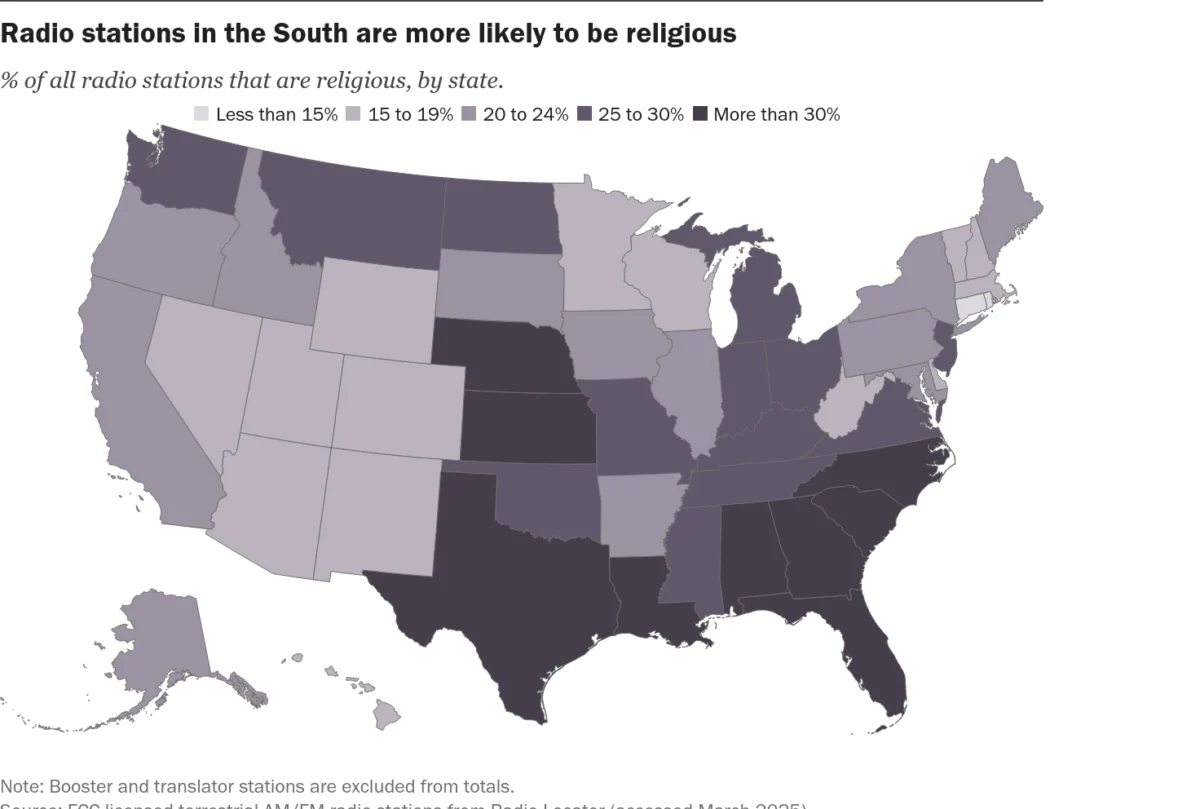
A comprehensive new report from the Pew-Knight Initiative sheds light on the significant presence and diverse characteristics of religious radio stations across the United States. The research, funded jointly by The Pew Charitable Trusts and the John S. and James L. Knight Foundation, delves into the landscape of AM and FM stations that primarily broadcast faith-based content, exploring their programming, listener demographics, and the underlying reasons for their appeal. This in-depth analysis reveals distinct regional concentrations and varied programming styles, offering a nuanced understanding of this often-overlooked segment of the American media ecosystem.
The Pew-Knight Initiative: Understanding Civic Engagement and Information Consumption
The Pew-Knight Initiative is dedicated to supporting new research that examines how Americans consume civic information, shape their beliefs and identities, and participate in their communities. Pew Research Center, a nonpartisan fact tank, and the Knight Foundation, a social investor focused on informed and engaged communities, collaborate through this initiative to provide data-driven insights into crucial societal trends. This particular report on religious radio aligns with the Pew Research Center’s long-standing commitment to understanding news habits and media consumption, recognizing that religious radio stations are a considerable part of the nation’s media landscape, accessible in most regions of the U.S.
Unveiling the Landscape of Religious Radio
This extensive study provides a detailed look at religious radio stations nationwide. It meticulously analyzes the types of programming these stations offer, from music-centric broadcasts to talk-based discussions and sermons. Furthermore, the research investigates the demographics of individuals who tune into religious programming and the motivations behind their listening habits. The initiative’s methodology involved a multi-pronged approach, utilizing FCC-licensed terrestrial AM/FM radio station data from Radio-Locator (accessed in March 2025), extensive analysis of programming content, and surveys to understand listener preferences.
Regional Disparities in Religious Radio Penetration
A striking finding of the report is the uneven distribution of religious radio stations across the United States, with certain regions exhibiting a significantly higher concentration. The data indicates that states in the South, in particular, show a greater proportion of their radio stations dedicated to religious content. For instance, states like Alabama, Florida, Georgia, Kansas, Mississippi, North Carolina, and Texas report over 30% of their total radio stations broadcasting religious programming. This contrasts with states like Connecticut, Massachusetts, New York, and Rhode Island, where the percentage of religious stations falls below 20%.
Key Regional Observations:
- Southern Dominance: States in the Southeast and parts of the Midwest consistently show higher percentages of religious radio stations. North Carolina leads with approximately 36% of its stations broadcasting faith-based content, closely followed by Texas (34%) and Nebraska (32%).
- Northeastern Lower Presence: Conversely, states in the Northeast and along the West Coast generally have a lower proportion of religious stations. For example, New York has about 21% of its stations broadcasting religious content, while California stands at 20%.
- Per Capita Analysis: When examining religious stations per 100,000 residents, states with sparser populations often exhibit higher numbers, such as Montana (5.9 stations per 100,000) and Wyoming (6.6 stations per 100,000). This highlights that while larger states might have more total religious stations, smaller states can have a more intense presence relative to their population.
Programming Diversity: Music vs. Talk
The study also delves into the nature of the programming offered by these religious stations. A significant portion of religious radio content is music-based, but talk programming, including sermons, Bible studies, and discussions on faith-related topics, also holds a substantial share. The data suggests that the balance between music and talk can vary considerably by state and by the specific religious tradition the station represents.
- Music-Heavy States: In some states, a majority of religious stations lean towards playing music. For instance, Colorado shows a remarkable 65% of its religious stations primarily broadcasting music. Other states with a strong music focus include Maryland (59%) and Michigan (56%).
- Talk-Oriented States: In contrast, other states have a higher prevalence of talk programming. Arkansas (45%) and Louisiana (54%) show a significant percentage of their religious stations dedicated to talk.
- Content Analysis Methodology: The categorization of stations as "mostly music" or "mostly talk" was based on whether 70% of their broadcast content fell into that category. Stations not meeting this threshold were classified as playing a mix of talk and music. This analysis was performed on 439,711 hours of programming recorded in July 2025, drawing from online streams of FCC-licensed terrestrial AM/FM religious radio stations.
Listener Motivations and Engagement
Understanding why Americans tune into religious radio is a key component of the Pew-Knight Initiative’s research agenda. While the report doesn’t detail specific listener survey results in the provided text, it acknowledges that religious radio stations serve as important sources of information and spiritual guidance for their audiences. The appeal of religious radio can be attributed to several factors, including the desire for spiritual connection, community building, and access to specific teachings and music that resonate with listeners’ faith. In an era of fragmented media consumption, these stations offer a consistent and often deeply personal form of engagement.

Ownership and Independence
The study also examined the ownership structure of religious radio stations, providing insights into whether they are independently operated or part of larger networks. The data reveals variations in independent ownership across different states. For example, states like Colorado (9% independent ownership) and Delaware (17% independent ownership) have a lower percentage of independently owned religious stations compared to states like Alabama (39%) or Florida (39%). This aspect of ownership can influence programming diversity and the station’s connection to its local community.
The Role of Catholic Broadcasting
While the broad category of "religious radio" encompasses a wide array of faiths, the report also provides specific data on Catholic-affiliated stations. The percentage of religious stations that are Catholic varies significantly by state. For instance, in states like Rhode Island (20%), Iowa (21%), and North Dakota (21%), a notable portion of religious stations identify as Catholic. In contrast, states like Delaware and Hawaii have 0% Catholic-identified religious stations within their religious radio landscape. This highlights the diverse denominational makeup within the broader religious broadcasting sphere.
Historical Context and Broader Implications
The rise of religious broadcasting in the United States can be traced back to the early days of radio, with various denominations and independent ministries recognizing the power of the medium to reach a wider audience. Over the decades, this sector has grown and diversified, adapting to technological changes and evolving listener preferences. The Pew-Knight Initiative’s research provides a contemporary snapshot of this dynamic field, underscoring its continued relevance.
The implications of this research extend beyond understanding a niche media market. Religious radio stations can play a significant role in civic discourse, community mobilization, and the dissemination of particular worldviews. In regions where they are particularly prevalent, they can shape local conversations and influence the social and cultural fabric. Understanding their reach and programming helps to paint a more complete picture of the American media landscape and how different communities engage with information and with each other.
Methodology and Data Sources
The robustness of the Pew-Knight Initiative’s findings is underpinned by its comprehensive methodology. The study relied on:
- FCC-Licensed Terrestrial AM/FM Radio Station Data: Information from Radio-Locator, accessed in March 2025, provided a foundational dataset of stations.
- Programming Analysis: A significant analysis of 439,711 hours of programming, recorded in July 2025, allowed for the categorization of stations based on their content (mostly music, mostly talk, or a mix). This analysis excluded stations that did not have available web streams, such as those located in the District of Columbia.
- Categorization of Religious Tradition: The identification of a station’s religious tradition was based on the content of its website, offering a qualitative layer to the quantitative data.
The research team also made publicly available the survey questions used, detailed response data, and the full methodology document, adhering to the Pew Research Center’s commitment to transparency and academic rigor.
Conclusion: A Vital, Diverse, and Regionally Influential Medium
The Pew-Knight Initiative’s report on religious radio reveals a media sector that is both widespread and deeply varied. While not always in the spotlight, these stations serve as vital conduits of spiritual content, community connection, and information for millions of Americans. The research highlights significant regional concentrations, diverse programming styles, and the complex factors that contribute to the enduring appeal of religious broadcasting. As the media landscape continues to evolve, understanding the role and reach of religious radio provides valuable insights into the diverse ways Americans connect with their faith, their communities, and the information that shapes their lives.