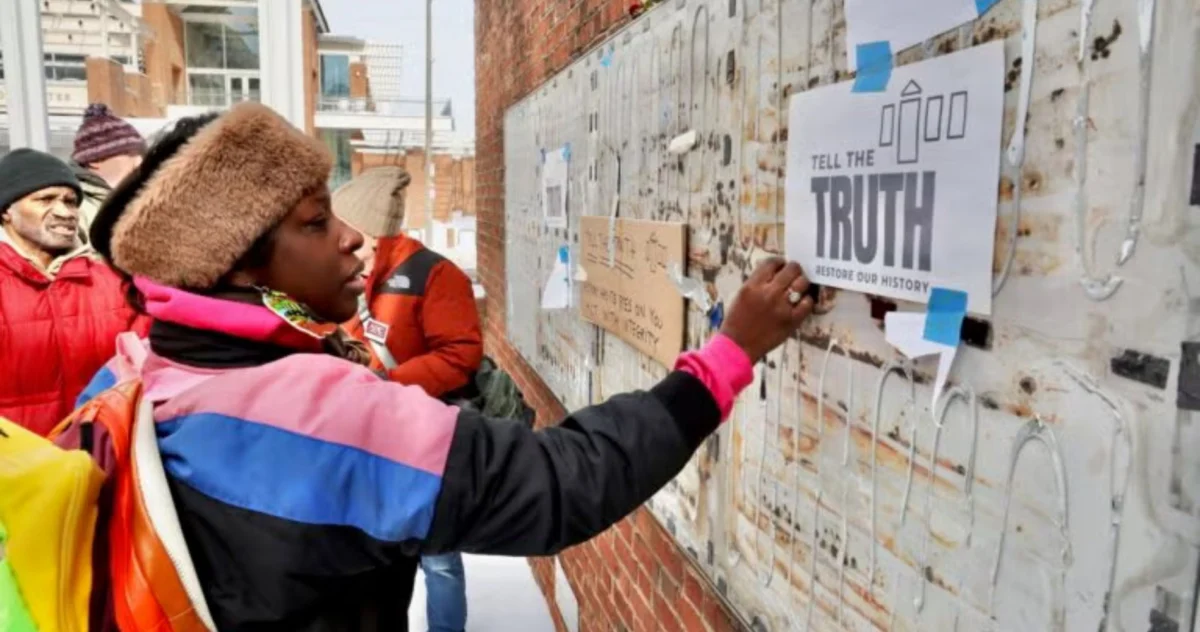
A federal court delivered a significant ruling on Monday, ordering the National Park Service (NPS) to immediately reinstall comprehensive exhibits at the President’s House in Philadelphia. These exhibits, which meticulously detail President George Washington’s ownership of enslaved people and chronicle the lives of individuals he held in bondage, were controversially removed by the NPS on January 22, 2026. The decision marks a pivotal moment in the ongoing national discourse surrounding the interpretation of American history, particularly the complex legacy of the nation’s founders and the indelible stain of slavery. The City of Philadelphia had initiated the federal lawsuit, seeking to halt the removal and compel the NPS to restore the vital historical narratives.
The court, in granting the city’s motion for a preliminary injunction, issued a clear directive: the NPS must "reinstall all panels, displays, and video exhibits that were previously in place" and "prevent any additions, removals, destruction, or further changes of any kind to the President’s House site." This decisive action underscores a judicial commitment to preserving historical accuracy and accessibility, especially at sites crucial to understanding the foundational contradictions of the United States.
The Heart of the Ruling: Preserving Historical Truth Against Erasure
The court’s exhaustive 40-page decision meticulously laid out the legal and historical grounds for its order. It highlighted that the removal of the exhibit by the Trump administration, executed without the consent of the City of Philadelphia, constituted a direct violation of federal law and pre-existing agreements. These agreements date back to the very establishment of Independence National Historical Park by Congress in 1948, an act intended to safeguard and present significant historical structures related to the nation’s founding for the benefit of the American people.
The ruling emphasized that the NPS’s actions contravened its mandate to maintain and interpret historical sites truthfully. The court found that the government failed to provide any "evidence" or "reasoned explanation" for the removal, instead pointing to a broad executive order from the Trump administration. This order had directed the NPS to review and remove materials deemed to "inappropriately disparage Americans" and had specifically identified Independence National Historical Park as a site promoting "corrosive ideology."
However, the court sharply rebuked this rationale, stating that the NPS itself had committed the very act the executive order condemned: "replacing objective facts with a distorted narrative driven by ideology rather than truth." The decision powerfully asserted, "It is not disputed that President Washington owned slaves. And yet, in its argument, the government claims it alone has the power to erase, alter, remove and hide historical accounts on taxpayer and local government-funded monuments within its control."
A Chilling Echo: Orwellian Control Over History
In a particularly striking passage, the court invoked George Orwell’s dystopian novel "1984," drawing parallels between the government’s arguments and the novel’s "Ministry of Truth," which was tasked with rewriting history to suit the ruling party’s agenda. "The government here likewise asserts truth is no longer self-evident, but rather the property of the elected chief magistrate and his appointees and delegees, at his whim to be scraped clean, hidden, or overwritten," the court found. It concluded, "And why? Solely because, as Defendants state, it has the power."
Justice Department lawyers had argued that "the Government gets to choose the message it wants to convey." The court firmly rejected this notion, asserting that "An agency … cannot arbitrarily decide what is true, based on its own whims or the whims of the new leadership." While acknowledging the government’s right to convey messages elsewhere, the court underscored that this right does not extend to "wiping away the history of the greatest Founding Father’s management of persons he held in bondage" at a site specifically dedicated to presenting that history.
A Decades-Long Effort: Genesis of the President’s House Exhibit
The President’s House site holds profound historical significance, marking the location of the official residence where Presidents George Washington and John Adams lived during their terms in Philadelphia, then the nation’s capital. While the physical structure no longer stands, archaeological work in the early 2000s identified its precise footprint, including the slave quarters.
The realization that the "First White House" in the nation’s birthplace was also a site of human bondage sparked a movement to acknowledge this painful truth. In 2003, the U.S. House of Representatives passed a resolution specifically urging the National Park Service to commemorate the lives of people enslaved by President Washington at the site. This congressional directive recognized the need for a more complete and honest portrayal of the nation’s origins.
Responding to this call, the City of Philadelphia invested millions of dollars into developing an exhibit designed "to tell an honest story about American history and the founding of this country and the role that slavery and enslaved Africans had." This substantial financial and intellectual commitment from the city underscored its dedication to presenting a nuanced and truthful historical narrative.
The culmination of these efforts was the opening of "President’s House: Freedom and Slavery in the Making of a New Nation" in December 2010. The exhibit was not merely an acknowledgment but a deep dive into what the NPS itself described as the "paradox of freedom and slavery" at the nation’s founding. It explored how the very ideals of liberty and self-governance were built upon the brutal institution of human enslavement.
Further cementing its importance, in 2022, the NPS designated the site a National Underground Railroad Network to Freedom site. This designation recognized its connection to individuals like Oney Judge, who famously escaped to freedom from the Washington household at this very location. The site was thus officially recognized for exploring "how her struggle for freedom represented this country’s progress away from the horrors of slavery and into an era where the founding ideals of ‘Life, Liberty and the pursuit of Happiness’ could be embodied for every American." The removal of the exhibits, therefore, directly undermined this established designation and the narrative it was meant to convey.
The Lives Remembered: The Enslaved Individuals
Central to the exhibit, and to the court’s decision, is the recognition of the nine enslaved Africans who lived and toiled at the President’s House. Historians meticulously uncovered details about Oney Judge, Austin, Christopher Sheels, Giles, Hercules Posey, Joe Richardson, Moll, Paris, and Richmond. These individuals were owned by President Washington, brought to the official presidential residence in Philadelphia, and were rotated in and out of Pennsylvania. This practice was a deliberate maneuver by Washington to circumvent Pennsylvania’s gradual abolition law, which granted freedom to enslaved people who resided in the state for six months. By periodically moving them across state lines, Washington sought to maintain their enslaved status, highlighting the lengths to which even the nation’s first president went to preserve the institution of slavery.
The exhibit aimed to restore humanity and agency to these individuals, whose stories are often overlooked in traditional narratives of the Founding Fathers. Oney Judge’s escape, in particular, became a powerful symbol of resistance and the enduring human quest for liberty, directly contradicting the "corrosive ideology" claim made by the Trump administration. The court’s order ensures that the stories of these individuals, and the broader context of their enslavement, remain central to the interpretation of the President’s House site.
Irreparable Harm: Undermining Public Trust and Memory
The City of Philadelphia’s argument for irreparable harm proved compelling to the court. The city contended that without the restoration and safeguarding of the displays, it would suffer "a loss of access to historical truth, an undermining of the public trust, and an inability to recount its own story in preparation for the semiquincentennial." The court concurred, finding that the removal "constitutes erasure, undermines public trust, and compromises the integrity of public memory."
The court elaborated on the profound impact of the removal: "The President’s House represents the City ‘fulfilling an obligation to tell the truth—the whole, complicated truth.’ Removal of the crucial interpretive materials strips the site of that truth and deprives the public of educational opportunities designed to be free and accessible."
Crucially, the court emphasized that the harm extended beyond the city to all visitors. It clarified that the removed displays and exhibits "were not mere decorations to be taken down and redisplayed." Instead, they constituted "a memorial to ‘men, women, and children of African descent who lived, worked, and died as enslaved people in the United States of America,’ a tribute to their struggle for freedom, and an enduring reminder of the inherent contradictions emanating from this country’s founding." The court concluded, "Each person who visits the President’s House and does not learn of the realities of founding-era slavery receives a false account of this country’s history."
Broader Implications for Public History and Memory
This federal court ruling carries significant implications for the field of public history, the management of national parks, and the ongoing national debate about confronting difficult aspects of American history. It reaffirms the principle that historical interpretation at public sites should be based on objective facts and scholarly consensus, rather than political whims or ideological agendas.
For the National Park Service, the ruling serves as a powerful reminder of its core mission to preserve and interpret historical sites accurately and comprehensively. It establishes a precedent that federal agencies cannot unilaterally alter or remove established historical narratives, especially those developed through extensive research and community engagement, without robust justification. This could deter future attempts by administrations to politicize historical representation at national sites.
The decision also empowers local governments and historical preservationists who advocate for inclusive and truthful historical accounts. It validates their role as guardians of historical integrity against potential federal overreach. As the nation approaches its semiquincentennial in 2026, the ruling reinforces the idea that a truly commemorative celebration must include a full and honest reckoning with all aspects of American history, including its most uncomfortable truths.
Furthermore, the court’s strong language, particularly its reference to Orwell, sends a clear message about the dangers of governmental attempts to control or rewrite history. It underscores the vital role of an independent judiciary in safeguarding historical truth as a public good, essential for informed citizenship and a robust democracy.
Reactions and Future Steps
The City of Philadelphia is expected to welcome this ruling as a significant victory for historical truth and public education. Cultural institutions and civil rights organizations across the country are also likely to laud the decision as a crucial affirmation of the importance of acknowledging the full complexity of American history. Historians and scholars, who have long advocated for a more complete narrative of the nation’s founding, will likely view this as a vindication of their efforts.
The National Park Service, while obligated to comply with the court’s order, has not yet issued a public statement regarding its next steps. It is anticipated that the NPS will begin the process of reinstating the exhibits as mandated. Whether the federal government will appeal the preliminary injunction remains to be seen. Any appeal would escalate the legal battle, prolonging the uncertainty surrounding the exhibits. However, the unequivocal language of the court’s decision suggests a strong legal foundation for the injunction, making a successful appeal challenging.
In the interim, the ruling ensures that visitors to the President’s House in Philadelphia will once again have access to a crucial, unvarnished account of President Washington’s relationship with slavery, fostering a deeper understanding of the "paradox of freedom and slavery" that continues to shape the American experience.