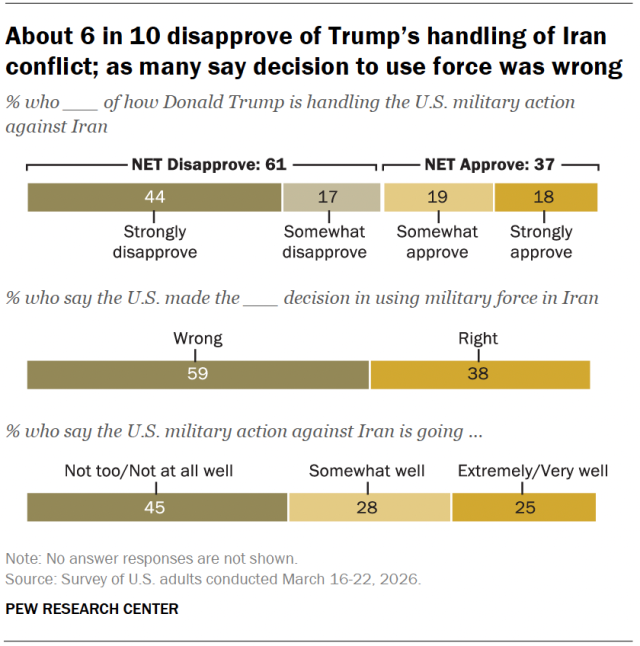
Weeks into the U.S. military campaign against Iran, a significant majority of Americans express disapproval of President Donald Trump’s handling of the conflict, with a similar proportion deeming the decision to employ military force as the wrong choice. A comprehensive survey conducted by the Pew Research Center reveals a deeply divided public opinion, marked by stark partisan lines, regarding the ongoing engagement in Iran.
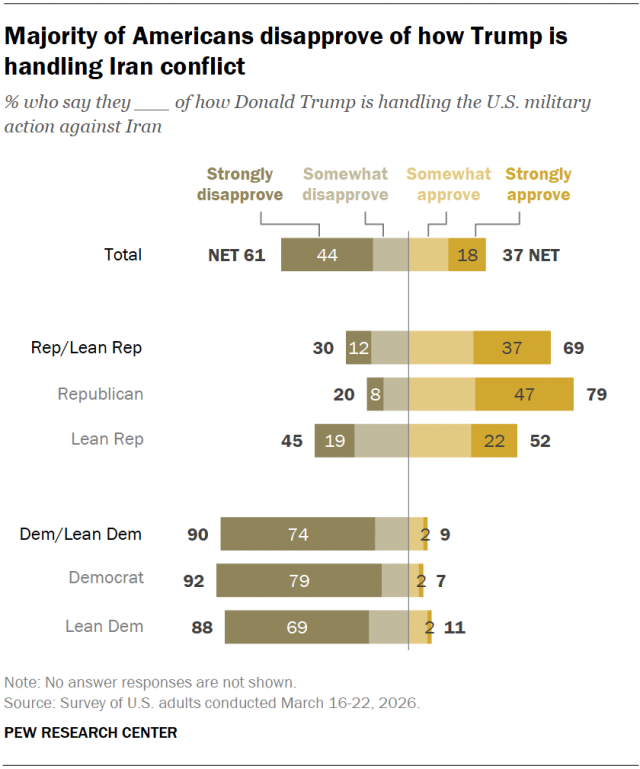
The Pew Research Center analysis, based on a survey of 3,524 U.S. adults conducted between March 16 and March 22, 2026, indicates that 61% of Americans disapprove of President Trump’s management of the conflict, while only 37% approve. This sentiment is mirrored in the public’s assessment of the initial decision to engage militarily. A majority of respondents, 59%, believe the United States made the wrong decision in using military force in Iran, with 38% affirming it was the right decision. Furthermore, the operational progress of the campaign is viewed with skepticism, as 45% of Americans feel the military action is not going well, compared to 25% who believe it is progressing extremely or very well.
Background and Timeline of U.S. Military Action in Iran

The U.S. military action against Iran commenced in February 2026, marking a significant escalation in regional tensions. While the specific catalysts for this intervention are not detailed in the provided data, such actions typically stem from complex geopolitical factors, including alleged threats to U.S. interests, regional stability, or international security. The duration of the military campaign, now entering its fourth week at the time of the survey, suggests a potentially protracted engagement, influencing public sentiment and expectations.
Deep Partisan Divides Emerge
The survey data highlights a profound chasm in public opinion along party lines. Democrats and Democratic-leaning independents overwhelmingly reject the military intervention, with 90% disapproving of President Trump’s handling of the conflict and 88% stating that the U.S. made the wrong decision to strike Iran. This unified front among Democrats stands in stark contrast to the views of Republicans and Republican leaners. Approximately seven-in-ten Republicans (69%) approve of President Trump’s approach to the conflict, and a similar percentage (71%) believe the decision to use military force was correct.
This partisan polarization extends to the perception of the conflict’s progress. While Democrats express significant dissatisfaction, with 69% stating the military action is not going well, Republicans are considerably more optimistic. Among Republicans and Republican leaners, 46% believe the action is progressing extremely or very well, and only 21% express the view that it is not going well.
Shifting Sentiments within the Republican Coalition
While Republicans broadly support the administration’s actions, the survey reveals nuanced differences within the Republican coalition. Self-identified Republicans exhibit stronger approval of President Trump’s handling of the conflict, with 79% expressing approval. This figure drops to 52% among Republican-leaning independents, indicating a divergence in opinion even within the broader conservative base.
Age also appears to be a factor among Republicans. Although not explicitly detailed for all age groups in the provided snippets, the implication of differing views based on age suggests that younger Republicans might hold less uniformly supportive opinions compared to their older counterparts. By contrast, Democratic views on the conflict and President Trump’s handling remain remarkably consistent across party affiliations and age demographics, with a near-unanimous disapproval rate.
Public Expectations for the Conflict’s Duration
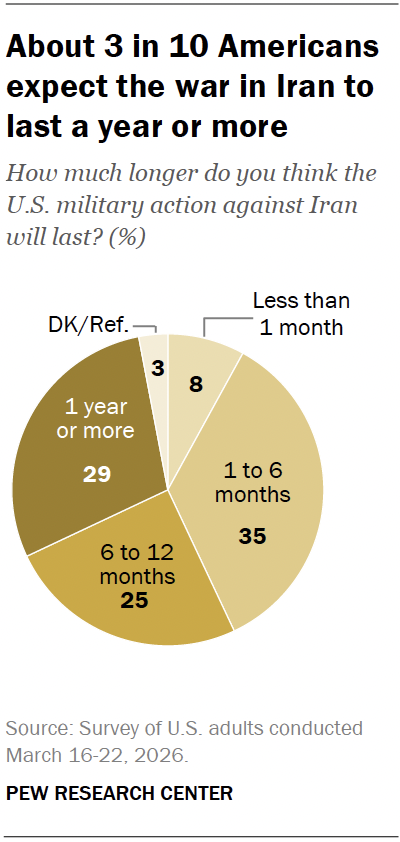
Looking ahead, a majority of Americans (54%) anticipate the U.S. military action in Iran will continue for at least six more months. A notable segment of the population, 29%, believes the conflict will persist for a year or longer. Conversely, 35% expect the war to conclude within the next one to six months, while a small fraction (8%) believes it will end in less than a month.
Partisan differences are again evident in these projections. A majority of Republicans (58%) foresee the conflict ending within the next six months. Democrats, however, hold a contrasting outlook, with 68% anticipating the war will extend beyond six months, including 40% who believe it will still be ongoing a year from now. This suggests a differing perception of the potential for a swift resolution among the two major political parties.
Concerns Over Long-Term Safety and Global Stability
Beyond the immediate assessment of the conflict, a significant portion of the American public expresses concern about its long-term implications for safety. Nearly two-to-one, more Americans believe the military action will make the United States less safe in the long run (40%) than believe it will enhance safety (22%). A fifth of respondents (20%) feel the action will leave the U.S. about as safe as before, while 18% remain unsure.
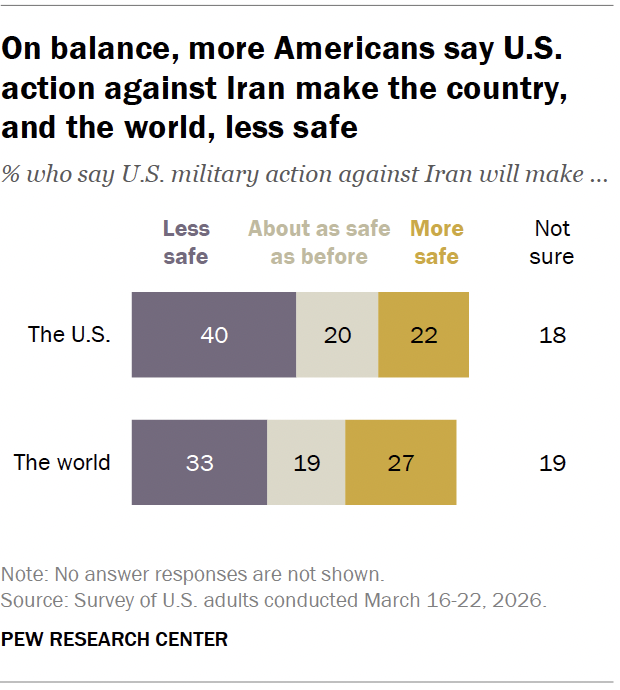
The impact on global safety presents a more divided picture, though still leaning towards apprehension. Thirty-three percent of Americans believe the U.S. military action will make the world less safe, while 27% believe it will make the world safer. Approximately one-fifth of respondents (19%) anticipate no change in global safety, with an identical share expressing uncertainty.
Methodology and Research Context
The findings are derived from a survey conducted by the Pew Research Center, a non-partisan fact tank that aims to inform the public, media, and policymakers on significant issues. The survey involved 3,524 U.S. adults and was administered from March 16 to March 22, 2026. All participants were members of the Center’s American Trends Panel, a nationally representative online survey panel. The methodology employed is designed to provide a robust representation of the views of the entire U.S. adult population. The Pew Research Center has a long history of studying public opinion on political and policy matters, including the use of U.S. military force. The detailed survey questions, topline responses, and methodology are publicly available for further examination.
Implications and Future Considerations
The broad disapproval of the military action in Iran and President Trump’s handling of it, coupled with concerns about long-term safety, signals a challenging political landscape for the administration. The stark partisan divisions suggest that public opinion on this issue is unlikely to converge in the near future, potentially influencing legislative debates and electoral strategies.
The differing expectations regarding the conflict’s duration also carry significant implications. A prolonged engagement could exacerbate public weariness and dissent, particularly if perceived progress remains slow or if casualties mount. Conversely, a swift resolution, even if initially met with mixed feelings, might alter public sentiment.
The survey’s findings underscore the critical role of communication and transparency from the administration regarding the objectives, strategy, and anticipated outcomes of the military campaign. As the situation in Iran evolves, continued public opinion monitoring will be essential to understanding the evolving American perspective on this consequential foreign policy undertaking. The data also raises questions about the potential for unintended consequences and the broader geopolitical ramifications of the U.S. military involvement in the region.