A significant and growing portion of the American public reports encountering news passively rather than actively seeking it out. New research from the Pew Research Center, conducted in collaboration with the John S. and James L. Knight Foundation, reveals that 49% of U.S. adults now state they primarily absorb news because they "happen to come across it," a notable increase from 39% when this question was first posed in 2019. This trend underscores a fundamental shift in how Americans engage with the information landscape, moving away from deliberate consumption towards a more incidental, often algorithmically curated, experience.
The Pew-Knight Initiative, a collaborative research program dedicated to understanding how Americans engage with civic information, form beliefs, and participate in their communities, highlights this evolving dynamic. The initiative’s latest findings, detailed in a recent report, paint a picture of a populace increasingly navigating a digital environment where news finds them, rather than the other way around. This shift has profound implications for the depth of public understanding, the formation of informed opinions, and the overall health of civic discourse.
The Rise of Serendipitous News Consumption
The data indicates a clear divergence in how Americans encounter different types of news content. While the general trend leans towards passive consumption, the nature of the content plays a crucial role. Content that often elicits emotional responses or provides immediate reactions to events, such as humor and opinions, is most frequently encountered by chance.
According to the survey, conducted from December 8-14, 2025, a substantial 66% of U.S. adults report encountering "funny posts" about news and issues primarily by chance. Similarly, 64% of Americans say they come across "people expressing opinions" on news events serendipitously. This suggests that the more ephemeral and reactive elements of the news cycle are readily absorbed through passive browsing, social media feeds, and other incidental digital encounters.
In stark contrast, the pursuit of more substantive information requires a more active approach. Only 31% of adults report stumbling upon "in-depth information or deep dives" into issues or events. Likewise, 38% of Americans say they primarily get "the most up-to-date information" about events by chance. This indicates a strong preference for intentional engagement when seeking out comprehensive understanding or timely updates, suggesting that when Americans want to truly grasp a complex issue, they are more likely to take deliberate steps to find that information.

Shifting Habits: A Look at the Data
The survey data provides a granular view of these consumption patterns:
- In-depth information or deep dives: While 58% of U.S. adults actively seek this type of content, 31% encounter it by chance, and 11% do not get this type of news.
- The most up-to-date information: A majority (55%) actively seek out the latest updates, with 38% coming across them incidentally and 6% not engaging with this type of news.
- People expressing opinions: A significant shift occurs here, with only 21% actively seeking opinions, while a dominant 64% report encountering them by chance. Fourteen percent do not get this type of news.
- Funny posts: This category shows the most pronounced passive consumption, with a mere 14% actively seeking humorous content related to news, while 66% encounter it by chance. Twenty percent do not get this type of news.
These figures highlight a critical distinction: Americans are more likely to actively pursue information that offers deeper understanding or timely relevance, while opinions and humor tend to be absorbed as part of a broader, often less curated, information stream.
Generational and Educational Divides in News Acquisition
The trend of passive news consumption is not uniform across the American population. Significant differences emerge when examining age and education levels, underscoring the diverse ways different demographics navigate the information ecosystem.
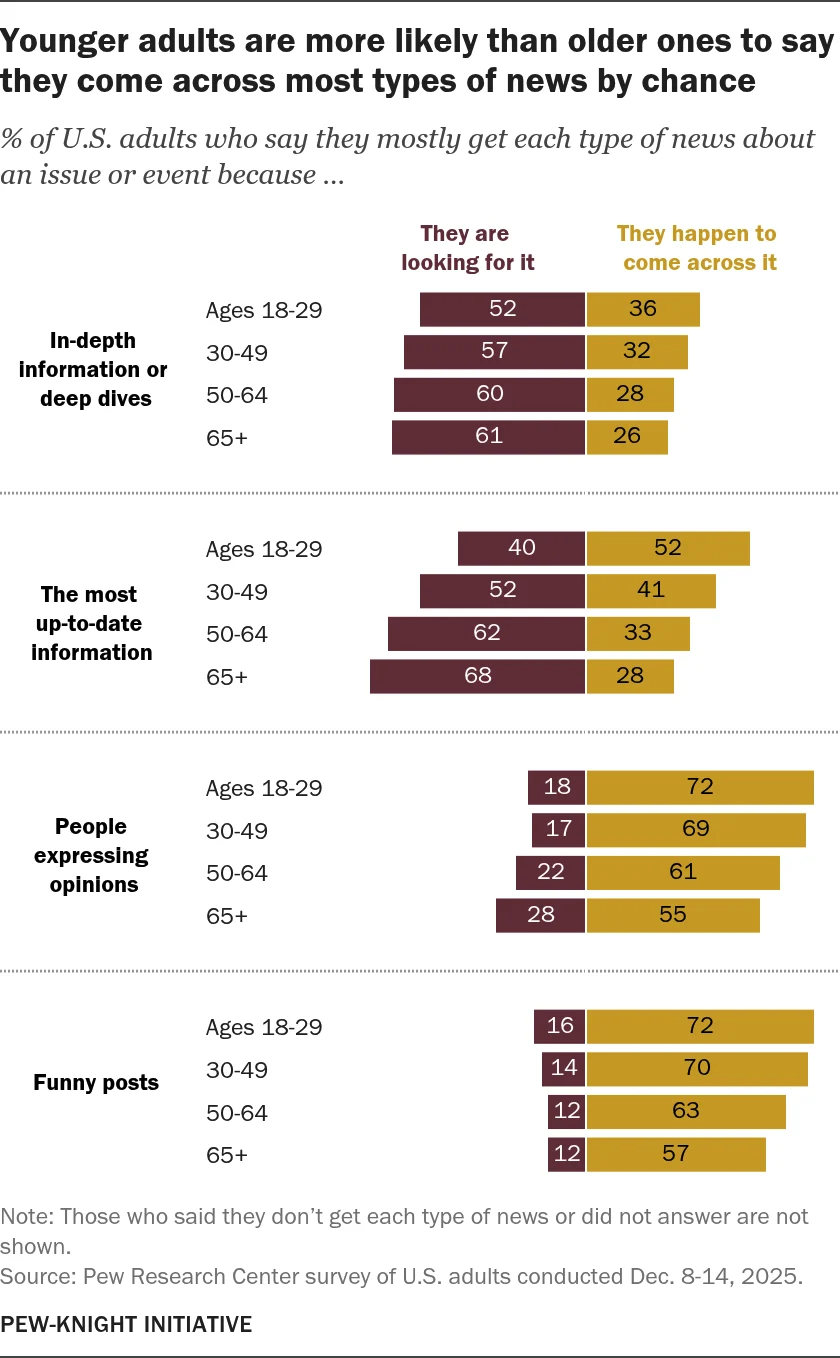
Younger adults, particularly those aged 18 to 29, are considerably more inclined to encounter news by chance across nearly all categories compared to their older counterparts. For instance, 52% of young adults report mostly getting up-to-date information by chance, a figure that drops to 28% among those aged 65 and older. This pattern extends to in-depth information, where younger demographics are more likely to stumble upon it, though a majority across all age groups still actively seek out such content.
This generational gap suggests that the digital natives, who have grown up immersed in social media and algorithm-driven platforms, are more accustomed to a serendipitous news discovery process. Older generations, perhaps more accustomed to traditional media consumption habits, may retain a stronger inclination for active news seeking.
Educational attainment also plays a role, particularly in the consumption of substantive news. A majority of college graduates report actively seeking out both in-depth information (70%) and up-to-date news (65%). In contrast, about half of adults without a college degree report similar active seeking behaviors for these content types (52% and 51%, respectively). However, when it comes to lighter content like funny posts or opinions, the likelihood of encountering them by chance is relatively similar across educational backgrounds, indicating that the passive consumption of these forms of content is more democratized.

Political Affiliation and Information Seeking
The survey also explored how political affiliation influences news-seeking behavior. While broad similarities exist between Democrats and Republicans in their overall approaches to news consumption, subtle distinctions emerge among partisan subgroups.
Conservative Republicans and liberal Democrats appear to be more driven by a desire for in-depth or up-to-date information compared to their more moderate peers within each party. For example, 65% of conservative Republicans and 69% of liberal Democrats actively seek out in-depth information, whereas these figures are lower among moderate Republicans (54%) and moderate or conservative Democrats (51%). This suggests that individuals at the ideological poles of the political spectrum may be more motivated to engage deeply with news when they are actively looking for it.
Interestingly, when it comes to opinions and humor, the differences between partisan groups are less pronounced. This could indicate that the consumption of these more reactive or expressive forms of news content is less tied to ideological conviction and more to broader social media trends or incidental exposure.
The Challenge of Understanding Incidental News
A crucial question arising from these findings is whether passively encountered news is as easily understood as actively sought information. The research suggests a potential correlation between the method of news acquisition and comprehension.
Generally, most Americans report finding news easy to understand, regardless of how they obtain it. However, the data reveals a trend: those who primarily encounter news by chance are slightly less likely to report easy comprehension compared to those who actively seek it out. Specifically, among those who come across in-depth or up-to-date information by chance, 70% state it’s generally easy to understand, while this figure rises to 81% for individuals who actively seek out such content.
This finding implies that while passive consumption may be prevalent, it might present a subtle barrier to full comprehension for some individuals. The lack of active engagement in seeking out information may also mean a reduced likelihood of engaging with the context, nuances, or corroborating sources that can aid understanding. This could contribute to a more superficial grasp of complex issues, potentially impacting informed decision-making and civic participation.

Background and Methodology
This research is part of the Pew-Knight Initiative, a long-standing collaboration that aims to provide a comprehensive understanding of the American news environment. The Pew Research Center, a nonpartisan fact tank, and the John S. and James L. Knight Foundation, a social investor focused on strengthening communities, jointly fund this initiative.
The findings presented are based on a survey of 3,560 U.S. adults conducted between December 8 and 14, 2025. Participants were drawn from the Pew Research Center’s American Trends Panel, a nationally representative online survey group designed to reflect the views of the U.S. adult population. The survey questions were specifically crafted to explore how Americans acquire different types of news, distinguishing between active seeking and incidental encounters. The detailed methodology and survey instrument are publicly available, allowing for transparency and further analysis by researchers and the public.
Implications for the Information Ecosystem
The findings from the Pew-Knight Initiative carry significant implications for media organizations, policymakers, and the public alike. The increasing reliance on serendipitous news encounters suggests that the architecture of online platforms, particularly social media algorithms, plays a powerful role in shaping public awareness and understanding.
For media outlets, this underscores the challenge of ensuring that substantive, in-depth journalism reaches audiences who may not be actively seeking it. Strategies that prioritize clear, engaging presentation of complex issues, alongside effective distribution on platforms where users are passively scrolling, may become even more critical. The potential for a less informed citizenry due to passive consumption also raises concerns about the spread of misinformation and the erosion of nuanced public debate.
Policymakers and civic educators may need to consider how to foster greater news literacy and encourage more active engagement with reliable information sources. Understanding the behavioral drivers behind news consumption is essential for developing effective strategies to promote an informed and engaged citizenry in an increasingly complex media landscape. As the digital environment continues to evolve, the ways in which Americans find, process, and understand the news will remain a critical area of study for ensuring a healthy democratic society.