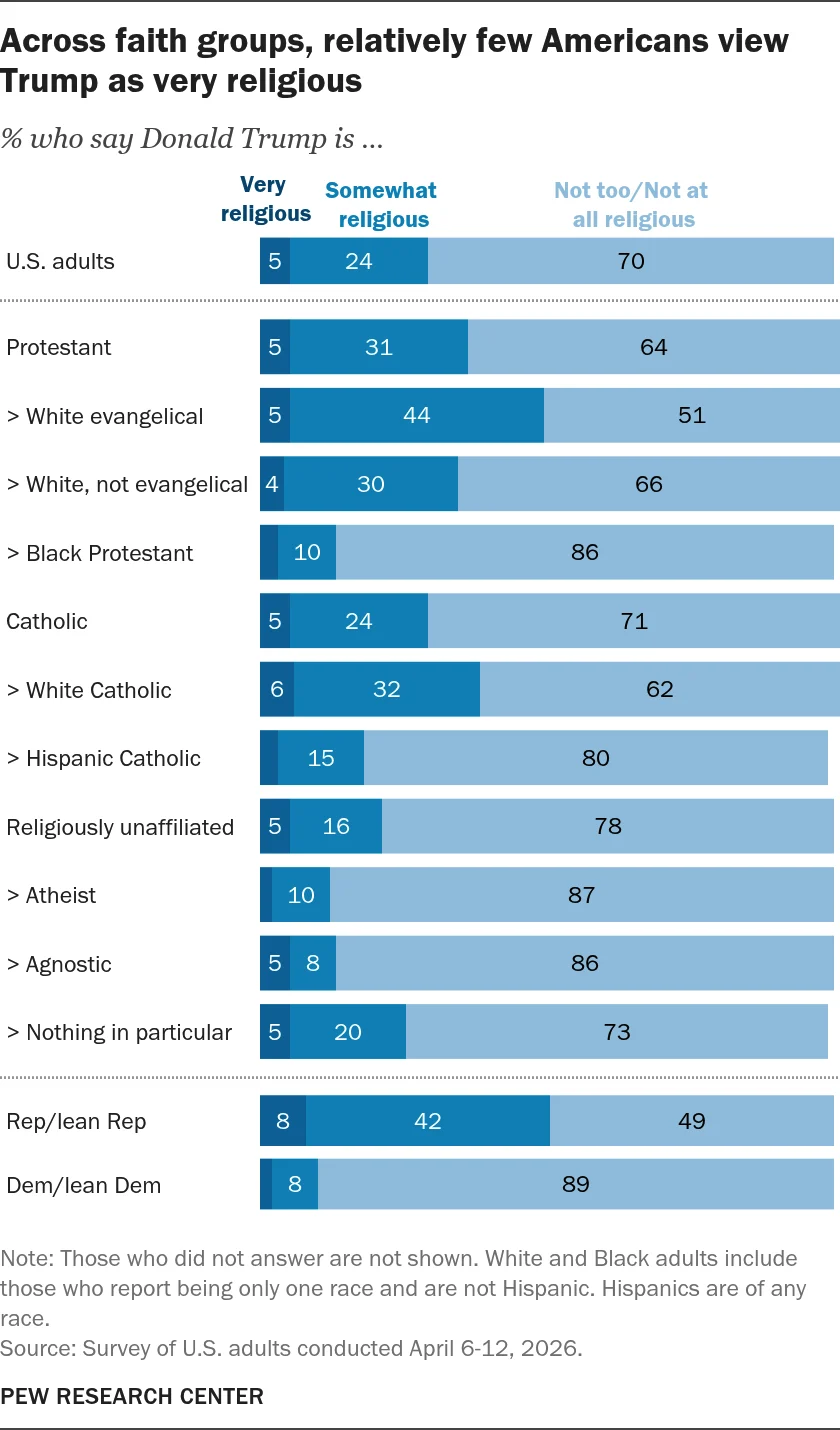
Seven-in-ten Americans now state that President Donald Trump is not too or not at all religious, a figure that has risen by 8 percentage points since the last assessment in the fall of 2024, according to a new survey conducted by the Pew Research Center. This growing perception underscores a notable shift in public opinion regarding the President’s personal faith and its public presentation.
The survey, conducted between April 6-12, 2026, revealed that 70% of U.S. adults hold this view. In contrast, 24% of respondents consider him to be somewhat religious, while a mere 5% believe he is very religious. These figures represent a significant increase in the segment of the population that views Trump as not particularly religious, a trend that has been developing over the past several years.
Shifting Perceptions of Presidential Religiosity
This latest data indicates a sustained trend of Americans expressing skepticism about the depth of President Trump’s religious convictions. The increase from 62% in October 2024 to 70% in April 2026 suggests a growing consensus, or at least a more pronounced expression of doubt, across the broader electorate. This sentiment has been a consistent undercurrent throughout his presidency and campaigns, often contrasted with his public engagement with religious communities and leaders.
Historically, public figures, particularly presidents, often navigate a delicate balance between projecting personal faith and maintaining political efficacy. Perceptions of a leader’s religiosity can influence their appeal to various demographic and religious groups. The Pew Research Center’s ongoing tracking of these perceptions provides valuable insight into how these dynamics are evolving.
Partisan and Religious Divides on Trump’s Faith
The survey data highlights stark partisan divides in how Americans perceive President Trump’s religiosity. A substantial 89% of Democrats and Democratic-leaning independents believe Trump is not too or not at all religious. This is in sharp contrast to Republicans and Republican leaners, where 49% hold the same view, indicating that a significant portion of his own party’s base also harbors doubts about his religious depth.
Conversely, Republicans are significantly more likely to describe Trump as "somewhat religious," with 42% of Republicans and Republican leaners holding this view, compared to only 8% of Democrats and Democratic-leaning independents. This suggests that while the Republican base may not universally see him as "very religious," there is a greater willingness within the party to attribute some level of religious engagement to him.
Evangelical Protestants and the "Stand Up For" Factor
Within specific religious demographics, the survey reveals nuanced perspectives. White evangelical Protestants, a key constituency for President Trump, show a notable inclination to view him as at least somewhat religious. However, even within this group, only 5% describe him as "very religious," while 44% consider him "somewhat religious," and 51% believe he is "not too or not at all religious." This finding suggests that while a majority of White evangelicals do not see him as deeply religious, they are more likely than the general population to attribute some religious standing to him.

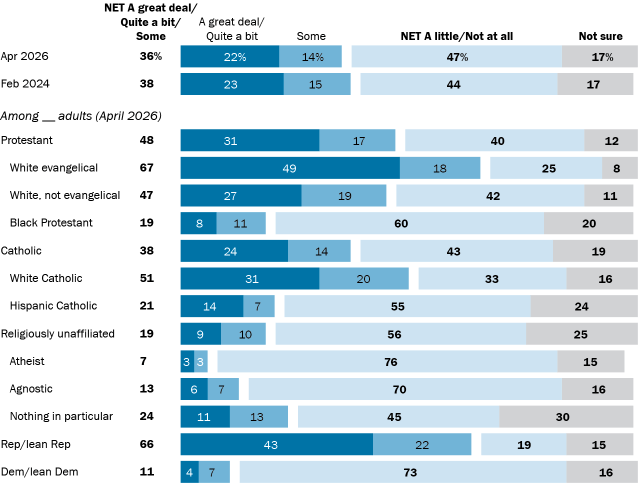
The survey also probed how much individuals believe Trump stands up for people with religious beliefs similar to their own. This "stand up for" metric appears to be a critical factor in how religious groups, particularly evangelicals, perceive his connection to their faith. Two-thirds of White evangelicals (67%) stated that Trump stands up "a great deal," "quite a bit," or "some" for people with their religious beliefs. This perception of advocacy may, in part, offset or contextualize doubts about his personal religiosity for some within this demographic.
Broader Religious Groups and Perceptions
Across other religious traditions, the views on Trump’s religiosity vary:
- Protestants (excluding White evangelicals): 66% of White, non-evangelical Protestants believe Trump is not too or not at all religious. Black Protestants are even more likely to hold this view, with 86% stating he is not too or not at all religious.
- Catholics: 71% of Catholics generally believe Trump is not too or not at all religious. This sentiment is particularly strong among Hispanic Catholics, with 80% holding this view, a figure that has increased from 60% in the previous survey. White Catholics show a slightly higher propensity to see him as somewhat religious, with 62% viewing him as not too or not at all religious, and a higher percentage (32%) considering him somewhat religious compared to the overall Catholic demographic.
- Religiously Unaffiliated: This group overwhelmingly views Trump as not too or not at all religious, with 78% expressing this opinion. This includes atheists (87%), agnostics (86%), and those identifying as "nothing in particular" (73%).
A Shifting Religious Landscape
The survey results come against a backdrop of evolving religious affiliation and practice in the United States. The number of Americans who identify with a specific religion has been declining, while the "religiously unaffiliated" segment has grown. This demographic shift can influence how religious identity is perceived and how public figures are evaluated in relation to faith.
President Trump’s public persona has often been characterized by a transactional approach to religion, emphasizing his support for religious freedom and his alignment with conservative religious values. While this has resonated with segments of the religious right, the broader public appears to be less convinced of the sincerity or depth of his personal religious convictions.

The "Standing Up For" Metric: A Key Indicator
Beyond personal religiosity, the survey explored how well President Trump is perceived to champion the religious beliefs of various groups. This metric reveals significant partisan and demographic differences:
- Republicans: A strong majority of Republicans (66%) believe Trump stands up "a great deal," "quite a bit," or "some" for people with their religious beliefs. This perception of advocacy is crucial for maintaining support among religious conservatives, even if personal religiosity is questioned.
- Democrats: In stark contrast, only 11% of Democrats and Democratic-leaning independents feel Trump stands up for people with their religious beliefs, while a commanding 73% believe he stands up "a little" or "not at all."
- White Evangelicals: As noted, this group shows high confidence in Trump’s advocacy, with two-thirds believing he stands up for their beliefs.
- Black Protestants: This group largely feels neglected by Trump’s perceived advocacy, with 60% stating he stands up "a little" or "not at all" for their religious beliefs.
- Catholics: While 38% of Catholics believe Trump stands up at least some for their religious beliefs, a larger proportion (43%) feel he stands up "a little" or "not at all." This indicates a divided sentiment within the Catholic community.
- Hispanic Catholics: This subgroup has shown a significant shift, with 55% now believing Trump stands up "a little" or "not at all" for their religious beliefs, an increase from 40% in February 2024. This suggests a growing perception of disconnect between the President’s actions and the concerns of this community.
- Religiously Unaffiliated: This demographic is largely skeptical of Trump’s advocacy, with 56% believing he stands up "a little" or "not at all" for their beliefs.
Implications and Future Considerations
The Pew Research Center’s findings offer a granular look at how Americans perceive their president’s relationship with religion. The persistent perception of Trump as not being particularly religious, coupled with the significant partisan divides on this issue, highlights the complex and often polarized nature of faith in American politics.
The "stand up for" metric appears to be a critical differentiator, particularly for Republican and evangelical voters. It suggests that for some, perceived policy alignment and representation may outweigh questions about personal piety. However, the growing sentiment among Hispanic Catholics and the continued skepticism from Democrats and the religiously unaffiliated underscore ongoing challenges in bridging religious and political divides.
As the political landscape evolves, these perceptions of a leader’s religiosity and their perceived commitment to religious communities will continue to be a significant factor in shaping public opinion and electoral outcomes. The data from this Pew Research Center survey provides a vital snapshot of these evolving sentiments in mid-2026.
About the Research
This analysis is based on a survey of 3,592 U.S. adults conducted by the Pew Research Center’s American Trends Panel (ATP) from April 6-12, 2026. The survey has a margin of error of plus or minus 1.9 percentage points. The research aims to inform the public and policymakers about the intersection of religion and politics in the United States, building upon the Center’s long-standing tradition of studying these dynamics. The full questionnaire, responses, and methodology are available on the Pew Research Center website.