The pursuit of genuine inclusion, diversity, and equity (IDE) within organizations, communities, and broader society has long been a complex and often frustrating endeavor. Despite widespread recognition of its importance and significant investment in various initiatives, progress frequently stalls, or gains are quickly reversed. This cyclical pattern of advancement followed by regression has led many change-makers to question the efficacy of traditional approaches and seek more robust, sustainable solutions. It is against this backdrop that Inclusion Nudges emerge as a scientifically grounded methodology, offering a new paradigm for fostering inclusive environments by subtly guiding human behavior.
The Persistent Challenge of Inclusion
For decades, organizations and societal leaders have championed diversity and inclusion through awareness campaigns, unconscious bias training, and policy overhauls. Yet, the lived experience for many remains unchanged. Internal change agents in multinational corporations, much like the founders of Inclusion Nudges, Lisa Kepinski and Tinna Nielsen, often faced the disheartening reality of initiatives that failed to yield the anticipated impact. Despite earnest efforts and substantial resources, the needle on true inclusion proved stubbornly difficult to move. This pervasive challenge highlights a fundamental disconnect between intention and action, a gap that conventional methods have struggled to bridge.
Reports from various global networks consistently echo these sentiments, indicating that while awareness of IDE issues has grown, the systemic behavioral shifts required for lasting change often remain elusive. The frustration stems from observing individuals revert to default behaviors, perpetuating established norms that subtly exclude or disadvantage certain groups. This phenomenon underscores the need for an intervention that operates at a deeper, more automatic level, beyond conscious rationalization or willpower alone.
The Unseen Barriers: Unconscious Bias in Action
To understand why traditional approaches often falter, it is crucial to delve into the subtle yet powerful influence of the unconscious mind. Consider a hypothetical, yet alarmingly resonant, scenario: a leadership team deliberates on candidates for a senior management role. One leader confidently asserts, "The best qualified candidate is undoubtedly the tallest. Tall leaders excel at executing strategy, possess greater presence, and demonstrate superior resilience." While consciously, no rational leader would explicitly articulate such a discriminatory belief based solely on height, this scenario, though absurd in its directness, mirrors an insidious reality driven by unconscious biases.
Extensive research across various fields, including social psychology and behavioral economics, consistently demonstrates that physical attributes, such as height, often unconsciously influence perceptions of leadership capability and success. Studies have shown a significant correlation between height and leadership positions, with a disproportionate number of top executives being taller than the average population. For instance, data indicates that approximately 60% of top leaders in certain sectors measure 185 cm (6 ft 1 in) or taller, compared to only 14% of the general population reaching that height. This "height-leadership effect" extends beyond initial hiring, influencing promotions, status opportunities, and even income levels, establishing tall leaders as a normative, albeit irrational, pattern across diverse cultures.
The mechanism behind this is rooted in the automatic system of the human brain. The unconscious mind forms instinctive associations—connecting "tall" with traits like "strong," "presence," "powerful," and "capable." Once this unconscious belief is activated, the reflective, rational mind often seeks evidence to confirm it, inadvertently overlooking the merits of other candidates who do not fit this unconscious archetype. This cognitive shortcut leads to flawed judgments and decisions, often without conscious awareness or intent, creating systemic exclusion despite stated commitments to meritocracy. This height bias is but one example; similar unconscious biases, such as affinity bias (favoring those similar to oneself), confirmation bias (seeking information that confirms existing beliefs), and the halo effect (allowing a positive trait to influence overall perception), permeate recruitment, promotion, and daily interactions, silently undermining efforts towards genuine inclusion.
Beyond Awareness: The Science of the Mind and Behavioral Economics
The challenge of bridging the gap between our rational intentions and our automatic actions lies at the core of human cognition. Pioneering work by Nobel laureates Daniel Kahneman and Amos Tversky, later popularized by Richard Thaler and Cass Sunstein in their seminal book "Nudge," illuminates the existence of two distinct, yet interdependent, systems of thinking:
- The Automatic System (System 1): This system is fast, unconscious, instinctive, effortless, associative, and uncontrolled. It operates like an autopilot, dominating the vast majority (an estimated 90-99%) of our daily thoughts, choices, and behaviors. It relies on mental shortcuts, or heuristics, such as associations and biases, to quickly process information and make decisions, conserving cognitive energy.
- The Reflective System (System 2): In contrast, this system is conscious, slow, effortful, rational, logical, self-aware, rule-following, and controlled. It is engaged for complex problem-solving, deliberate decision-making, and critical analysis.
While the automatic system is incredibly efficient and crucial for survival, its reliance on shortcuts can lead to systematic errors in judgment and choice, especially in complex social contexts. The "intention-action gap" arises because even when individuals consciously know that height does not equate to leadership ability, their unconscious mind might still make judgments as if it does. They believe they are hiring based on merit and are committed to diversity, but their automatic processes can lead to contradictory actions.
This fundamental insight from behavioral economics explains why simply "knowing" about bias or being "aware" of the benefits of diversity is often insufficient to instigate lasting behavioral change. The human brain, evolved to prioritize quick responses and conserve energy, is increasingly susceptible to these mental shortcuts in an era of cognitive overload—fueled by information saturation, the echo chambers of social media, and increasingly busy and stressful lives. This intensified reliance on automatic processing inadvertently reinforces existing biases and leads to greater homogeneity and exclusion, directly counteracting the collective need for diversity and inclusion.
Inclusion Nudges: A Paradigm Shift for Systemic Change
Recognizing the limitations of traditional, awareness-based diversity initiatives, the Inclusion Nudges approach represents a paradigm shift. It moves beyond attempting to "fix" individuals’ biases through conscious effort, instead focusing on redesigning the environments and processes within which choices are made. Derived from insights in behavioral economics, psychology, anthropology, linguistics, neuroscience, and complex systems theory, Inclusion Nudges are deliberate design interventions that subtly steer the unconscious mind towards more inclusive behaviors without restricting freedom of choice.
The core principle is to address the false assumption that people always act in their own or their group’s best interest. By strategically modifying the "choice architecture"—the context in which decisions are made—Inclusion Nudges make it easier for individuals to act inclusively as the default. This non-intrusive "push" bypasses the reflective system’s resistance, targeting the automatic system’s drivers, judgment processes, and perceptions.
Unlike traditional unconscious bias training, which often relies on confronting individuals with their biases (which can lead to defensiveness or a boomerang effect), Inclusion Nudges embed inclusive behaviors directly into systems and processes. This makes inclusion the norm effortlessly, without the need for rational arguments, threats, or conscious willpower. As Kepinski and Nielsen assert, "Knowing is not enough. Designing for inclusion is a must." This approach is particularly critical as research indicates that the power of the unconscious mind is increasing due to modern life’s complexities, making it even more vital to design for inclusive defaults.
Implementing Inclusion Nudges: Three Strategic Pillars
The Inclusion Nudges change approach is built upon three distinct yet interconnected types of design interventions, each serving a specific purpose in fostering inclusive behavior:
1. Unveiling Hidden Realities: "Feel the Need" Nudges
Human behavior is often driven by what we see and feel, rather than by abstract knowledge or rational arguments. "Feel the Need" Inclusion Nudges are designed to make invisible patterns visible, thereby motivating the unconscious mind to engage with the need for change. These designs avoid directly "telling" people they are biased; instead, they show the implications of bias or exclusion in a way that resonates emotionally.

An example of this is a design that visualizes network imbalances. In one instance, a company sought to address the lack of gender equality in senior executives’ formal and informal networks. Rather than lecturing leaders on bias, a visual representation was created, showcasing the extensive network connections of male executives versus the sparse connections of female talent. By presenting the names of numerous men and only a handful of women in a stark comparison, leaders were confronted with a palpable disparity. This visual demonstration circumvented intellectual resistance, triggering an unconscious "feeling of need" to act, particularly in supporting a proposed sponsorship program for women. This design leverages the psychological principle that experiential learning and emotional engagement are far more powerful drivers of behavioral change than purely cognitive appeals. It makes the invisible patterns of exclusion undeniable, prompting a desire to alter the status quo.
2. Engineering Inclusive Processes: "Process Design" Nudges
Sometimes, simply motivating people is not enough; the systems and processes themselves must be redesigned to facilitate inclusive actions. "Process Design" Inclusion Nudges embed inclusive behaviors as the default, making it effortless to act inclusively without conscious reflection or explicit discussion of diversity and inclusion. These designs mitigate bias by structuring interactions, decision-making, and collaboration in ways that naturally foster equity.
A powerful example is the "Share with a Peer" technique used in group discussions. This design addresses the common challenge where certain voices dominate, while others self-silence, leading to a loss of diverse perspectives crucial for innovation and robust decision-making. Before opening a topic for general group discussion, participants are first asked to share their initial thoughts or ideas with a single peer. This simple step serves multiple purposes: it ensures every individual has a voice, reduces conformity to majority opinions by allowing ideas to be articulated privately first, and helps identify and correct communication misunderstandings. By creating a psychologically safe space for initial sharing, this process design enables a more equitable distribution of airtime and access to the full spectrum of ideas, making inclusive participation an automatic outcome of the meeting structure. Other process designs include structured interview formats, anonymized CVs to reduce initial screening biases, and mandatory diverse candidate shortlists.
3. Reshaping Perceptions: "Frame Perceptions" Nudges
The way information is presented, the language used, and the framing of issues profoundly influence perceptions, judgments, and subsequent behaviors. "Frame Perceptions" Inclusion Nudges strategically alter the mental lens through which individuals view issues related to inclusion, diversity, equality, and human rights. By manipulating cognitive anchors, priming specific associations, or appealing to identity, these designs can shift narratives and stereotypes that often impede progress.
One effective technique is "Reversing the Numbers" to highlight hidden groups or consequences. Instead of focusing on the majority, this design reframes data to draw attention to the minority or those who are typically overlooked. For example, if 80% of a certain demographic holds a particular advantage, instead of emphasizing the 80%, the frame is shifted to highlight the 20% who do not share that advantage, and the consequences of their exclusion. This reversal forces the unconscious mind to perceive the "hidden people" and the impact of existing disparities in a new light. It can transform the perception of diversity from a "burden" or "quota" to an undeniable value proposition by revealing the full picture and the lost potential. Such framing can effectively counter ingrained stereotypes and narratives, fostering a more inclusive understanding and prompting action where traditional data presentations might fail to register.
The Global Movement: Sharing, Reciprocity, and Open Access
Inclusion Nudges is more than just a collection of behavioral designs; it is a global initiative and a movement founded on the principles of sharing, reciprocity, and open source. Lisa Kepinski and Tinna Nielsen, having experienced the frustration of "what" without "how" in their own careers and within various professional networks, established the initiative to empower change-makers worldwide with actionable, step-by-step guidance. Their motivation stems from a belief that true social change requires collective action and the open exchange of effective methodologies.
The initiative challenges the common tendency in social change circles to discuss outcomes without revealing the practical implementation details. Kepinski and Nielsen meticulously document their effective change designs, providing detailed "how-to" descriptions in resources like The Inclusion Nudges Guidebook and Action Guide Series. This commitment to transparency and practical guidance aims to enable and empower a broad community of change agents, ensuring that valuable insights are not hoarded but widely disseminated for the greater good.
Underpinning this ethos are three core values:
- Sharing: The initiative thrives on collaboration and co-creation. Change-makers are invited to share their own experiences and successful behavioral designs with the founders. These contributions are then analyzed, documented, and integrated into the growing body of Inclusion Nudges, enriching the collective knowledge base and accelerating progress in inclusive change.
- Reciprocity: This principle emphasizes the mutual exchange of knowledge and support. By receiving and contributing examples, individuals actively participate in a virtuous cycle that strengthens the movement. Sharing resources, offering peer support, and spreading awareness of the available tools are all vital acts of reciprocity that fuel the movement’s momentum.
- Open Source: In a radical departure from traditional intellectual property models, the Inclusion Nudges concept and approach are not copyrighted. Instead, they are shared under a Creative Commons License, making them freely accessible to everyone—from those who wish to apply existing nudges, to those who are inspired to design their own, and even those who are simply curious. This open access philosophy ensures that knowledge and practical designs are democratized, fostering widespread adoption and innovation without barriers.
This commitment to open knowledge and collaborative empowerment positions Inclusion Nudges as a unique and powerful force in the global effort to create a more inclusive world.
Driving Impact: Real-World Applications and Future Outlook
The application of behavioral insights and Inclusion Nudges has demonstrably simplified the role of change agents, making the pursuit of inclusivity more impactful and sustainable. By co-creating changes with the very people they are designed to benefit, these interventions foster greater buy-in and ensure that shifts are deeply embedded and enduring. Organizations, communities, and individuals worldwide can leverage these principles to design systems, processes, cultures, technologies, policies, and environments that naturally foster inclusive behaviors, interactions, and decision-making.
The urgency for fundamentally rethinking how we achieve inclusive outcomes has never been greater. The complexity of modern society and the persistent challenges of discrimination and exclusion demand approaches that address the root causes of biased behavior at an unconscious level. The mission of the Inclusion Nudges global initiative is to empower every individual to become an agent of change, capable of applying these designs to make inclusion the default everywhere, for everyone.
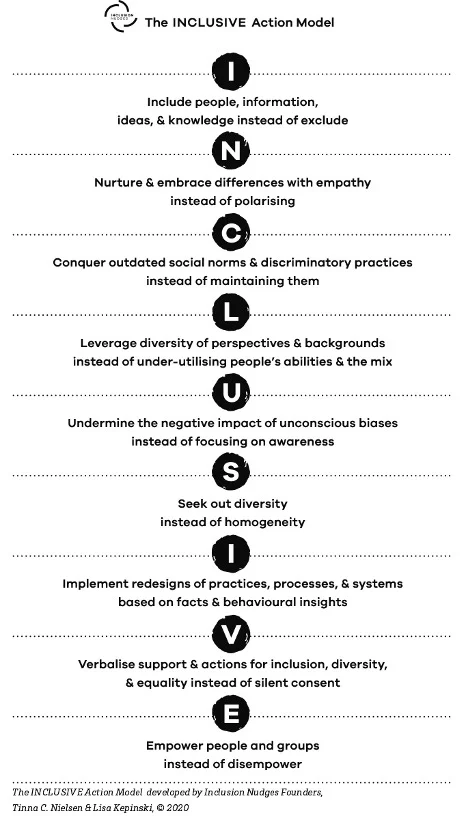
By integrating Inclusion Nudges into daily actions, individuals and organizations can transform the often-arduous task of fostering inclusion into an accessible, even natural, part of their work and interactions. The initiative provides comprehensive resources, including the INCLUSIVE Action Model detailed in The Inclusion Nudges Guidebook and Action Guides, which distills decades of practical experience into actionable frameworks.
The Invitation to join the Inclusion Nudges movement is a call to collective action. By embracing the principles of sharing, reciprocity, and open source, participants contribute to a growing global repository of effective behavioral designs. Together, through sustained, subtle, and scientifically informed interventions, the aspiration of making inclusion the norm—everywhere, for everyone—can transition from an ambitious goal to an achievable reality.
NOTE: All sources and references in this article are listed in The Inclusion Nudges Guidebook and Action Guides.